India’s Civil Aviation Ministry has circulated a draft policy that proposes blending sustainable aviation fuel (SAF) into aviation turbine fuel (ATF) used on international flights, starting at 1% in 2027 and reaching 5% by 2030. The proposal is not in force: official government reporting has said the draft is still being finalised, while reports published on 4–5 Nov 2026 say ministry approval and the final policy are still pending.
For airline passengers, the immediate question is how the fuel requirement could affect operating costs and, eventually, fares. For road users, the proposal is about aviation fuel rather than petrol, diesel or tolls, so it does not by itself change the numbers used for an Indian road trip.
Key takeaways
- The draft proposes a 1% SAF blend in ATF for international flights in 2027, rising to 2% in 2028, 3% in 2029 and 5% in 2030, according to Mint and Business Standard reports dated 5 Nov 2026.
- Only domestically produced SAF would be eligible under the reported draft, with fuel suppliers responsible for blending it before airport supply.
- The draft proposes that international operators uplift at least 90% of annual sector fuel from Indian airports to limit economic tankering.
- SAF is reported to cost two to three times as much as conventional jet fuel, but analysts say the initial 1% blend would have a relatively small direct effect on fuel bills.
- The proposal is not final, and published reports differ on the indicative 2040 level.
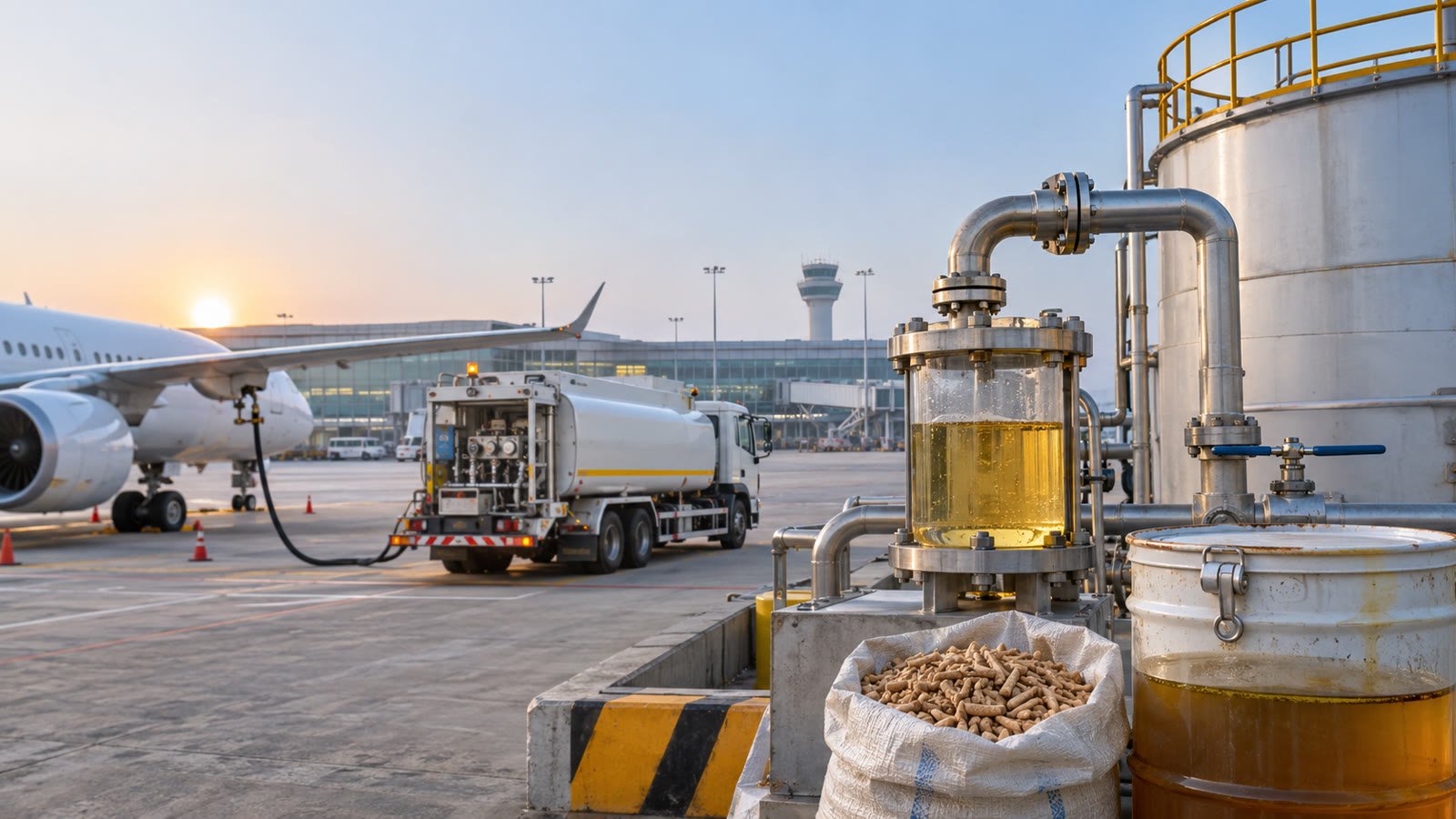
Illustration: FuelPrice, AI-generated and representative of SAF blending and airport refuelling; it is not a photograph of a specific airport or official facility.
What India’s draft SAF policy proposes
The reported roadmap is limited to international aviation in its first phase. Mint and Business Standard describe a proposed blend of 1% in 2027, 2% in 2028, 3% in 2029 and 5% in 2030. The earlier 1%, 2% and 5% indicative targets for international flights are already part of the government’s published SAF direction, but the new draft adds a more detailed implementation framework.
| Year | Proposed SAF blend in ATF | Status |
|---|---|---|
| 2027 | 1% | Draft proposal for international flights |
| 2028 | 2% | Draft proposal for international flights |
| 2029 | 3% | Draft proposal reported by Mint and Business Standard |
| 2030 | 5% | Draft proposal for international flights |
The draft reportedly requires the SAF used for the mandate to be produced in India. Fuel suppliers, including oil marketing companies, would blend it with ATF at a production facility, refinery or intermediate storage point before the fuel is sent to airports. The plan also proposes a national SAF registry under the Directorate General of Civil Aviation to track production, blending, supply, consumption and emissions-related information.
Why the policy could raise airline fuel costs
SAF can be made from feedstocks such as agricultural residues, used cooking oil, municipal waste and other approved pathways. New Indian Express and Mint reports say the draft estimates SAF could cost two to three times more than conventional jet fuel, although the actual premium would depend on supply, technology, certification and policy support.
That price difference does not translate directly into a two- or three-fold increase in an airline’s fuel bill. At a 1% blend, Mint quoted aviation analysts who expect a relatively small initial increase. The cost pressure could become more visible as the mandatory share rises, particularly if domestic production does not expand quickly enough or if airlines cannot pass the extra cost through competitive fares. Mint also noted that any effect on passenger airfares remains dependent on supply and pass-through, and is not a confirmed fare increase.
The proposed 90% uplift rule is a separate supply-side measure. Economic tankering means carrying extra fuel from a cheaper airport to avoid buying at a more expensive destination. The draft, as reported by Economic Times and Business Standard, would require international operators to source at least 90% of their annual sector aviation fuel from international airports in India. The stated objective is to create dependable domestic demand for blended fuel and limit that practice.
What it means for passengers and road users
International airfares may face gradual pressure
There is no confirmed fare revision attached to the draft. If the final policy raises fuel costs and airlines cannot absorb them, ticket prices could move at the margin, but that outcome will depend on the SAF price premium, availability and competition. Passengers should therefore treat any claim of a fixed fare increase as speculation until an airline publishes a fare or surcharge change.
Petrol, diesel and toll calculations are separate
The proposal covers ATF and international aviation. Nothing in the cited draft reporting indicates a change to retail petrol or diesel prices, FASTag charges or highway tolls. Drivers can continue to check current road-fuel rates on the live fuel prices page rather than use aviation-fuel headlines as a proxy for pump prices.
For a traveller comparing an internal flight with a road journey, the road-trip planner can help compare route time and distance. A separate fuel-cost calculation can estimate the road-fuel portion; tolls, parking and other costs still need to be considered separately.
The 2040 target is not settled
Reports agree that the post-2030 pathway is not final, but they do not use the same 2040 number. New Indian Express and the Economic Times Bureau report describe a path towards 20% SAF by 2040. A separate PTI report carried by the Economic Times describes 40% by 2040, while Business Standard says the later levels are suggestions and that a proposed National Council on SAF would decide mandatory requirements for the next decade.
That conflict is important for readers and businesses: 20% or 40% should not be presented as a confirmed future obligation until the government publishes the final policy, its effective dates and the formal implementation rules.
What to watch next
- Whether the Ministry of Civil Aviation approves the draft and opens it for stakeholder consultation.
- The final blend percentages, the international-flight scope and the effective date.
- How fuel suppliers will prove domestic SAF production, blending and chain-of-custody records.
- The proposed registry, reporting format and penalty rules for suppliers and aircraft operators.
- Whether the government announces tax, financing or production support to narrow SAF’s cost gap with conventional ATF.
The reader takeaway is simple: India is moving from indicative SAF targets towards a more detailed policy framework, but the 1% 2027 blend remains proposed. Until a final notification is issued, airline costs, airfares and later targets should be treated as watch points rather than completed changes.
Sources
- The New Indian Express — DGCA green aviation fuel norms ready — 5 Nov 2026
- Mint — India’s green aviation push comes with a fuel bill: SAF mandate to hit airlines — 5 Nov 2026
- The Economic Times — India proposes 1% mandatory blending of green jet fuel from January — 5 Nov 2026
- Business Standard — Draft green aviation fuel plan mandates 5% blending by 2030 on global routes — 4 Nov 2026
- Press Information Bureau, Ministry of Civil Aviation — Minister reviews India’s preparedness for SAF and CORSIA implementation — 29 Jul 2026
- Press Information Bureau, Ministry of Petroleum and Natural Gas — Government brings SAF-blended aviation fuel under ATF control order — 23 Apr 2026