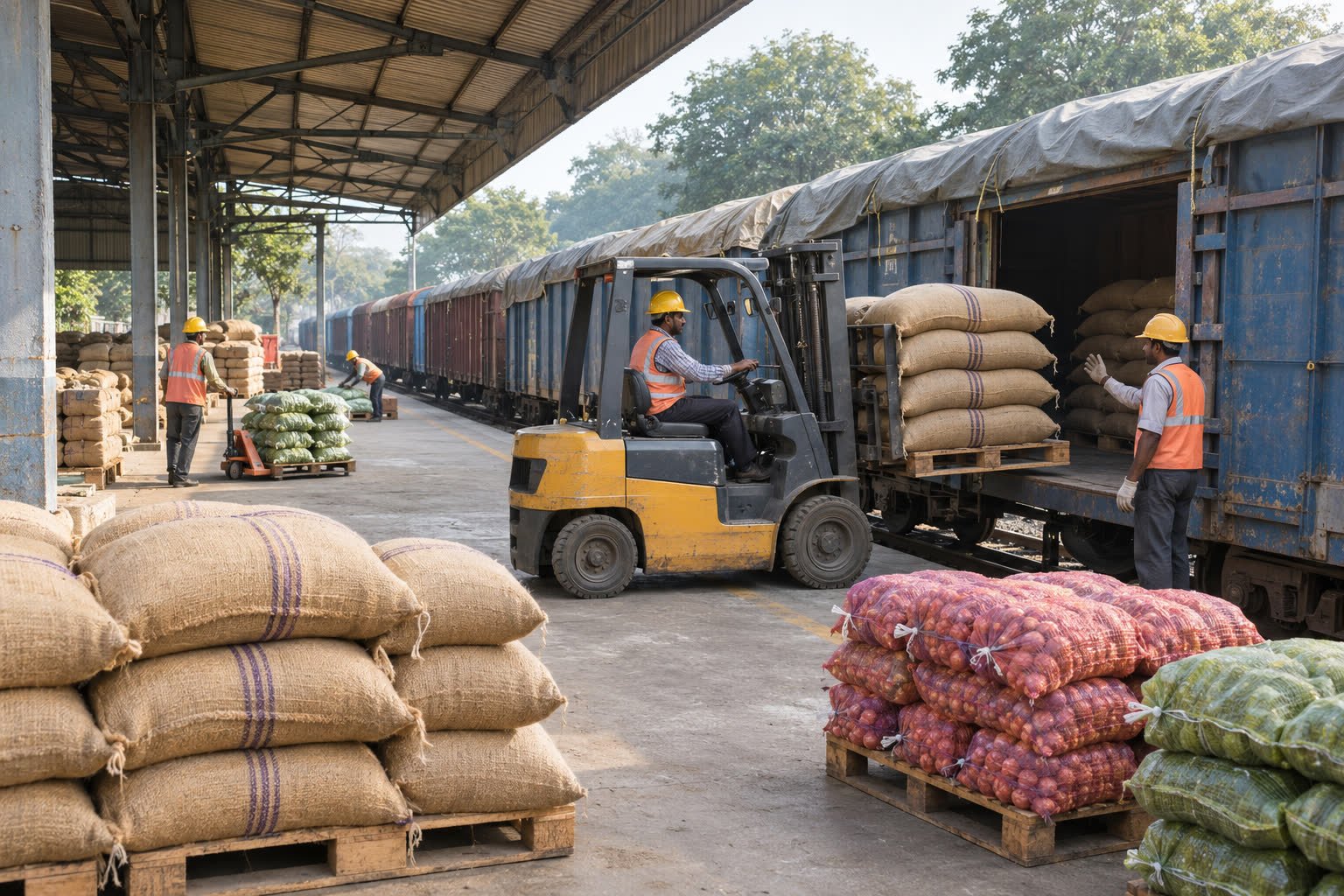
Indian Railways loaded a record 145.07 million tonnes of freight in October 2026, up 8.32% from October 2025. For Indian fleet and road-transport operators, the result is a signal about cargo demand and network capacity—not a change to retail diesel prices or toll fees.
The Railway Ministry reported the October result on 4 Nov 2026. It said the month was the best October performance on record, with growth led by foodgrains, domestic coal and other goods. The practical question for road users is how much of that momentum reaches the first- and last-mile road legs that still connect factories, depots, terminals and customers.
Key takeaways
- October freight loading reached 145.07 million tonnes, compared with 133.93 million tonnes in October 2025.
- Foodgrain loading rose 26.3% year on year and domestic coal loading increased 16%.
- Coal supplies to power plants averaged 469.8 rakes a day, up 19.5% from 393.2 rakes a day a year earlier.
- Freight loading for April–October 2026 reached 978.78 million tonnes, 4.67% above the comparable period.
- The figures do not by themselves show that truck volumes, diesel use or road-freight rates have fallen.
What changed in October
The 145.07-million-tonne total was 8.32% higher than the 133.93 million tonnes recorded in October 2025. Business Standard and Financial Express both reported the ministry’s figures, including the rise in foodgrain and coal movement. The ministry also listed increases in clinker, domestic containers and iron ore, while finished-steel loading grew only marginally.
Foodgrains and coal led the increase
Foodgrain loading grew 26.3% year on year, the strongest increase among the major commodity groups listed in the release. Domestic coal loading rose 16%, and coal supply to power plants averaged 469.8 rakes per day in October, compared with 393.2 rakes per day in October 2025. That is a 19.5% increase in the average daily supply of coal rakes.
For transport businesses, the mix matters more than the headline total. Bulk commodities such as coal and foodgrains follow different routes, handling systems and delivery schedules from containerised cargo or finished goods. A higher rail total therefore does not translate into one uniform change for every trucking corridor.
The year-to-date picture is positive, but slower
From April to October 2026, Indian Railways loaded 978.78 million tonnes, against 935.10 million tonnes in the same period a year earlier. The 4.67% year-on-year increase is below October’s monthly growth rate, which is why one strong month should be treated as a useful signal rather than a complete forecast for the rest of the financial year.
Passenger demand also rose during October. The ministry said Indian Railways carried 64.72 crore passengers, compared with 63.52 crore in October 2025. Business Standard reported the same comparison in million passengers. Freight and passenger demand growing together makes wagon availability, train paths and terminal turnaround important issues to watch.
What the record means for road freight
It is tempting to read a rail-freight record as a shift away from trucks. The available data does not support that conclusion. The Railway Ministry’s release reports rail loading and passenger traffic; it does not quantify how much cargo moved from road to rail, how many truck trips were displaced or how diesel consumption changed.
The more defensible reading is that cargo demand and rail capacity both deserve closer attention. Rail may handle the long-haul portion of a movement while trucks continue to serve farms, factories, warehouses, ports and retail delivery points. For a fleet operator, the cost and time of those road legs still depend on distance, diesel, tolls, loading time and the likelihood of an empty return trip.
When comparing a road route or a rail-linked movement, the fuel cost calculator can help separate the diesel cost of the road leg from the rest of the trip budget. This is especially useful when a route includes a short first-mile or last-mile run rather than a full highway journey.
What it means for fuel planning
This announcement is not a petrol or diesel price revision. It contains no new retail fuel rate, tax order or toll-fee notification. Operators using a current diesel assumption should check the live fuel prices before comparing a road movement with a rail-linked option, because the fuel input is date- and location-sensitive.
The record may still matter indirectly to fuel planning. If rail terminals handle more bulk or container cargo, road operators may see changes in where vehicles collect or deliver loads, how long they wait at terminals and how many kilometres are covered between a railhead and the customer. Those are operating questions, not guaranteed savings. The article data does not establish a lower cost for any particular operator, vehicle or route.
Toll remains another separate input. A truck that covers only the connecting road leg may face a different toll profile from one completing the entire journey by road. The toll-charge calculator can be used alongside the fuel estimate when mapping that road portion.
What to watch next
The next useful checks are November freight loading, wagon and rake availability, terminal turnaround time and the performance of the road links around major freight nodes. Financial Express quoted former East Central Railway general manager Lalit Chandra Trivedi cautioning that higher tonnage alone does not establish market share or profitability; reliable rake availability, predictable delivery and faster terminal handling also matter.
For private drivers, the immediate takeaway is limited: the October freight result does not change what a petrol pump or toll plaza may charge today. For truckers, logistics managers and businesses moving goods, it is a data point to place beside route fuel cost, tolls, delivery time and loading constraints. A sustained run of stronger rail volumes would be more meaningful than a single monthly record, particularly if it is accompanied by dependable last-mile connections.
Sources
- Press Information Bureau, Ministry of Railways: Indian Railways Registers Freight Loading of 145.07 Million Tonnes in October 2026 (4 Nov 2026)
- Business Standard: Indian Railways freight loading rises 8.3% to 145.07 million tonnes in Oct (4 Nov 2026)
- Financial Express: Coal, foodgrain movement pushes railways’ October freight traffic to record high (4 Nov 2026)
- News On AIR: Indian Railways achieve its highest-ever freight loading in October 2026, transporting over 145 million tonnes (4 Nov 2026)