Jharkhand’s transport department has sent a proposal for 500 electric-vehicle charging stations across the state, with a target of a charging point within every 20 km on national highways, state highways and major district roads, according to reports published on 17 Nov 2026. The plan has been sent to the government for approval and is not an operational network yet.
For EV owners, that distinction matters. If the proposal is cleared and built as described, it could make intercity stop planning more predictable across Jharkhand. Until then, the number of live chargers, their connector mix, pricing and uptime remain separate questions that drivers need to check before travelling.
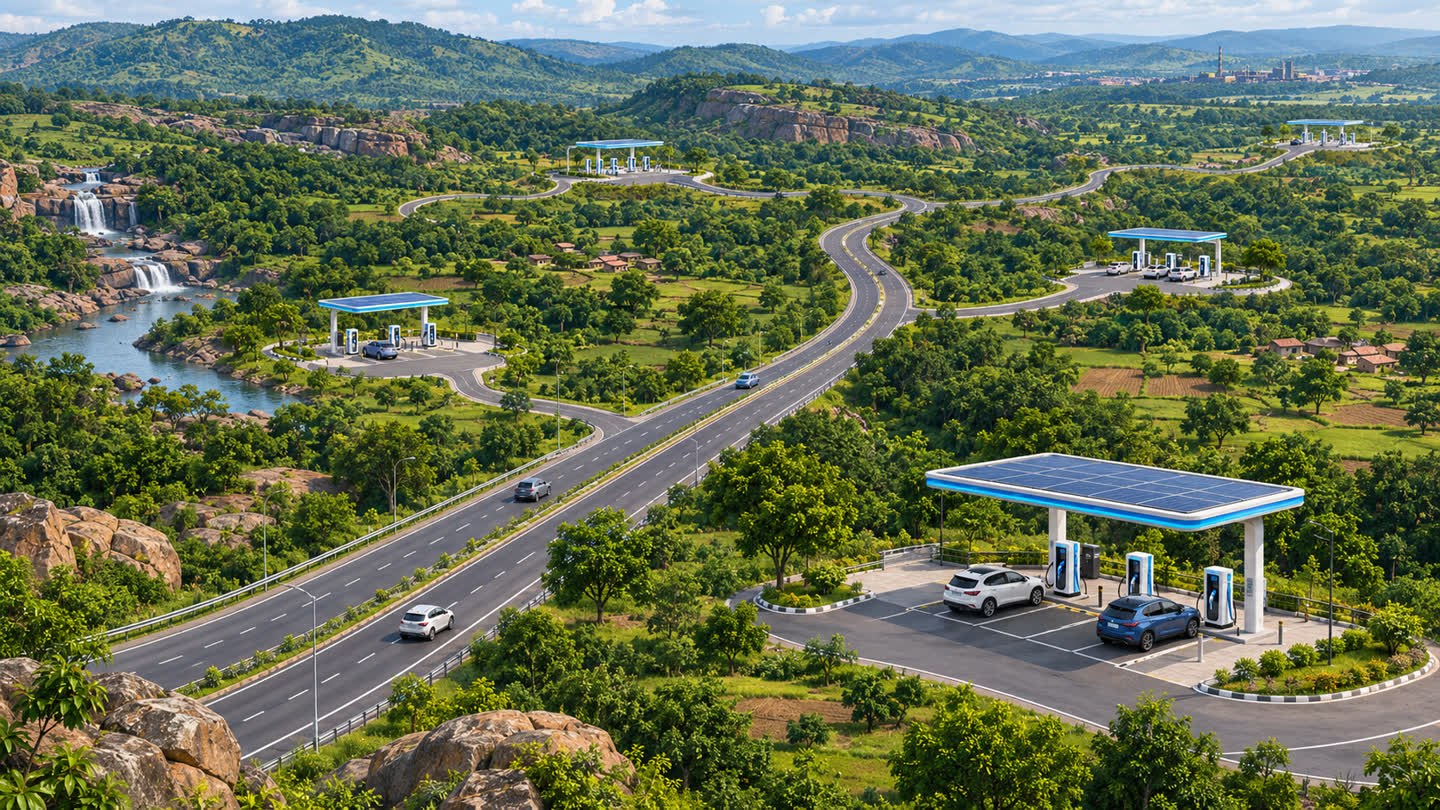
Hero image: Representative editorial illustration of a proposed highway EV charging stop; it is not a photograph of an operating Jharkhand station.
Key takeaways
- Jharkhand has reported a proposal for 500 EV charging stations across the state.
- The proposed spacing is one charging point within every 20 km across national highways, state highways and major district roads.
- The plan is proposed, not approved or commissioned; no opening date has been announced.
- The reported model uses public-private participation, roadside landowners and private technical operators.
- Reports describe possible support for eligible women and Scheduled Caste or Scheduled Tribe applicants, but the application process and final terms are not public.
What Jharkhand has proposed
The Times of India and The Avenue Mail reported on 17 Nov 2026 that the state transport department had prepared a formal proposal and sent it to the government for approval. The stated aim is a statewide network rather than a few chargers limited to Ranchi or another major city.
The planned coverage would include national highways, state highways and major district roads. That is important for EV users because a charger in a city does not solve the stop-planning problem on the road between cities. A network that reaches major district roads could also matter to smaller towns and to commercial three-wheelers that work beyond municipal limits.
Why the 20-km target matters
EV range is only one part of a road trip. Drivers also need to know whether the next usable charger is on the route, whether it supports the vehicle’s connector and charging speed, and whether it is available when they arrive. A stated spacing target gives planners and operators a simple network objective, but it is not the same as a guaranteed charger at every interval.
The difference between a proposal and a working network is especially important for drivers travelling through less populated areas. Construction, grid connection, equipment commissioning, payment systems and maintenance all have to be completed before a map entry becomes a dependable stop. The state has not yet published a construction calendar or a list of locations.
How the proposed PPP model would work
According to the 17 Nov reports, the department wants to use a public-private partnership model. People who own or lease roadside land along national or state highways would be invited to apply for station installation. Private companies would handle the technical set-up, while the landowner would operate and maintain the site and retain the profits described in the proposal.
The reported framework also says that women applicants and applicants from Scheduled Caste or Scheduled Tribe communities could receive a state subsidy of around 20% to 25%, while 50% of project financing could be arranged through banks. These are reported features of a proposal, not confirmed entitlements. The reports do not state the eligible project cost, charger capacity, repayment terms, selection process or date on which applications will open.
That distinction protects both potential site hosts and drivers from reading a policy outline as a ready-to-use scheme. Any final notification would need to specify who can apply, which costs qualify, what technical standards apply and how station performance will be monitored.
How it fits Jharkhand’s existing EV policy
The Government of Jharkhand’s Jharkhand Power Policy, 2023 document records charging infrastructure as part of the state’s EV objectives. It refers to the Jharkhand Electric Vehicle Policy 2022 and records a highway charging objective of public stations at 25 km intervals on both sides of national highways and major state highways. It also describes wider grid-based charging goals.
If the new proposal is implemented as reported, its 20-km target would be a tighter spacing than the 25-km highway distance recorded in that state policy document. That suggests continuity with an existing policy direction, but it does not by itself confirm funding, locations or delivery.
What it means for EV drivers now
For people already driving an EV in Jharkhand, nothing changes on the day of the proposal. Existing public chargers remain the relevant network until new sites receive approval, are installed and appear as usable locations. Drivers should also allow for the possibility that a listed charger is busy, offline or temporarily unavailable.
Before a Jharkhand road trip, use FuelPrice’s state-wise EV station directory to identify charging points along the broader route and check the operator details available for each location.
For the route itself, the FuelPrice road-trip planner can help organise the journey around distance and stops. The plan should still include a practical buffer for detours, queues and a charger that is unavailable when reached.
For households comparing an EV with petrol or diesel running costs, the FuelPrice fuel cost calculator provides a baseline for the fuel-powered alternative. That comparison does not predict an EV’s charging bill, which depends on the tariff and operator at each charging point.
What remains unconfirmed
The current reports do not name the first locations, the number of fast or slow chargers, the charging standards, the expected power at each site, the user tariff, the construction timetable or the commissioning date. They also do not establish that all 500 proposed stations will become available at the same time.
The plan should therefore be read as a proposed infrastructure expansion, not as a promise that an EV can currently find a charger every 20 km across Jharkhand. That status may change only after an approval, tender, notification or implementation update from the state authorities.
What to watch next
- Government approval and any formal notification from the transport department.
- A location list showing which highways and districts are covered first.
- The final PPP rules, subsidy conditions and financing terms.
- Charger specifications, user tariffs, payment options and uptime requirements.
- Evidence that commissioned sites are listed and working before drivers plan around them.
Reader takeaway: Jharkhand’s proposed network could improve EV road-trip planning if it is approved and delivered, but the 500-station figure and 20-km spacing are targets reported for a proposal. For now, check live charger listings and plan with a buffer.
Sources
- The Times of India — Jharkhand transport department plans EV charging stations every 20km on NH, state highways — 17 Nov 2026
- The Avenue Mail — 500 EV charging points planned across Jharkhand — 17 Nov 2026
- Government of Jharkhand — Jharkhand Power Policy, 2023 (EV and charging-infrastructure section) — 2023 document