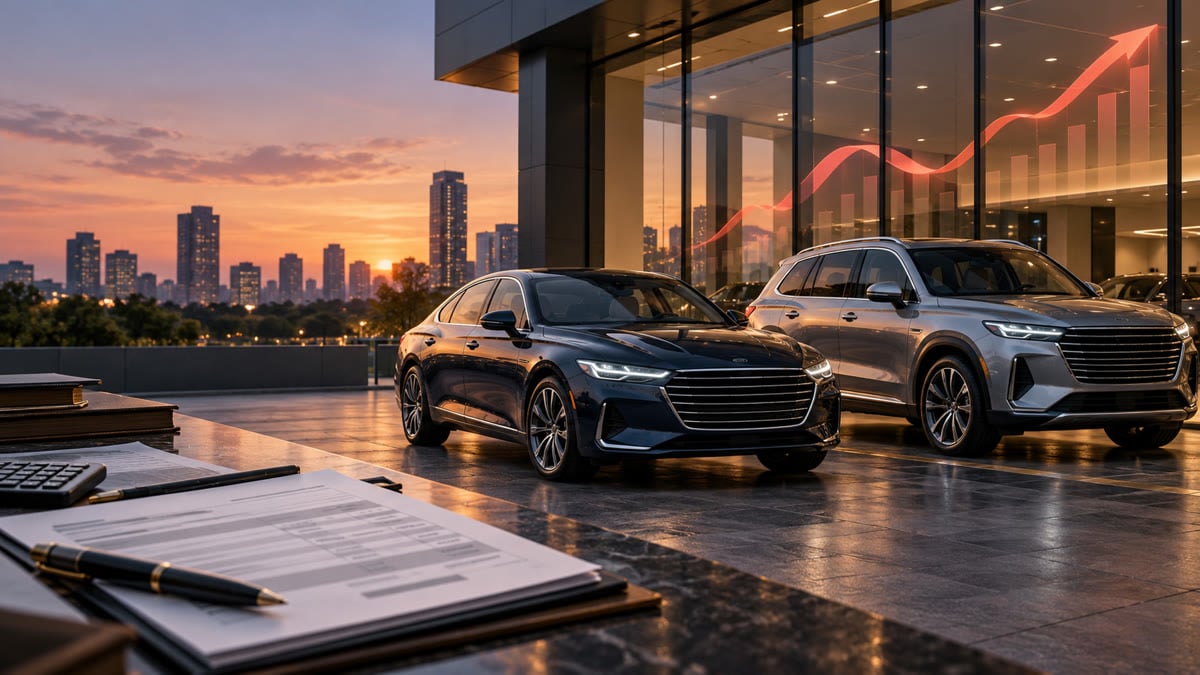
Luxury-car buyers in India are seeing most of the September 2025 GST 2.0 benefit absorbed by repeated manufacturer price increases. Reports published on 16 Oct 2026 say Mercedes-Benz, BMW and Audi have raised prices to offset currency, logistics and input-cost pressure, so the tax-reduced sticker price is not the same as today's buying advantage.
Key takeaways
- The GST Council's official FAQ put large and mid-size cars and qualifying utility vehicles at 40% GST without compensation cess after the 2025 change; the earlier combined tax incidence was 45–50%.
- Current reports say repeated manufacturer price hikes have absorbed most of the roughly 7% initial price relief.
- BMW's own 8 Jun 2026 release confirmed an increase of up to 2% across BMW and MINI vehicles effective 1 Jul 2026, citing rupee depreciation and logistics costs.
- The final benefit varies by brand, model, variant, exchange rate and dealer quote, so buyers need dated ex-showroom and on-road numbers.
What changed after GST 2.0
The GST Council's official FAQ says large and mid-size cars above 1,500 cc or 4,000 mm, along with qualifying utility vehicles, moved to a 40% GST rate without compensation cess under the September 2025 changes. The same official document describes the earlier combined tax incidence on the affected vehicles as 45–50%. The GST Council FAQ is the primary reference for the tax structure; it does not promise that every manufacturer will keep the full reduction in its ex-showroom price.
That distinction is central to the current buyer story. A tax change can lower the tax component, but the manufacturer can later revise the base price because of imported parts, currency movements, logistics or other costs. The price a buyer sees today is therefore a combination of the tax regime and the latest company price list, not a frozen calculation from September 2025.
How price hikes have narrowed the saving
The Economic Times reported on 16 Oct 2026 that the GST change initially brought luxury-car prices down by roughly 7%. It also reported that two to three rounds of manufacturer price hikes had clawed back most of that reduction. The report attributed the pressure to the rupee's movement against the dollar and euro and to higher input costs.
Team-BHP's 16 Oct 2026 report gave a similar brand-by-brand picture: Mercedes-Benz had raised prices by 2% in January and April 2026, with another 2% revision reported for October; BMW had announced increases of up to 2% in April and July; and Audi had made two increases taking its cumulative rise to about 4%. These are reported manufacturer revisions, not a change in the GST rate itself.
BMW has also published a primary confirmation for one of those revisions. Its 8 Jun 2026 release said prices across the BMW and MINI range would rise by up to 2% from 1 Jul 2026, citing rupee depreciation and escalating logistics costs. The increase applied to locally produced cars as well as completely built-up vehicles, so local assembly did not remove all cost exposure.
What this means for buyer math
The practical effect is that a percentage change can be large in rupee terms even when the headline rate looks modest. For illustration, a 2% revision on a ₹1 crore ex-showroom price is ₹2 lakh before registration, insurance and other on-road charges. This is an arithmetic example based on the reported up-to-2% revisions, not a quoted price for a specific model or a promise that every car will move by the same amount.
There is also no single GST-saving number for the whole luxury market. Some variants may still sit below their pre-GST price, while others can return to or exceed that earlier level after repeated revisions. A buyer comparing a current quote with an old article should record the date, ex-showroom price, variant, optional equipment and whether the quote includes any temporary dealer or manufacturer discount.
Running cost remains a separate part of ownership. A premium vehicle's fuel bill can materially change the monthly cost even when the purchase price is the main focus. Use the fuel-cost calculator with the expected monthly distance and the vehicle's stated or observed economy, then check the live fuel-prices hub for the relevant city rather than using an undated national assumption. The monthly car-ownership guide can help organise fuel, insurance, maintenance and finance into one comparison sheet.
Checks before booking
- Ask for a dated written price list and confirm whether the quoted ex-showroom figure is valid through the expected invoice date.
- Separate tax, manufacturer discount, dealer discount, accessories and finance charges. A discount can change the final amount without changing the underlying list price.
- Compare the old GST-era price with today's variant-equivalent price; do not compare a base model with a differently equipped vehicle.
- Request a full on-road breakup covering registration, insurance, tax collected at source and other statutory or local charges.
- If a finance offer is part of the quote, compare its total repayment and conditions separately from the vehicle price because a lower monthly payment can reflect a longer tenure.
What to watch next
The next useful signal will be the brands' dated price lists and any further revisions linked to currency or input-cost pressure. For a buyer, the important question is not whether GST 2.0 still exists—it does—but how much of its original benefit remains in the exact model and variant being considered.
The broader market context also matters. The Economic Times and Team-BHP both reported expectations of about 58,000 luxury-car sales in 2026, up roughly 11%, while the wider passenger-vehicle market was expected to grow 13–14%. That suggests the segment is still expanding, but it does not turn a tax saving into a guaranteed bargain for an individual buyer.
The reader takeaway is simple: treat the GST reduction as one input in the purchase calculation, not as the final price. Check the latest ex-showroom list, the complete on-road breakup, the financing terms and the vehicle's running cost before comparing offers.
Sources
- The Economic Times — Luxury car buyers lose most GST 2.0 benefits as Mercedes, BMW and Audi raise prices — 16 Oct 2026
- Team-BHP — Luxury cars offset gains from GST cuts as prices rise — 16 Oct 2026
- BMW Group India — BMW Group India to increase prices by up to 2% from 01 July 2026 — 8 Jun 2026
- GST Council — Press Release FAQ on the 56th GST Council recommendations — 9 Sep 2025
This article is for general information only and is not financial, insurance or legal advice.