A car can look affordable when you check only the EMI, while fuel, insurance, servicing, tolls and parking quietly become the bigger monthly commitment. This guide shows Indian drivers how to build a realistic monthly ownership budget from their own loan offer, kilometres, fuel price and renewal bills. The useful rule is simple: calculate a 12-month average first, then stress-test it for a higher rate, lower mileage or more driving.
Key takeaways
- Total ownership cost is EMI plus fuel, insurance, maintenance, tolls, parking and other running costs. Depreciation is a separate ownership cost, even though it is not a monthly cash payment.
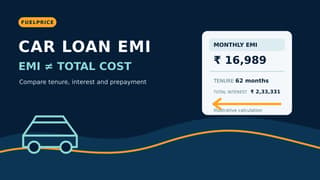
- TransUnion CIBIL reported an average passenger-vehicle loan of ₹8.2 lakh and average tenure of 62 months for H1 2026. That is a market average, not a quote for every borrower.
- Use the reducing-balance EMI method and compare total repayment, not only the advertised rate or the lowest monthly instalment.
- Fuel cost is driven by actual kilometres, real-world mileage and the price where you refuel. Update the calculation when any of the three changes.
- Keep insurance and service bills as monthly reserves, using your own renewal quote and past invoices instead of a generic premium promise.
Why a full ownership budget matters now
Vehicle finance is becoming a larger part of the purchase decision. TransUnion CIBIL’s 13 October 2026 release says the average passenger-vehicle loan rose 49% between H1 2019 and H1 2026 to ₹8.2 lakh, while the average repayment tenure increased by five months to 62 months. Moneycontrol reported the same findings from the bureau’s Shifting Gears 2026 report. A longer loan may spread the monthly payment, but it also keeps the borrower exposed to interest and ownership costs for more months.
The current rate trigger is also relevant. The Economic Times reported that SBI revised its EBLR, RLLR and some MCLR rates effective 15 October 2026 after a recent policy-rate move. The effect on a particular car loan depends on the benchmark, spread, reset date and sanction documents. FuelPrice has separately explained the SBI vehicle-loan rate update and the CIBIL car-loan trend; the lasting lesson is to budget for the whole car, not only the instalment.
The seven lines in a monthly car budget
1. Finance cost
Start with the amount actually financed, not the showroom price. Subtract the down payment, then add only charges clearly shown as financed. Record the annual rate, whether it is fixed or floating, tenure in months, processing fees, documentation charges and bundled products.
- EMI: the scheduled monthly repayment of principal and interest.
- One-time costs: processing, documentation, registration and accessories should not be hidden inside a low EMI.
- Total repayment: multiply EMI by instalments and add disclosed fees. This is the number to compare.
2. Fuel
The formula is: monthly fuel cost = monthly kilometres ÷ real-world kilometres per litre or kilogram × local fuel price. Use a rolling three-month mileage figure from your own fuel records. Brochure mileage is a starting point, not a guaranteed city-driving result.
FuelPrice’s fuel cost calculator can do the arithmetic for a commute or trip. Before using a price, check the relevant city on the live fuel-price page, because taxes, transport and fuel type make rates different across India.
3. Insurance reserve
Budget the next renewal as an annual reserve divided by 12. Do not treat one online quote as a permanent premium. IRDAI says third-party liability insurance is mandatory for vehicles using public roads, while own-damage pricing varies with vehicle age, IDV, claims history, deductibles and the insurer’s filed rates. A lower quote can come with a lower IDV or higher deductible, so compare coverage with price.
4. Maintenance and repairs
Use the last 12 months of service invoices as the starting point. Include scheduled service, filters, tyres, battery, brake wear, alignment and small consumables. If the car is new, use the manufacturer’s service schedule and create a reserve for items that are not due every month. The reserve is a planning tool, not a forecast of a particular repair.
5. Tolls and parking
Separate predictable commuting tolls and parking from occasional road trips. Add them to the month in which they are paid or average the last 12 months. For a highway journey, use the road-trip planner and include both fuel and tolls before deciding whether the trip fits the budget.
6. Taxes and compliance
Road tax, registration and statutory charges are usually upfront or periodic. Convert each bill to an annual equivalent when comparing vehicles, but keep one-off purchase costs separate from recurring ownership. Track PUC, insurance renewal and document expiry dates.
7. Depreciation
Depreciation is not a cash bill, but it matters when comparing a new car with a used car or deciding how long to keep a vehicle. Estimate purchase value minus expected sale value, then divide that difference over planned ownership months. Treat it as an estimate because resale value depends on age, kilometres, condition, location, demand and service history.
Worked example: turning the inputs into rupees
This is an illustrative planning example, not a lender, insurer or service quote. It uses the ₹8.2 lakh H1 2026 average passenger-vehicle loan reported by TransUnion CIBIL and a 62-month tenure. SBI’s auto-loan page, updated 16 September 2026, listed a mean auto-loan rate of 9.08% for Q1 FY26–27. Applying the reducing-balance method described by the National Institute of Securities Markets gives an EMI of about ₹16,619 for ₹8,20,000 over 62 months at 9.08% per year.
For fuel, assume 1,000 km a month, 18 km per litre and Delhi petrol at ₹102.12 per litre as of 15 October 2026. The calculation is 1,000 ÷ 18 × ₹102.12, or about ₹5,673. If the annual insurance renewal quote is ₹24,000, the reserve is ₹2,000 per month. If the previous 12 months of maintenance total ₹18,000, the reserve is ₹1,500. Add a planning allowance of ₹1,500 for tolls and parking.
The illustrative monthly cash budget is ₹16,619 + ₹5,673 + ₹2,000 + ₹1,500 + ₹1,500 = ₹27,292. It excludes down payment, registration and road tax, depreciation, financing fees, accident repairs and unusually large bills. Replace every assumption with the driver’s own records.
| Cost line | Input used | Monthly amount | How to read it |
|---|---|---|---|
| EMI | ₹8.2 lakh, 62 months, 9.08% p.a. | ₹16,619 | Calculated example using CIBIL and SBI inputs; not a live offer. |
| Rate sensitivity | 8.40%–9.35% p.a., ₹8.2 lakh, 60 months | ₹16,784–₹17,161 | Derived from SBI’s new-car fixed-rate band dated 16 September 2026. |
| Fuel | 1,000 km, 18 km/l, ₹102.12/l | ₹5,673 | Delhi petrol price is dated 15 October 2026; mileage is a planning assumption. |
| Insurance reserve | ₹24,000 annual quote | ₹2,000 | Illustrative user input; actual premium varies by profile and cover. |
| Maintenance reserve | ₹18,000 from the last 12 months | ₹1,500 | Replace with service and repair records. |
| Tolls and parking | Monthly planning allowance | ₹1,500 | Illustrative usage input; road-trip costs can be higher. |
| Total cash budget | Excludes depreciation and one-time purchase costs | ₹27,292 | Use as a starting budget, then update with actuals. |
Fixed versus floating: what to compare
A fixed rate is stable for the fixed period stated in the contract. SBI’s auto-loan page describes its displayed auto-loan rates as fixed, with the rate applied at disbursement remaining the same for the entire loan period. That is a lender-specific product description, not a rule that every car loan is fixed.
A floating rate changes with a benchmark and the lender’s spread. The Ministry of Finance explains that new floating retail loans such as auto loans may be linked to an external benchmark including the RBI policy repo rate or specified government-security yields. Check the benchmark, spread, reset frequency and how a change affects EMI or tenure. RBI guidance also describes the need to communicate reset impacts and repayment options for applicable EMI-based personal loans.
| Point to compare | Fixed-rate structure | Floating-rate structure |
|---|---|---|
| Rate movement | Does not change during the fixed period; check for a reset clause. | Moves when the stated benchmark or spread changes. |
| Budget predictability | EMI is easier to plan when fixed for the full tenure. | Keep room for a higher EMI, a longer tenure or both. |
| If market rates fall | The existing rate may not fall automatically. | The contract may pass through a lower rate at reset. |
| Extra checks | Ask about switch, foreclosure and fixed-period charges. | Check benchmark, spread, reset date, notification and prepayment terms. |
Do not compare a fixed and floating loan by headline percentage alone. Align principal, tenure, fees, reset rules and prepayment terms, then compare total rupees paid. For eligible floating-rate term loans to individuals for non-business purposes, the Department of Financial Services notes that banks cannot charge foreclosure or prepayment penalties under RBI guidelines; confirm the rule for the specific product and read disclosed charges.
What to check before you finalise the budget
- Write the on-road price, down payment, amount financed, rate type, rate, tenure and every fee from the written offer.
- Run the EMI using the same principal and tenure for each lender, and save total repayment as well as EMI.
- Record three months of kilometres, fuel purchased and actual mileage.
- Check the city fuel price on the day you build the budget and run a higher-price sensitivity test.
- Divide the latest insurance quote by 12 and compare IDV, deductible, exclusions and add-ons.
- Add scheduled service, tyres, battery, brakes and irregular repair bills to a maintenance reserve.
- Recheck the worksheet at renewal, after a rate reset, after a major repair or when monthly distance changes.
Frequently asked questions
What is the easiest formula for monthly car ownership cost?
Add EMI, monthly fuel, one-twelfth of annual insurance, one-twelfth of expected maintenance, tolls, parking and regular usage costs. Add depreciation separately when comparing the economic cost of different cars.
Does a longer car-loan tenure reduce the total cost?
It can reduce the scheduled EMI by spreading repayment over more months, but total interest depends on principal, rate and repayment schedule. Compare total repayment instead of treating a smaller EMI as a lower total cost.
How much should I set aside for car insurance?
Use the latest renewal quote for the exact car and divide it by 12. The amount can change with vehicle age, IDV, claims history, location, deductibles, add-ons and insurer, so a generic premium is only a placeholder.
Should depreciation be included in a monthly budget?
Include it when comparing the cost of buying, keeping or selling a car. For day-to-day cash planning it is separate from EMI and bills, but ignoring it can make a newer vehicle look cheaper over the full ownership period.
Sources
- TransUnion CIBIL, “Rising Car Prices and Aspirational Consumer Choices Drive Higher Auto Loan Sizes” — 13 October 2026.
- Moneycontrol, “Car Loan Amounts Jump 49% to ₹8.2 Lakh: CIBIL Report” — 13 October 2026.
- SBI, “SBI Auto / Vehicle Loans Interest Rates” — updated 16 September 2026.
- The Economic Times, “Higher EMIs ahead on SBI loans: State Bank of India revises lending interest rates” — 15 October 2026.
- Reserve Bank of India, “FAQs: Reset of Floating Interest Rate on EMI-based Personal Loans” — 10 January 2025.
- Department of Financial Services, Ministry of Finance, “Banking” — accessed 15 October 2026.
- National Institute of Securities Markets, “Vehicle Loan Calculator” — accessed 15 October 2026.
- IRDAI, “Motor Insurance — Policy Holder” — accessed 15 October 2026.
- Petroleum Planning & Analysis Cell, “Archive — RSP of Petrol in Delhi as per IOCL outlet” — 10 September 2026.
- NDTV, “Petrol Price in New Delhi Today” — 15 October 2026.
- Pexels, “A Person Driving a Car” by Chris F — accessed 15 October 2026; representative hero photograph.
This article is for general information only and is not financial, insurance or legal advice.