The Maharashtra State Consumer Disputes Redressal Commission has directed United India Insurance Company to pay ₹70 lakh—the BMW’s Insured Declared Value (IDV)—after a roadside fire destroyed the car. In its 16 Sep 2026 order, the commission held that locking and parking a punctured vehicle by the roadside late at night did not, on these facts, breach the policy’s requirement to take reasonable precautions.
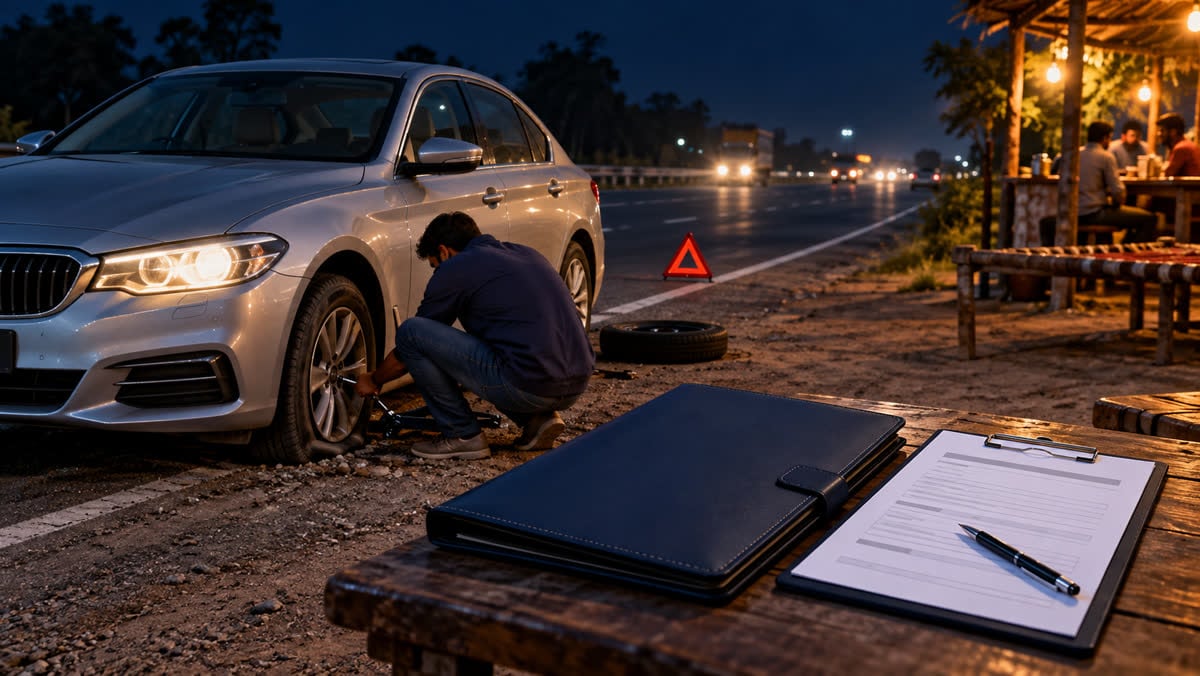
Image: Representative illustration of a roadside breakdown and motor-insurance paperwork; it is not a photograph of the vehicle in this case.
Key takeaways
- The ruling is about one claim and one policy condition; it is not a blanket direction to pay every claim involving an unattended vehicle.
- The insurer was directed to pay the agreed ₹70 lakh IDV, with 7% annual interest from 23 Nov 2012 until actual realisation, plus ₹50,000 for mental agony and ₹25,000 in litigation costs, according to the commission order.
- The commission treated the late-night highway setting, the car being moved off the road, and the doors and windows being secured as relevant precautions.
- For vehicle owners, the practical lesson is to keep the policy schedule, breakdown-condition wording, incident reports and claim correspondence together; the outcome still depends on the facts and policy terms.
What the commission decided
The dispute began on 8 Mar 2012, when Ravikant S. Patil’s BMW suffered a tyre puncture near Dhulkhed while he was returning towards Solapur. The commission’s order records that the policy ran from 22 Dec 2011 to 21 Dec 2012, carried an IDV of ₹70,00,000, and had a premium of ₹1,65,996. With no repair facility available at that late hour, the driver moved the car to the roadside near Chacha Dhaba, locked it and returned in another vehicle.
When the driver came back on 9 Mar 2012, the car had been completely burnt. Police and fire-department records were part of the case file. United India Insurance initially treated the matter as a total-loss claim, but later rejected it on 23 Nov 2012 by relying on Condition 4 of the policy. The insurer’s position was that leaving the vehicle unattended without adequate safeguards breached the requirement to prevent further damage or loss.
The insurer also argued that the puncture was a minor breakdown, that the vehicle could have been towed or repaired, and that the owner or driver should have remained with it. It disputed the fire’s cause and argued that depreciation reduced the vehicle’s value below the agreed IDV. These positions are recorded in the commission order and were also reported by The Times of India.
The commission did not read Condition 4 as an absolute ban on leaving a broken-down vehicle. It said the meaning of “proper precautions” had to be judged against the circumstances. Moving the car to the side of the road, securing it and leaving because it was late at night and no mechanic was available were treated as practical precautions. The bench also rejected the idea that a driver had to risk personal safety by staying beside a vulnerable vehicle on a highway shoulder overnight.
It further found no evidence establishing a direct connection between leaving the locked car and the fire. The exact origin of the fire remained undetermined in the police and fire records available to the commission, and the insurer had not produced forensic evidence showing that the alleged policy breach caused the loss. On that basis, the commission held that the claim rejection amounted to deficiency in service.
Why the IDV finding matters
The insurer had argued that the BMW’s post-depreciation value was about ₹59 lakh. The commission rejected that approach for this total-loss claim, holding that once an IDV has been agreed and the premium charged on that basis, the insurer cannot unilaterally reduce the settlement value without a statutory basis.
The order therefore directs payment of ₹70 lakh, plus interest at 7% per year calculated from 23 Nov 2012—the date of repudiation—until actual realisation. It also orders ₹50,000 for mental agony and harassment and ₹25,000 as litigation costs. The fixed amount before interest is ₹70.75 lakh; the final amount depends on when payment is actually made. The order does not establish that the money has already been received.
In this case, the IDV is the figure used for the total-loss settlement, but it does not remove every other policy requirement. A vehicle owner reviewing the distinction between declared value, depreciation and claim settlement can read FuelPrice’s guide to how IDV changes a claim amount.
What this means for policyholders
This is a case-specific consumer commission decision, not a new nationwide insurance rule. It does not mean that every vehicle left unattended after a breakdown will be covered, or that an insurer cannot examine late notice, excluded risks, fraud indicators, causation or other policy conditions. The commission applied the wording before it to the evidence in this particular dispute.
Its reasoning does, however, identify the questions that can matter in a breakdown-related claim: what the policy actually requires, what precautions were realistically possible at the location and time, whether the alleged breach caused the insured loss, and whether the insurer has relied on the agreed IDV consistently. A general overview of notice, documents and timelines is available in FuelPrice’s car insurance claim process guide.
Records worth keeping together
The case puts four groups of records in focus for anyone checking a vehicle policy or an open claim:
- The policy schedule showing IDV, cover period, premium and any breakdown or safeguarding condition.
- Time, location and vehicle-condition evidence, including photographs, roadside-assistance records and towing or repair communications where available.
- Police, fire-department or other incident records when the loss involves fire, theft or a road incident.
- The insurer’s acknowledgement, surveyor requests, written questions and final repudiation or settlement letter.
These documents do not guarantee a claim outcome. They make it easier to compare the insurer’s stated reason with the policy wording and the evidence. Owners can also use FuelPrice’s vehicle-insurance validity and document-check guide for the basic policy details to verify.
What to watch next
The 16 Sep 2026 order is the material development in this case. The available court record and independent reports establish the direction to pay, the interest start date and the additional compensation, but they do not provide a later payment or appeal update. The broader takeaway is narrower than a promise of coverage: when an insurer relies on a safeguarding condition, the facts, the wording and the link between the alleged breach and the loss all remain important.
Sources
- Maharashtra State Consumer Disputes Redressal Commission, “Ravikant Patil vs The United India Insurance Co. Ltd.” — 16 Sep 2026
- NDTV, “Man Wins 14-Year Battle, Gets Rs 70 Lakh Insurance Claim Over Punctured BMW” — 13 Oct 2026
- The Times of India, “Parked BMW on highway catches fire; consumer court orders insurer to pay Rs 70 lakh” — 28 Sep 2026
This article is for general information only and is not financial, insurance or legal advice.