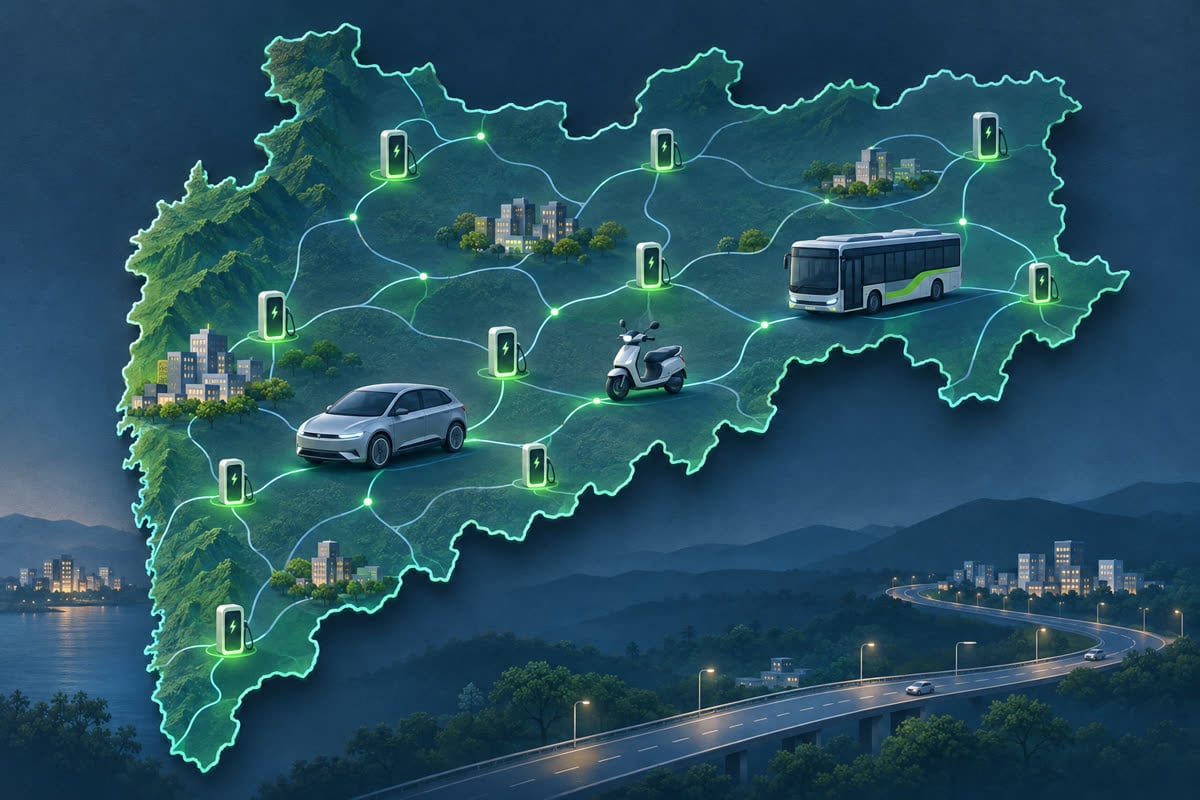
Maharashtra has reiterated its target that electric vehicles make up 30% of all new vehicle registrations by 2030, alongside a push for highway charging and battery recycling. At a Pune industry event on 4 Nov 2026, Chief Minister Devendra Fadnavis restated the goal under the Maharashtra Electric Vehicle Policy 2025, making the development relevant to future vehicle buyers, fleet operators and drivers planning long trips.
The target is a policy direction, not an instruction for existing petrol, diesel or CNG vehicles to be replaced immediately. The practical question for drivers is whether charging, incentives and toll-system changes keep pace with the registration goal.
Key takeaways
- The Maharashtra EV Policy 2025 targets EVs at 30% of all new vehicle registrations by 2030.
- The policy sets higher targets of 40% for new electric two-wheelers and eligible three-wheelers, and 30% for new electric cars.
- It plans charging facilities at 25 km intervals on highways, subject to implementation and technical feasibility.
- The policy provides for a 100% toll-tax exemption for passenger EVs on the Mumbai-Pune Expressway, Maharashtra Samruddhi Mahamarg and Atal Setu; current route-level FASTag handling should be checked before a trip.
What Maharashtra has reiterated
ETGovernment reported on 5 Nov 2026 that Fadnavis said 30% of new vehicle registrations in Maharashtra should be electric by 2030. The Free Press Journal separately reported the same target after the Chief Minister’s 4 Nov event in Pune. Both reports described the goal as part of the state’s wider plan to become a future-mobility hub, with fast charging, battery recycling and vehicle-technology development included in the agenda.
The target itself is not new: it is written into the Maharashtra Electric Vehicle Policy 2025, issued through a Government Resolution dated 23 May 2025. That policy applies from 1 Apr 2025 to 31 Mar 2030. The fresh development is the state government’s public restatement of the direction while Maharashtra is positioning its manufacturing and research ecosystem for the next phase of vehicle adoption.
How the targets are split across vehicle categories
The official policy does not treat every vehicle segment identically. The figures below are policy targets, not current registration shares; they are taken from the Government of Maharashtra resolution dated 23 May 2025.
| Segment | Policy target |
|---|---|
| All new vehicle registrations | 30% electric |
| New electric two-wheelers | 40% of registrations |
| Eligible new electric three-wheelers | 40% of registrations |
| New electric cars | 30% of registrations |
| New electric light goods carriers | 25% of registrations |
| Public buses in the top six urban agglomerations | 40% of fleet size |
For a private car buyer, the important distinction is that a state-level target does not guarantee that a particular model, price band or city will have a subsidy available on a given day. Eligibility, the remaining incentive allocation and the vehicle’s registration status still need to be verified through the applicable government or manufacturer process.
Charging is the practical test
The policy aims for a charging facility at every 25 km along state and national highways. It also says existing and new highway fuel pumps should have at least one fast-charging station where technically feasible, while MSRTC bus stations and bus stops are planned to receive fast-charging facilities. This is the part of the policy that will most directly determine whether an EV can serve intercity commuters, taxis, buses and goods carriers.
The resolution also creates an incentive framework for some high-power charging stations, with support of up to 15% of eligible station cost in specified categories. That is an infrastructure-side provision, not a promise of a 15% discount on a driver’s charging bill or vehicle purchase price. Before an EV road trip, check the state-wise EV charging directory for the actual location, connector type, operating status and access conditions.
What it means for tolls and trip cost
The Maharashtra policy provides for a 100% toll-tax exemption for passenger electric vehicles on the Yashwantrao Chavan Mumbai-Pune Expressway, the Maharashtra Samruddhi Mahamarg and the Atal Bihari Vajpayee Sewri-Nhava Sheva Atal Setu. The policy names these corridors as a sustainable-transport demonstration, so the provision is narrower than a blanket toll waiver on every road in Maharashtra.
Drivers should treat the exemption as a policy provision and confirm the current route-level process before travelling. Toll-plaza operations, FASTag treatment and vehicle-class rules can affect how a waiver is applied at the point of passage. The toll-charge calculator can help compare the route-cost line, while the fuel-cost calculator remains useful for benchmarking an equivalent petrol or diesel trip.
What changes now—and what does not
For a current petrol, diesel or CNG owner, the announcement does not create an immediate replacement deadline. The 30% figure is measured across new registrations, so it describes the mix of vehicles entering the fleet rather than ordering existing vehicles off the road. The policy also does not make every EV purchase automatically eligible for a particular incentive; the applicable vehicle category, registration conditions and implementation channel still matter.
For fleet operators, the direction is more consequential. The policy separately targets electric adoption in buses, goods carriers, city-utility vehicles and aggregators, while linking the transition to charging corridors and battery-recycling capacity. That creates a planning signal for depot charging, route scheduling and vehicle procurement, but it is not proof that every highway or depot is ready today.
What to watch next
The next useful evidence will be implementation detail: a current public charging-coverage map, clear incentive availability, route-level toll instructions and progress reports against the registration targets. The official policy assigns responsibilities across the Transport, Energy, Urban Development and Public Works departments, so rollout may appear through separate notifications and portals rather than one single announcement.
For buyers and drivers, the sensible takeaway is to compare the complete operating picture: purchase price, current incentive eligibility, insurance, charging access, electricity cost, maintenance, toll treatment and the route actually travelled. Maharashtra’s target points to a faster EV transition, but the value for an individual trip will depend on what is live at the time of travel.
Sources
- Maharashtra Electric Vehicle Policy-2025 — Government of Maharashtra, 23 May 2025.
- Maharashtra targets 30% electric vehicle registrations by 2030 to drive a greener future — ETGovernment/PTI, 05 Nov 2026.
- Maharashtra CM Pushes ‘Innovate In India’ For Global Mobility, Pawar Seeks Industry Support For Water Security In Drought-Prone Regions — Free Press Journal, 04 Nov 2026.