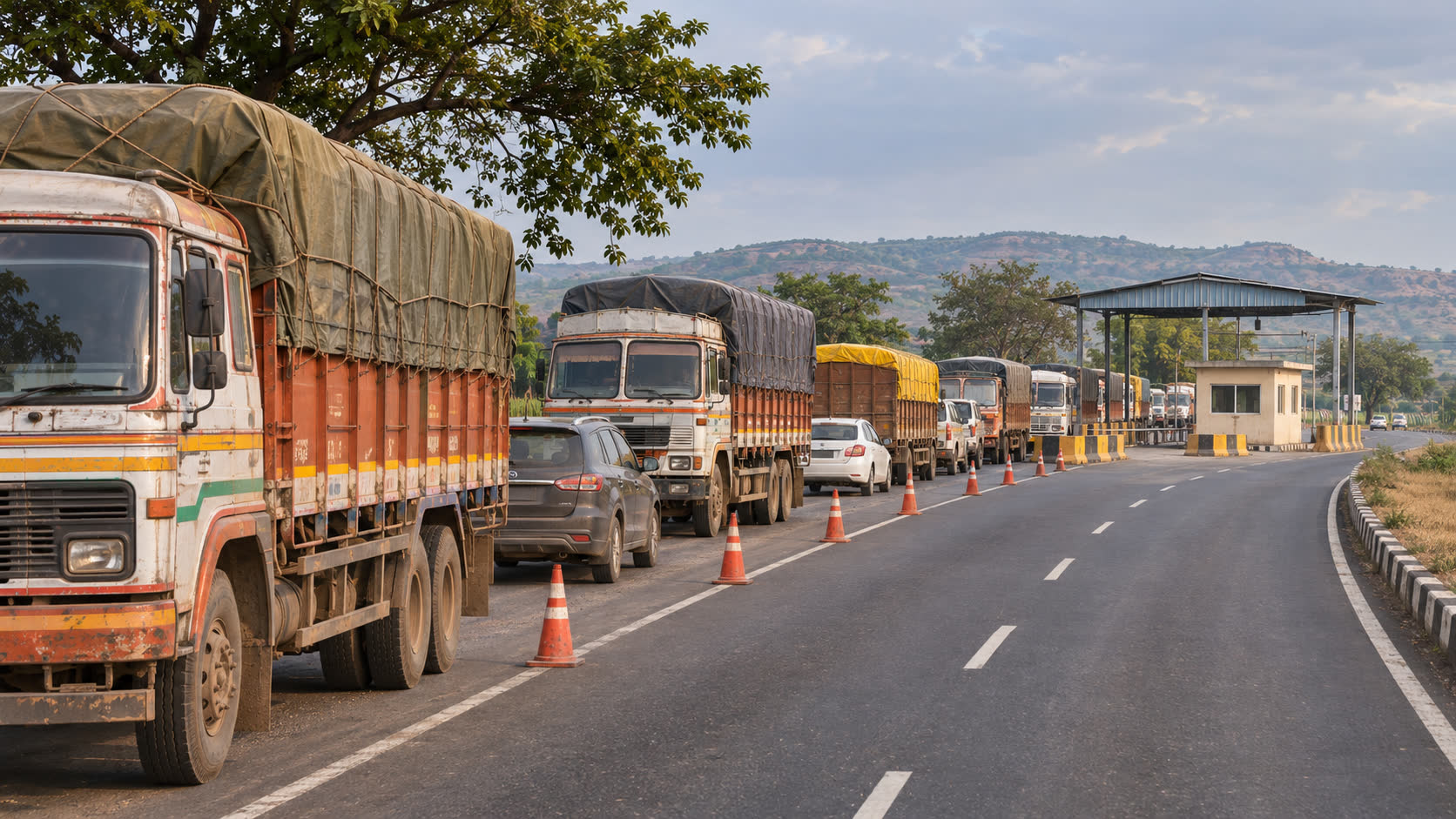
Truck drivers blocked the Srinagar–Kanyakumari National Highway at the Mansar–Kandri check post in Maharashtra on 16 Nov 2026 after alleging that RTO personnel were forcing collections, according to reports by The Times of India and United News of India. Maharashtra Minister of State Ashish Jaiswal acknowledged the complaints and said the matter would be examined, while a senior RTO official denied that department personnel were involved.
Key takeaways
- The protest took place on Monday evening at the Mansar–Kandri check post in Ramtek tehsil, Nagpur district.
- Truckers parked vehicles on the highway, creating a long queue and temporarily bringing traffic to a standstill.
- UNI reported that police used a lathi-charge to disperse the protesters after attempts to pacify the situation failed.
- The minister said the chief minister had taken note and directed officials to conduct an inquiry; the RTO’s version disputes the allegation.
What happened at the Mansar–Kandri check post
The incident unfolded on Monday evening, 16 Nov 2026, at a transport check post in Ramtek tehsil on the Srinagar–Kanyakumari highway. The drivers alleged that money was being forcibly collected from vehicles by RTO personnel. In response, they parked trucks on the road, and the queue grew as other vehicles were held up.
The Times of India reported that a large police force reached the location and tried to calm the drivers. When the situation escalated, police dispersed the protest with a lathi-charge. UNI carried a similar account on 17 Nov 2026, attributing the police action to officials at the scene. Neither report gives a quantified estimate of the delay, the number of trucks held up or any financial loss from the stoppage.
For motorists who were using the corridor, the practical effect was a temporary obstruction rather than a reported change in the highway’s toll or FASTag system. Drivers planning a long journey can review distance and timing with the road-trip planner before leaving, but any local traffic diversion should still be checked against current authority updates.
What is confirmed, and what remains disputed
Both reports attribute the allegation to protesting truck drivers. They also report a response from Ashish Jaiswal, Maharashtra’s minister of state for finance and planning. UNI said Jaiswal acknowledged the allegations, and that he stated Chief Minister Devendra Fadnavis had taken cognisance and directed an inquiry. The Times of India reported that Jaiswal said the chief minister, transport minister and other officials had taken note and that appropriate action should follow.
The department’s position is different. A senior RTO official told The Times of India that RTO officers had not asked drivers for money. The official said trucks are checked for overloading in a designated lane by a private company appointed by the government, whose employees inform RTO officials when a vehicle is found to be overloaded. The official also said the vehicle involved had used a central lane rather than the designated checking lane.
That means the public record currently contains an allegation, a ministerial acknowledgment that a complaint requires action and an RTO denial. It does not establish that any individual RTO employee committed wrongdoing. The outcome of the promised inquiry, if publicly released, will be the next material development.
Why the stoppage matters to transporters and travellers
Check-post disruption can affect more than the vehicle stopped at the barrier. A queue can push freight arrivals beyond delivery windows, extend driver waiting time and increase idling or rerouting costs. The reports do not quantify any of those effects in this incident, so operators should not treat a specific rupee loss as verified.
For fleet operators, the useful record is the time, location, lane used, documents presented and any receipt or official notice issued during a check. Keeping those details can help separate a documented compliance issue from an unverified claim when a complaint is reviewed. A delayed or diverted trip can also change fuel use; the fuel cost calculator can help compare the planned and revised route once the actual distance is known.
Private motorists should also avoid assuming that a report about an RTO check post is a new toll fee or FASTag rule. There is no such toll revision in the two reports used for this article. For a route that includes several fee plazas, the toll-charge calculator can be used to estimate the planned toll component separately from any traffic delay.
What drivers and fleet operators can do now
- Check the road’s current status before entering the corridor, especially if a shipment or appointment has a fixed arrival window.
- Carry the vehicle’s registration, permit, insurance, fitness and other required transport documents in an accessible form.
- Keep dated receipts, notices and the check-post details for any payment or inspection that is disputed.
- Use the transport department or police complaint channel for a documented grievance instead of blocking the highway or treating an allegation as a confirmed finding.
Drivers should also be cautious with social-media posts that claim the check post has been permanently closed, that a new fee is in force or that a statewide rule has changed. The reports reviewed here describe a local incident and a proposed inquiry; they do not announce a permanent closure or a new national highway charge.
What to watch next
The next useful update would be an official statement on the inquiry, any action taken by Maharashtra’s transport authorities and whether the check-post process has been changed. A separate traffic advisory would also matter to freight operators and motorists using the route. Until those updates are issued, the allegations and the RTO’s denial should remain clearly separated in any account of the incident.