MaxVolt Energy has broken ground on a proposed ₹700-crore lithium battery-pack manufacturing campus in Aligarh, Uttar Pradesh, with 10 GWh of annual capacity planned across two phases. The 23 Sep 2026 ground-breaking matters to EV and fleet readers as a new domestic pack-supply project, but the facility is not operational yet and does not mean an immediate change in vehicle prices, driving range or charging times.
Key takeaways
- MaxVolt held the Bhoomi Pujan for the Aligarh campus on 23 Sep 2026 and said construction would begin immediately afterwards.
- The planned 10 GWh capacity is split into two 5 GWh phases. The company targets the first phase in 24–30 months and the second phase within a further 18 months.
- The Aligarh project is planned to add to MaxVolt’s operational 2.5 GWh Duhai facility, taking combined planned capacity to 12.5 GWh a year.
- The project is for battery-pack assembly and related systems, with dedicated OEM lines and four-wheeler EV capability; it is not described as a cell-manufacturing plant.
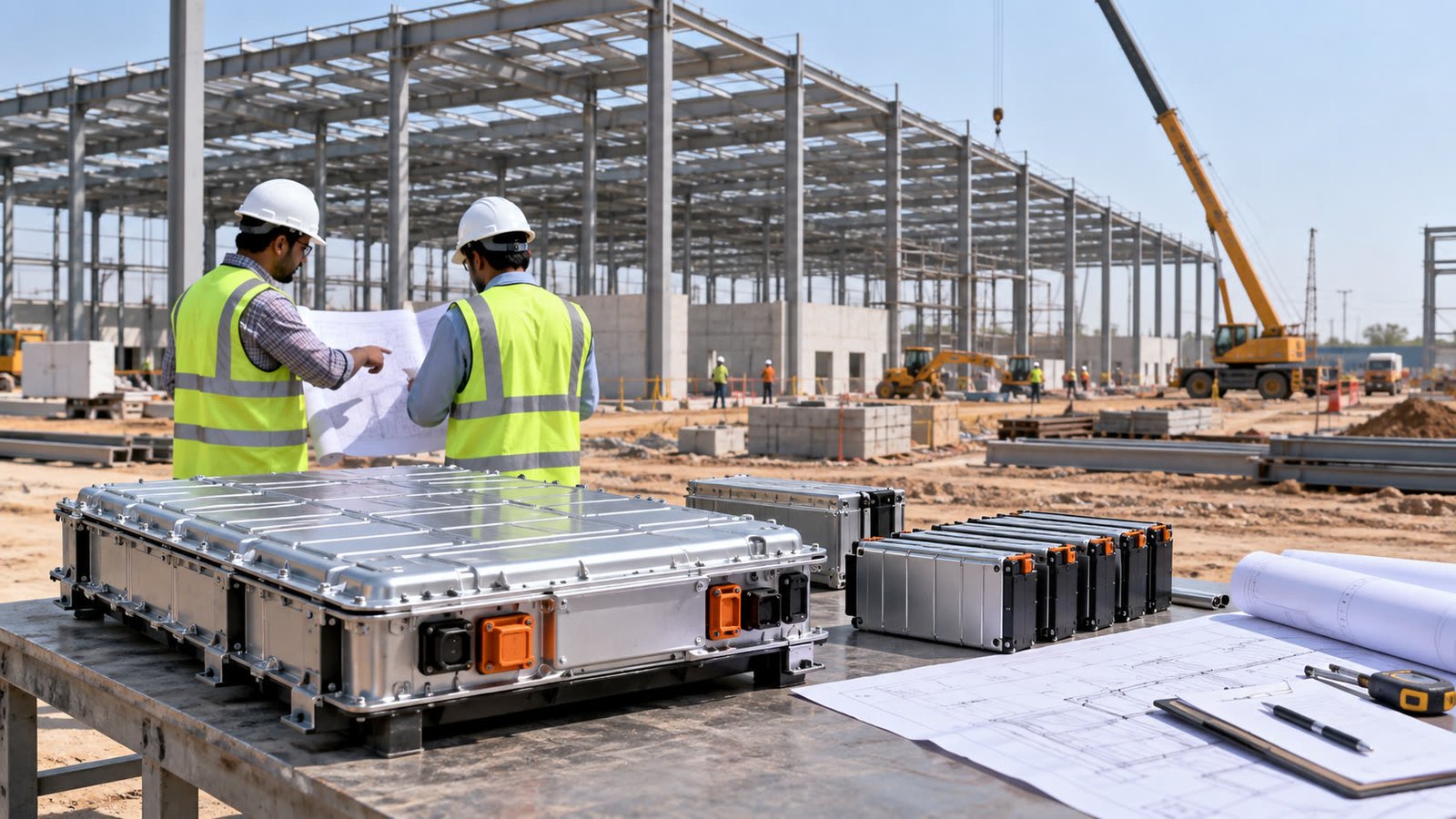
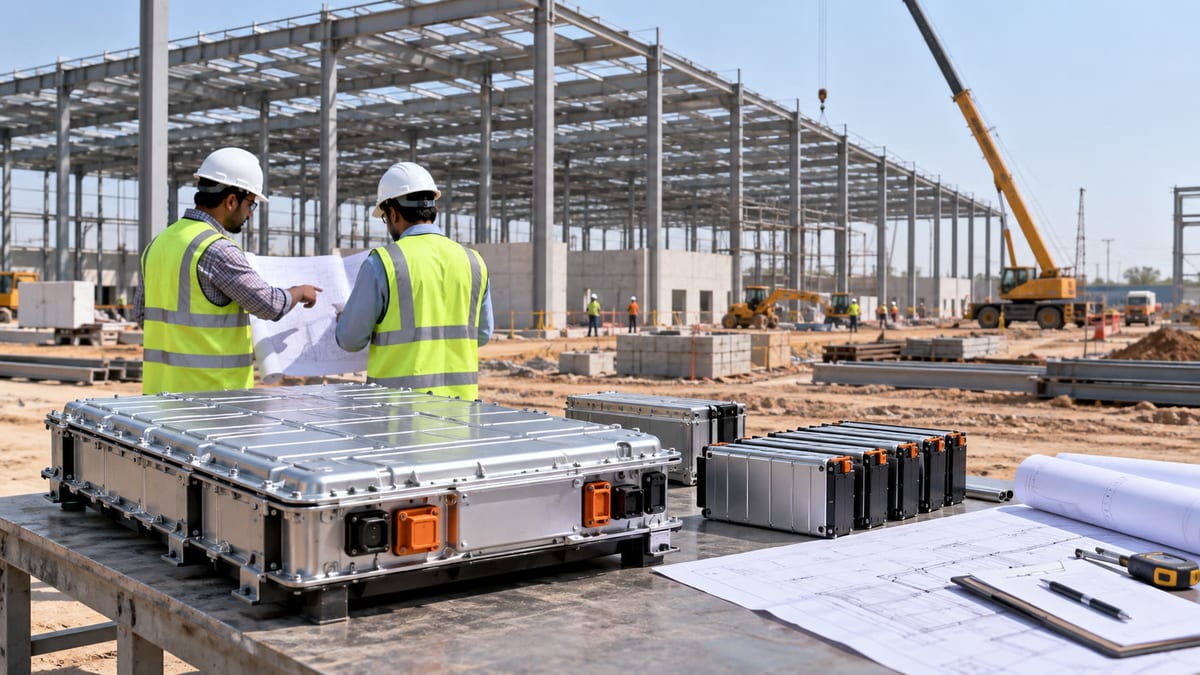 Editorial illustration of a proposed EV battery-pack campus at the construction stage; not an official MaxVolt facility photograph.
What happened in Aligarh
MaxVolt’s regulatory filing with the National Stock Exchange said the company performed the Bhoomi Pujan for the proposed facility in Aligarh on 23 Sep. Its accompanying press release described the project as an approximately ₹700-crore expansion covering about 23,576 square metres, or nearly six acres, at Khyamai in Aligarh.
Autocar Professional and PTI, in contemporaneous reports, independently reported the same ground-breaking, investment and 10 GWh plan. That makes the event a confirmed company disclosure and ground-breaking milestone. It is not confirmation that the plant has started commercial production.
Two phases, not an instant 10 GWh supply boost
MaxVolt said the campus will be developed in two phases of 5 GWh each. The company’s stated target is to commission Phase I within 24–30 months and Phase II within a further 18 months. These are company timelines, so they should be read as targets rather than guaranteed delivery dates.
The filing says the new campus would sit alongside MaxVolt’s operational 2.5 GWh facility at Duhai, Ghaziabad. If the Aligarh plan is completed as announced, the two sites would have a combined planned capacity of 12.5 GWh a year. The word “planned” matters: nameplate capacity is not the same as output shipped to vehicle makers, and the actual ramp-up will depend on construction, equipment, testing, orders and utilisation.
What the facility will make
MaxVolt describes the Aligarh site as a battery-pack manufacturing and assembly facility. The company says it will assemble packs and integrate battery-management systems, chargers and inverters, while adding dedicated production lines for original-equipment manufacturers and expanding into four-wheeler EV battery packs.
This is different from a cell factory. Cells are the electrochemical units inside a battery; pack assembly combines cells or modules with the enclosure, thermal and electrical systems, controls and safety hardware. A pack plant can still be important to an EV supply chain because it can support vehicle-specific designs and local integration, but it does not by itself remove every cost or sourcing dependency in the battery.
The project is also intended to serve more than passenger cars. The company and PTI said the planned applications include electric two-wheelers, three-wheelers, four-wheelers, energy storage and other industrial uses. That mix means the eventual 10 GWh cannot be converted into a fixed number of cars: the energy capacity per product and the share allocated to each segment will vary.
What it means for EV buyers and operators
For a vehicle buyer, the immediate takeaway is limited but useful. The ground-breaking does not announce a new MaxVolt vehicle, a new battery chemistry, a new charging standard or a confirmed price cut. It signals a possible increase in domestic battery-pack supply over the next few years, subject to execution and customer orders.
More local pack capacity could give Indian OEMs another supplier option and support faster adaptation of packs for electric cars, two-wheelers and commercial vehicles. It could also deepen the component, testing and service ecosystem around Uttar Pradesh. Those are potential supply-chain effects, not guaranteed savings for the person buying an EV today.
Running cost remains a separate question. Electricity tariffs, charging losses, charger availability, financing, insurance and the vehicle’s efficiency still determine ownership economics. Buyers comparing an EV with petrol, diesel or CNG can use the fuel cost calculator to test their own distance and energy assumptions instead of treating a factory announcement as a cost estimate.
For long-distance users, manufacturing capacity also does not replace route planning. The state-wise EV charging station directory is the more direct tool for checking where public charging may be available, while the road-trip planner helps map a journey before relying on a new vehicle or charging network.
Jobs and local industrial impact
MaxVolt’s filing puts the project’s employment potential at 1,500–2,000 direct jobs and 7,500–10,000 indirect opportunities at the planned scale. PTI also reported the company and state officials’ expectation that the project could support suppliers, logistics, engineering and other activity around Aligarh.
Those figures are projections attached to full development, not jobs already created on 23 Sep. The same caution applies to the company’s stated potential annual turnover of more than ₹6,800 crore at full capacity. Neither figure is a present operating result.
What to watch next
- Construction progress and the company’s first-phase commissioning update against the 24–30-month target.
- Announcements from EV, energy-storage or industrial customers that confirm actual offtake, rather than only planned capacity.
- Battery-pack safety testing, quality certifications, warranty support and the sourcing of cells and other critical components.
- Whether the project adds measurable local charging, service and recycling capacity as the broader EV ecosystem develops.
Reader takeaway
MaxVolt’s Aligarh announcement is a real investment and construction milestone, not an operating 10 GWh factory. For Indian EV users, the useful signal is the possibility of more locally assembled battery packs and supplier depth; the practical effect on vehicle prices, range and charging will only become clear after construction, commissioning and customer production are demonstrated.
Sources
- MaxVolt Energy Industries Limited, “MaxVolt Energy Breaks Ground on 10 GWh Lithium Battery Pack Campus in Aligarh”, NSE filing and press release, 23 Sep 2026.
- Autocar Professional, “Maxvolt Energy Begins Work on Rs 700 Crore Aligarh Battery Facility”, 23 Sep 2026.
- Rediff Moneynews/PTI, “UP Gets Rs 700-Cr Battery Plant in Aligarh for EV Push”, 23 Sep 2026.