India's electric-vehicle push is entering a less visible but decisive phase: charging must become reliable, affordable and practical enough for drivers and fleets to depend on it. An analysis published by Autocar Professional on 07 Nov 2026 said the next challenge is not only adding chargers, but making the network work with the grid and with viable operating models.
That matters to Indian buyers because a charger count alone cannot answer the questions that affect a trip: will the point be working, will the connector fit, can the driver pay, and is the stop placed where the route actually needs it? For private owners, the issue shapes confidence beyond the daily commute. For commercial fleets, it affects vehicle utilisation, schedules and operating costs.
Key takeaways
- Charging availability is moving from a vehicle-sales issue to an uptime, payment and route-planning issue.
- The Ministry of Heavy Industries said in its 12 Aug 2026 update that 67,657 EV chargers had been installed across states and Union territories as of 07 Aug 2026, including 1,139 chargers at battery-swapping stations.
- The Ministry said PM E-DRIVE had a ₹2,000 crore allocation for public EV charging in that 12 Aug 2026 update, but funding deployment alone does not guarantee reliable service.
- Buyers and fleet operators should check real-world charger availability, connector compatibility, payment options and backup stops before depending on an EV for longer routes.
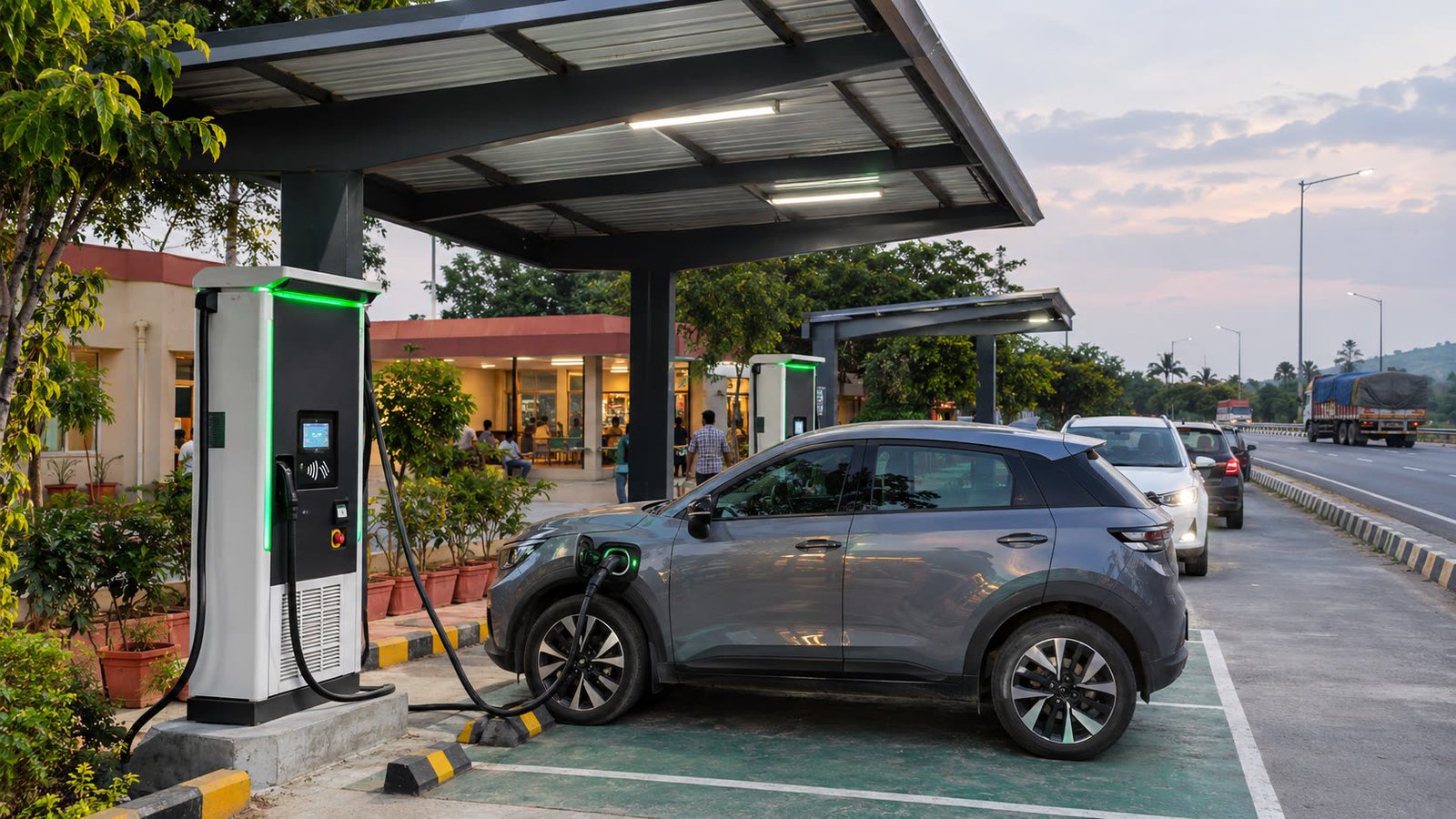
Image note: This is a representative editorial visual of an EV charging bay in India, not a photograph of a specific vehicle, site or charging operator.
Why charger count is not the whole story
The official installation figure shows that the network has expanded, but it is not the same as a guarantee of public access on every road. A charger can be counted in an official total while still being difficult to use because of downtime, a blocked parking bay, a payment failure, a queue or a location that is open only during limited hours.
The Ministry of Heavy Industries' 12 Aug 2026 update also shows how policy support is being measured across different schemes. It reported the charger figure above and identified public charging as a funded component of PM E-DRIVE. The policy direction is clear: public infrastructure is being built alongside incentives for electric vehicles and buses. The practical test is whether drivers experience a dependable service rather than simply a larger inventory.
Where the bottlenecks are
Reliability and payment
Autocar Professional highlighted reliability, affordability and interoperability as central issues. Drivers need a charger that is visible in an app, operational when they arrive and usable without an unexpected payment or account problem. A network with several operators can also leave users checking different apps, tariffs and access rules before a single journey.
For a private owner, a failed stop may mean a delay or a detour. For a taxi, delivery vehicle or bus, it can disrupt a shift and reduce the time available to earn revenue. That is why uptime and transparent status information are as important as the headline number of connectors.
Grid connection and utilisation
Fast charging needs suitable electrical capacity, a safe site and a connection that can support demand when several vehicles arrive together. Autocar's analysis links charging viability to grid readiness and business models. Operators must cover equipment, electricity, land, maintenance and financing costs, while utilisation can remain uneven outside busy corridors.
Business Standard, in its 17 Sep 2026 report on an IEEFA analysis, said the public-charging allocation could cover only a small fraction of the infrastructure estimated to be needed by 2030. That is an estimate rather than an official shortfall target, but it underlines the scale question: public money can accelerate deployment, while long-term availability will also depend on private investment, usage and predictable returns.
Home charging and shared parking
Home charging can reduce dependence on public points for owners who have a dedicated parking space and an appropriate electrical connection. That advantage is less straightforward for apartment residents, tenants and people who park on the street. The public network therefore remains important even when most routine charging is done privately.
What PM E-DRIVE changes
The Ministry of Heavy Industries said in its 12 Aug 2026 update that PM E-DRIVE includes ₹2,000 crore for public EV charging. The allocation can help expand charging at highways, cities, depots and other high-use locations, but it should be read as an infrastructure push, not a promise that every proposed site is already available or operational.
The next stage will need clear responsibility for site selection, grid upgrades, maintenance and user-facing information. A charger placed where vehicles do not stop may have low utilisation; a busy site without enough electrical capacity may create queues. The strongest projects will connect funding with measurable service quality, including uptime, transparent pricing and simple payment.
What this means for buyers and fleets
EV buyers can treat charging access as part of the vehicle decision, alongside range, battery warranty and service support. Before a long journey, the state-wise EV charging directory can help identify available options, while the road-trip planner can help map distance, stops and time. It is sensible to identify a backup charger rather than plan around one point on a route.
Fleet operators need a more structured check. They can compare duty cycles with the location of depots and chargers, confirm whether vehicles can use the same connector and payment system, and allow time for charging in schedules. A route that works for a privately owned car may not work for a high-use commercial vehicle if a stop is unreliable or too slow.
For drivers comparing an EV with a petrol or diesel vehicle, the live fuel prices tool can provide the current fuel-price baseline for a running-cost comparison. That does not replace a vehicle-specific calculation, but it helps separate the purchase decision from assumptions about fuel prices or charging access.
What to watch next
The useful signals will be operational rather than promotional: more chargers that show accurate live status, fewer payment barriers, common access standards, published tariffs and evidence that sites remain maintained after installation. Grid upgrades and charging at workplaces, housing societies, bus depots and freight hubs will also determine how broadly the network serves different types of users.
Autocar Professional also discussed possible improvements such as greater interoperability and better network coordination. These remain areas to watch, not completed national rules. For now, the reader takeaway is simple: India's charging story is moving from how many points exist to whether they are dependable at the moment and place a driver needs them.
Sources
- Autocar Professional — Making EV Charging Viable The Next Challenge for India's Electric Mobility Push — 07 Nov 2026
- Ministry of Heavy Industries / PIB — FAME India Scheme Phase-II: Progress in Electric Vehicle Adoption and Charging Infrastructure — 12 Aug 2026
- Business Standard — India's ₹2,000-crore EV charging push may fall short of 2030 target: Report — 17 Sep 2026