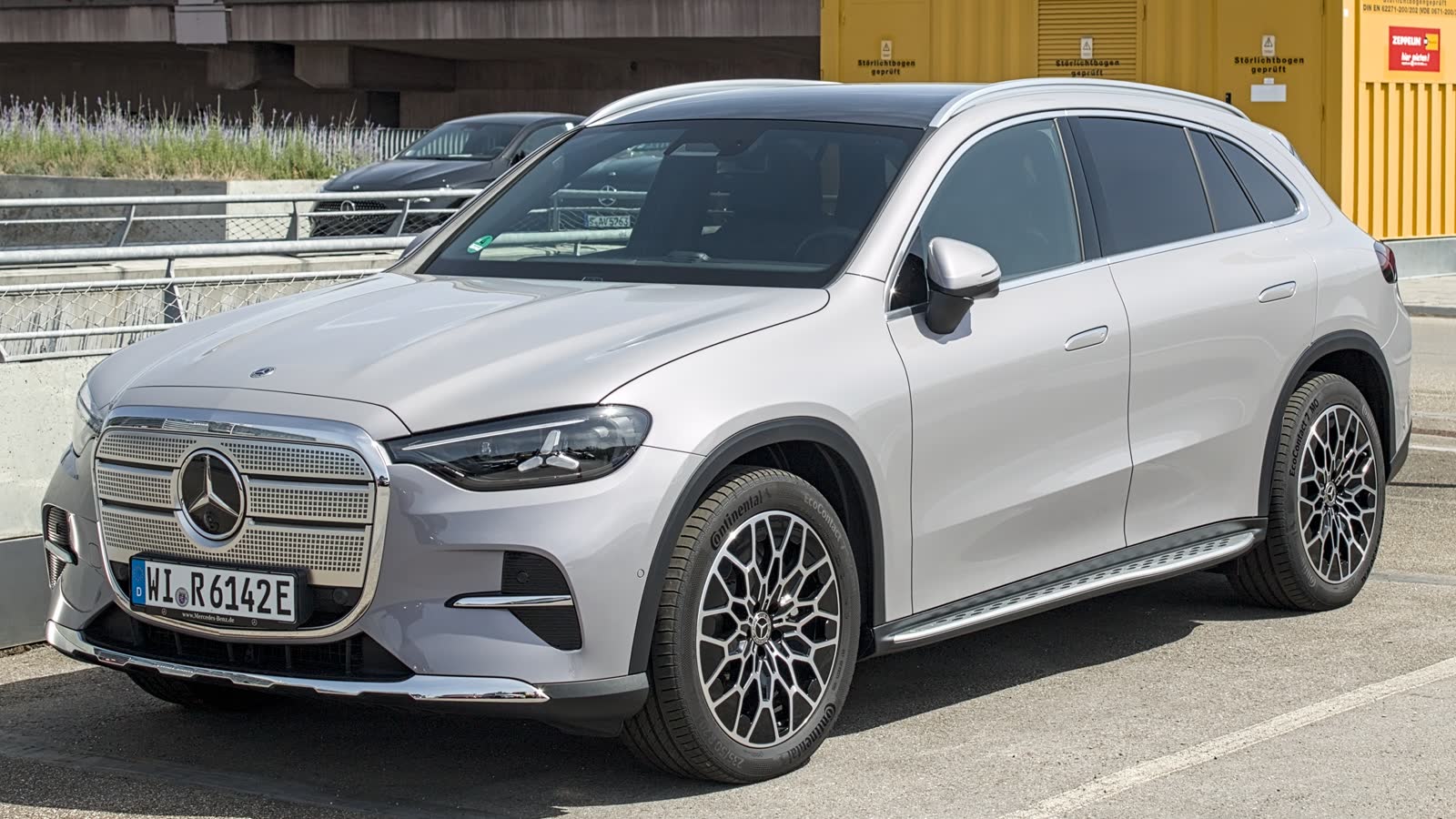
Mercedes-Benz has launched the GLC 400 4MATIC electric in India at an introductory ex-showroom price of ₹78.50 lakh on 4 Nov 2026. It is locally assembled at the company’s Chakan plant in Pune and brings a 94 kWh battery, all-wheel drive and a claimed 711 km WLTP range to the luxury EV market.
Key takeaways
- The India-spec GLC Electric is sold in one GLC 400 4MATIC configuration at an introductory ₹78.50 lakh ex-showroom.
- It uses a 94 kWh battery and dual electric motors with all-wheel drive.
- Launch-day reports list a claimed 711 km WLTP range; earlier pre-launch reports had cited 715 km.
- Mercedes-Benz says the battery can charge from 10% to 80% in about 22 minutes on a 330 kW DC charger.
- The SUV is assembled in Pune, which makes the launch relevant to buyers comparing imported and locally assembled luxury EVs.
Launch price and India-specific configuration
CarWale and Motoring World both report an introductory ex-showroom price of ₹78.50 lakh for the GLC Electric. That is the price before state registration, insurance, road tax and other on-road charges, so the amount payable will vary by city. The introductory label also matters: a later price revision or a change in the equipment package would make a fresh dealer quote necessary.
India gets the SUV in the GLC 400 4MATIC guise, with a dual-motor, all-wheel-drive layout. Mercedes-Benz’s India product page lists output of 489 hp and 800 Nm, while the launch reports from CarWale and Motoring World express the power figure as about 483 bhp. The small difference is a horsepower-unit convention, not a separate India variant; the torque figure is 800 Nm in the official and independent specifications.
The car is being assembled at Mercedes-Benz’s Chakan facility near Pune. That is a material detail for this segment because local assembly can affect how the vehicle is positioned against fully imported luxury EVs, although it does not by itself determine the final on-road price or ownership cost.
Battery, performance and range
The GLC 400 4MATIC electric uses a 94 kWh battery. CarWale’s launch-day report and Motoring World’s launch report both list a claimed WLTP range of 711 km. Some pre-launch listings from Autocar India and India Today had cited 715 km, so the sources are not fully aligned. This article uses 711 km because that is the figure repeated by the two reports published after the India launch; the final homologation or vehicle documentation should be the reference for a specific car.
Mercedes-Benz and the independent launch reports put the 0–100 km/h time at a claimed 4.3 seconds. That figure describes the performance potential of a premium dual-motor SUV, but it is not the number that will decide whether the car works for a particular Indian route. Highway speed, air-conditioning use, passenger and luggage load, temperature, tyre pressure and charging access will all influence an actual trip.
Charging and trip planning
The official India page says the GLC Electric can charge from 10% to 80% in about 22 minutes on a 330 kW DC charger. Motoring World reports the same charging time and peak charger capability. The claim is therefore dependent on access to a suitably rated charger, the station’s live condition and the battery’s temperature and state of charge; it should not be read as a guaranteed stop time at every public charger.
For an owner, charger availability is as important as the headline range. FuelPrice’s EV charging-station directory can help identify charging locations by state, while the road-trip planner is useful for checking how a route, stops and driving distance fit together. A petrol-versus-EV comparison should also account for the actual electricity tariff and charging losses rather than comparing a WLTP number directly with a fuel-tank range; the fuel-cost calculator provides the petrol or diesel side of that comparison.
Features that matter for Indian use
The cabin’s headline feature is a 39.1-inch MBUX Hyperscreen spanning the driver display, central infotainment screen and passenger display. Mercedes-Benz’s product page and Autocar India both describe the fourth-generation MBUX setup, while the official page lists Level 2 driver assistance with some Level 2+ functions available through the system.
For luggage, the launch specifications list a 570-litre boot and a 128-litre front trunk, or frunk. That extra front storage can be useful for keeping charging cables separate from everyday luggage, but the final practicality depends on the shape of the cargo area and the equipment carried in the car. CarWale also lists features such as a panoramic glass roof, premium audio, front-seat ventilation and massage functions, while the exact standard-equipment list should be checked against the India-spec brochure.
What changes for an EV buyer now
- Use ₹78.50 lakh only as the reported introductory ex-showroom price, then compare the complete on-road quote for the registration city.
- Check whether home charging is practical and whether the routes used most often have compatible public chargers.
- Treat 711 km as a claimed WLTP comparison figure, not a fixed real-world highway range.
- Compare the delivered equipment, battery and vehicle warranty, tyres, service schedule and charging support before evaluating the ownership cost.
The GLC Electric gives Mercedes-Benz a locally assembled luxury EV with a clearly stated launch price, a large battery and fast-charging capability. The useful takeaway for a buyer is not simply the range headline: it is whether the city on-road price, home or public charging access and regular travel pattern make the specification workable.
Sources
- Mercedes-Benz India — “All-New Electric GLC 400 4MATIC” — 4 Nov 2026.
- CarWale — “Mercedes-Benz GLC Electric Launched in India at Rs. 78.50 lakh” — 4 Nov 2026.
- Motoring World — “Mercedes-Benz GLC EV launched at ₹78.5 lakh” — 4 Nov 2026.
- Autocar India — “Mercedes-Benz GLC Electric launch on November 4” — 29 Sep 2026.
- India Today — “Mercedes-Benz GLC Electric launch live updates: Price, range, features and more” — 4 Nov 2026.
Hero image credit: Alexander Migl, Wikimedia Commons — “Mercedes-Benz GLC with EQ Technology IMG 7650.jpg”, CC BY-SA 4.0.