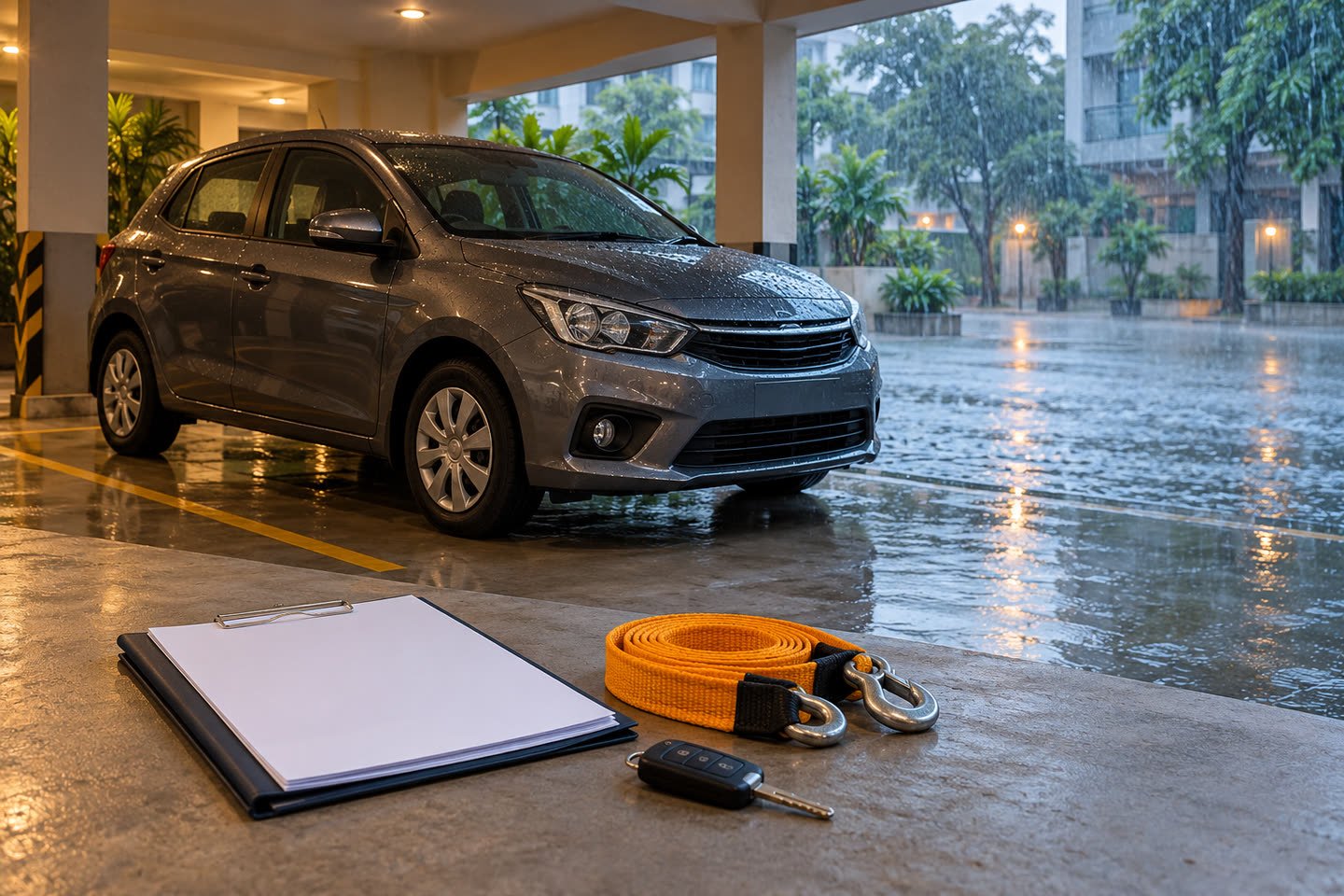
Sudden rain and waterlogged roads can expose a gap in car insurance: eligible flood damage to the body may be covered, while water ingress or hydrostatic-lock engine damage often depends on a separate engine-protection add-on. The practical takeaway for Indian drivers reviewing cover on 26 Oct 2026 is to check the base policy, add-on wording and roadside-assistance limits before a claim is needed.
Key takeaways
- A comprehensive or standalone own-damage policy may cover eligible accidental damage caused by natural calamities, subject to the policy wording.
- Water entering the engine can be treated differently from damage to the body, cabin or other insured parts.
- Engine protection is an add-on, not an automatic feature of every comprehensive policy.
- Roadside assistance can help with a breakdown or towing, but service limits and exclusions depend on the selected plan.
- Do not restart a car that has stalled in water; arrange professional assistance and notify the insurer.
Why sudden rain changes the insurance question
A current Business Today report on 26 Oct 2026 highlighted a problem many owners discover only after a flooded-road incident: the words “comprehensive cover” do not settle every question about water damage. A policy can cover eligible accidental damage from a natural calamity while treating consequential engine damage separately. The outcome depends on the policy schedule, exclusions, deductibles and any add-ons shown in the documents.
That distinction matters in Indian cities where a short, intense downpour can turn a familiar commute into a waterlogged stretch. A vehicle may suffer body or interior damage, need towing and later develop an engine problem. Those parts of the same incident can be assessed under different clauses. This is why a renewal check should focus on what the policy actually says, not only on whether it is described as “full” or “comprehensive”.
What the main add-ons do
Engine protection
Engine protection is designed to address a gap that can arise when water enters the engine or gearbox. The official insurer material reviewed for this report says the add-on may cover eligible repair or replacement costs for internal engine components and related parts, subject to the policy’s terms, conditions and exclusions. It is generally attached to a comprehensive or standalone own-damage policy rather than a third-party-only policy.
The wording matters. Check whether the cover refers to water ingression, hydrostatic lock, lubricating-oil leakage, gearbox damage and the relevant internal components. Also check eligibility, deductibles, claim limits and exclusions. Two policies can use the same add-on name while offering different conditions, so the schedule and wording should be treated as the controlling documents.
FuelPrice’s car insurance add-ons guide explains how engine protection differs from zero depreciation and other optional covers.
Roadside assistance
Roadside assistance addresses the immediate mobility problem rather than replacing the engine. Depending on the plan, it can coordinate help when the vehicle is stranded and may include towing to a garage. Business Today’s report noted that roadside assistance products can be offered for both internal-combustion and electric vehicles, but the services, distance limits and approved-provider conditions are plan-specific.
That means RSA should not be read as a promise that every flood-related repair will be paid. Its value is in the response after a breakdown: getting the vehicle to a safe location, following the insurer’s process and preserving evidence for the claim assessment.
Other add-ons solve different gaps
Zero depreciation, invoice cover, consumables cover and personal-belongings cover are listed separately from engine protection in the product material reviewed for this article. They should not be treated as substitutes for one another. A zero-depreciation clause does not automatically answer a water-ingress question, and an invoice-related cover does not automatically pay for an engine repair. The exact scope, age limits and exclusions must be checked in the policy documents.
What to check at renewal
Before renewing, keep the following checks together with the quote rather than comparing only the headline premium:
- Policy type: identify whether the document is third-party-only, standalone own-damage or a package/comprehensive policy.
- Water-damage wording: look for the treatment of flood, inundation, water ingress, hydrostatic lock, engine seizure and consequential loss.
- Add-on schedule: confirm whether engine protection and roadside assistance are included, separately priced or absent.
- Limits and exclusions: check deductibles, claim frequency, towing distance, garage conditions, vehicle age and any requirement to avoid further damage.
- Claim process: save the insurer’s notification channel and ask what inspection, photographs, bills and police or service records may be needed.
For a second comparison, readers can use FuelPrice’s car insurance renewal quote checklist to keep IDV, deductibles and add-ons side by side. The aim is to understand differences between quotations, not to assume that one label guarantees a particular settlement.
If the car stalls in water
- Do not crank or push-start the engine. Restarting after water exposure can worsen internal damage and may affect how the claim is assessed.
- Move occupants away from the hazard and call the insurer’s roadside or emergency assistance channel if it is safe to do so.
- Record the location and visible damage without entering unsafe water or opening components unnecessarily.
- Notify the insurer promptly and use the instructed towing or garage process before authorising dismantling or repairs.
- Keep the policy, towing receipt, survey documents and repair estimates together until the claim decision is complete.
What changes for Indian drivers now
The 26 Oct 2026 report is a consumer warning, not a new nationwide insurance rule. It does not make an engine-protection add-on compulsory, and it does not guarantee that every flood-related loss will be paid. The immediate change for a policyholder is awareness: a rain event can create separate body, towing and engine questions, each governed by different wording.
The useful cost comparison is therefore the total renewal premium against the limits and exclusions attached to the cover. A lower quote may have a different IDV, deductible, add-on schedule or towing limit. A higher quote may still exclude the exact event the owner is trying to protect against. Reading the schedule and the policy wording is more informative than relying on a “full cover” label.
The bottom line
Sudden rain can turn insurance terminology into a real repair and mobility question. Indian car owners should verify what their policy says about flood-related damage, engine water ingress and towing, and they should avoid restarting a stalled vehicle. The final decision on coverage rests on the insurer’s policy wording, the facts of the incident and the claim assessment.
Sources
- Business Today — Sudden rains, flooded roads: Which motor insurance add-ons can protect your car from expensive repairs? (26 Oct 2026)
- ICICI Lombard — Engine Protect Cover in Car Insurance (accessed 26 Oct 2026)
- IRDAI — Clarificatory note on damage to engine parts, gear box parts and transmission arising from ingress of water due to accidental means (official document page)
- ACKO — Summary of Add-Ons Approved by IRDAI (accessed 26 Oct 2026)
This article is for general information only and is not financial, insurance or legal advice.