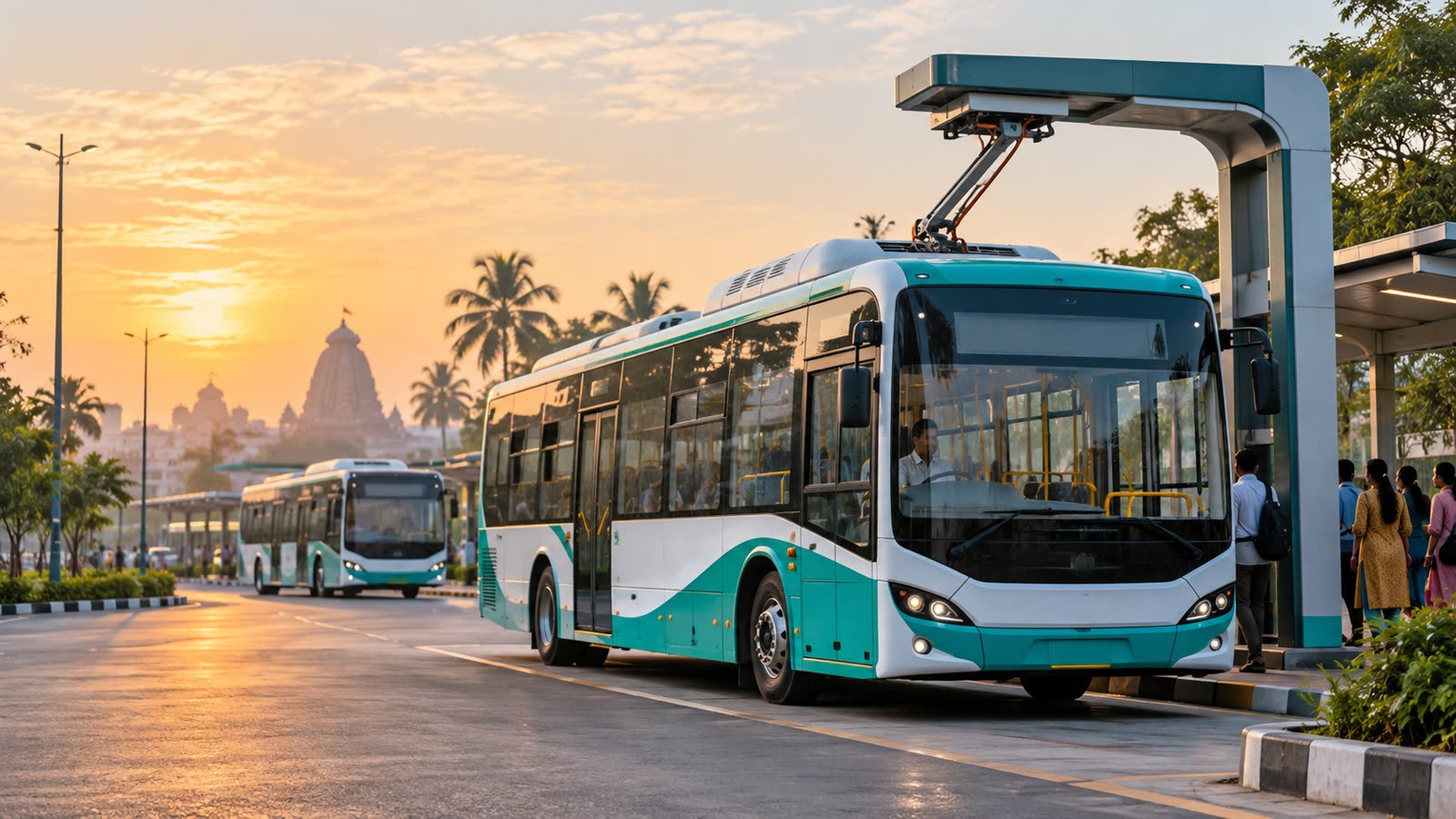
Odisha has flagged off 26 electric-bus services in Bhubaneswar under PM e-Bus Sewa, while the state plans a much larger fleet expansion for nine additional cities. The immediate change is a public-transport rollout, not a retail fuel-price move: commuters still need official route, timetable and fare information before treating the buses as a replacement for a current commute.
Reports by The New Indian Express and Prameya News say Chief Minister Mohan Charan Majhi flagged off the first services at the National Urban Conclave on 24 Oct 2026. The reports describe a plan for 400 electric buses, 100 midi buses and 50 mini electric buses, with Ama Bus coverage to extend beyond the existing Capital Region Urban Transport network.
Key takeaways
- The reported first rollout covers 26 electric-bus services in Bhubaneswar.
- The larger plan combines 400 electric buses with 100 midi and 50 mini electric buses.
- Services are planned for nine additional cities: Baripada, Angul, Jharsuguda, Balasore, Jajpur, Rayagada, Jeypore, Bhadrak and Balangir.
- The announcement does not by itself publish every route, timetable, fare or charging-depot schedule.
What Odisha has announced
The 24 Oct event came as the Ministry of Housing and Urban Affairs closed the two-day Urban Mobility India Conference in Bhubaneswar. In its release, the ministry said the conference focused on integrated transport, first- and last-mile connectivity, sustainable public transport and the use of digital tools to improve mobility. It also highlighted the PM e-Bus Sewa programme as part of the wider urban-transport transition.
The local rollout numbers come from separate reports on the National Urban Conclave. The New Indian Express and Prameya News both reported that 26 electric-bus services were flagged off and that Odisha plans 400 electric buses, 100 midi buses and 50 mini electric buses. They also identified the nine additional cities that are expected to receive expanded Ama Bus coverage.
That distinction matters. A flag-off confirms the start of a defined batch of services; it does not mean the full 550-vehicle plan is already operating. The larger fleet will have to be delivered, assigned to routes and supported by depots, charging equipment, drivers and operating contracts.
What changes for passengers
For commuters in Bhubaneswar, the immediate question is practical: which corridors are served, how often the buses run, what they cost and whether the service is available at the time of the daily trip. Those details are more useful than the headline fleet size, but they were not included in the reports reviewed for this article.
For the nine cities named in the announcement, the rollout is a planned expansion rather than a guarantee that every route starts at once. Baripada, Angul, Jharsuguda, Balasore, Jajpur, Rayagada, Jeypore, Bhadrak and Balangir should therefore be treated as the next coverage areas to watch. City transport notices will need to establish the start date, route map, stop locations, ticketing method and accessibility arrangements.
What it means for fuel and EV users
Electric buses draw power from the grid rather than burning petrol or diesel on the route. That can reduce tailpipe emissions on the corridors they serve, but the flag-off does not provide a quantified diesel saving or establish that retail fuel prices will change. The buses' wider effect will depend on whether people can use them reliably instead of private cars, motorcycles or diesel buses.
Depot charging is also different from public charging. An electric-bus depot may use high-capacity equipment and operating schedules that are not available to private vehicle owners. EV drivers planning an inter-city trip can use the state-wise EV charging directory to check public charging options, but should not assume that a bus depot is open to public vehicles.
The announcement does not change petrol, diesel or CNG rates. Motorists budgeting a current commute can check the live fuel prices page, while the fuel cost calculator can help estimate the private-vehicle cost of the same trip once the relevant route and distance are known. Those figures can then be compared with the actual bus fare when the operator publishes it.
Why implementation details matter
Electric buses can be cleaner at the point of use, but a dependable service requires more than vehicles. The state and its operating partners will need to coordinate grid connections, charging windows, depot space, maintenance, route scheduling and passenger information. If any one of those pieces is delayed, a vehicle allocation may not translate into more frequent service for commuters.
Reliability will also determine whether the rollout changes travel behaviour. A bus that connects a residential area to a workplace, college or railway station at predictable times can replace some private trips. A bus that is available only intermittently may add capacity without materially changing the fuel demand of the city. That is why route frequency, on-time performance and ticketing data will be more revealing than the announced procurement total.
What to watch next
- Official route and timetable notices for the first Bhubaneswar services.
- Deployment dates and route lists for the nine additional cities.
- Depot, charging and maintenance arrangements for the larger fleet.
- Fare, ticketing, real-time tracking and accessibility information for passengers.
The useful reader takeaway is straightforward: Odisha has a concrete first step in service, alongside a reported 550-vehicle expansion plan. The first batch may affect some Bhubaneswar commutes now, while the wider promise will be judged by phased deployment and dependable routes. Until those details are published, commuters should treat the plan as a development to monitor rather than an immediate change to every city journey.
Sources
- Ministry of Housing and Urban Affairs, “19th Urban Mobility India Conference and Exhibition 2026 concludes in Bhubaneswar with participation of around 1,500 delegates and experts” (24 Oct 2026)
- The New Indian Express, “Odisha eyeing 40% urbanisation, $500 billion economy by 2036: CM Mohan Charan Majhi” (25 Oct 2026)
- Prameya News, “National Urban Conclave: Odisha CM flags off 26 e-buses; 400 more in pipeline” (24 Oct 2026)
- Press Information Bureau, “PM-eBUS SEWA–PSM SCHEME” (10 Mar 2026)