The Centre has published a fresh update on the approved four-laning of the 82.57-km Muzaffarpur–Sitamarhi–Sonbarsa section of NH-22 in Bihar, linking Muzaffarpur with the India–Nepal border at Sonbarsa. The ₹3,590.73 crore Hybrid Annuity Mode project is expected to improve movement for local drivers, freight operators and cross-border cargo, but it is a planned upgrade—not an immediate four-lane opening or toll revision.
The project runs through Sitamarhi and is intended to improve the connection between Muzaffarpur’s link to NH-27 and the border-side transport network. For people using the route today, the practical point is that the latest announcement describes the infrastructure to be built; it does not announce a completed road, a new FASTag charge or a confirmed opening date.
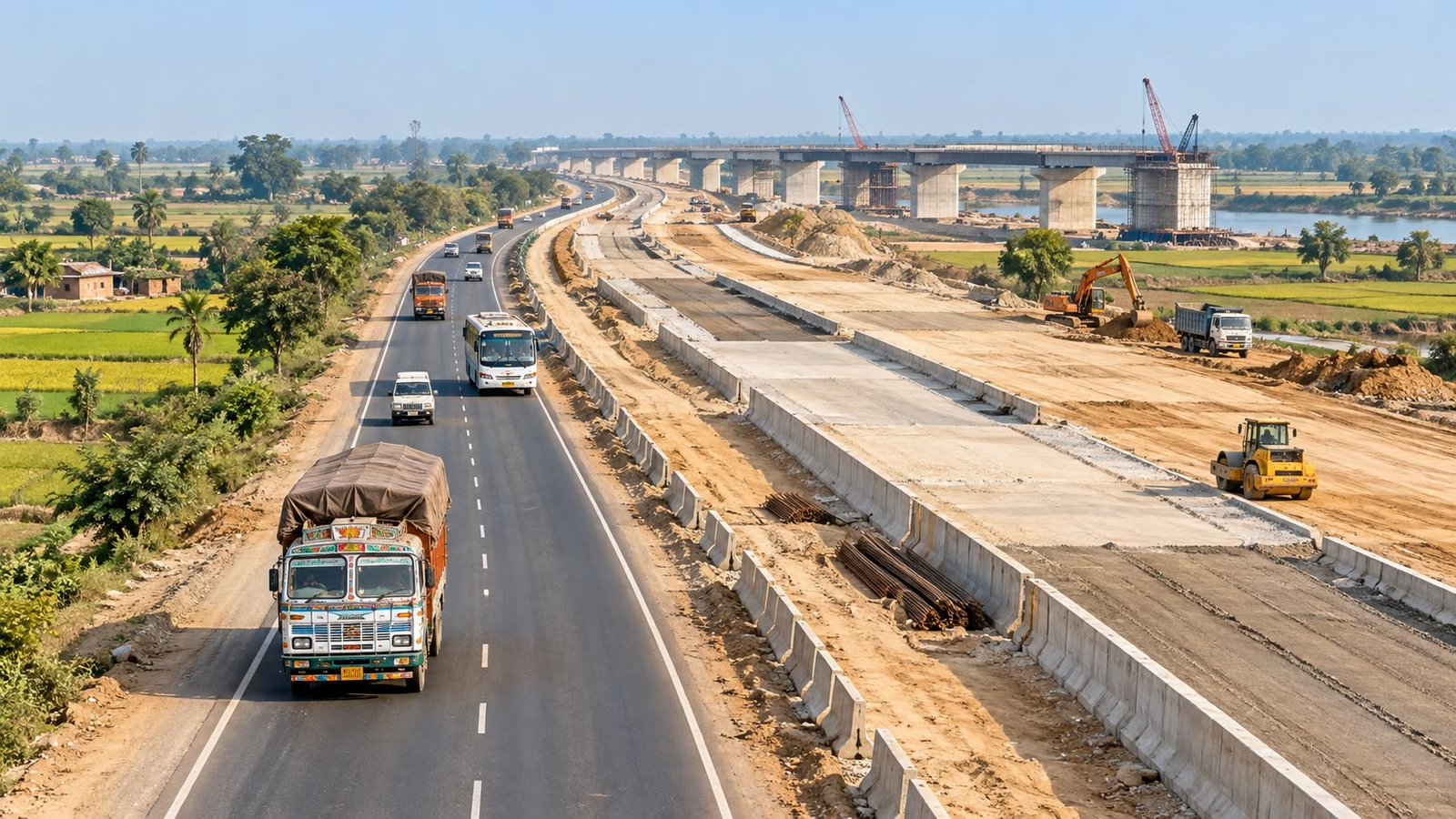
Image note: This is an illustrative visual of highway widening, not a photograph of the NH-22 project.
Key takeaways
- The approved plan covers 82.57 km from Muzaffarpur through Sitamarhi to Sonbarsa in Bihar.
- The stated capital cost is ₹3,590.73 crore, with the project structured under the Hybrid Annuity Mode.
- The design includes seven major bridges, three railway overbridges and two flyovers, including a 340-metre bridge over the Bagmati River.
- The planned road has a design speed of 100 kmph and an average operating speed of 80 kmph, with no at-grade median openings in the design.
- No new toll rate, live diversion plan or completed four-lane opening is announced in the fresh update.
What the 13 October update confirms
The Ministry of Road Transport and Highways, through the Press Information Bureau, said on 13 October 2026 that the corridor has been approved for four-laning. The Cabinet Committee on Economic Affairs approved the project in August 2026 at a total capital cost of ₹3,590.73 crore. The latest release is therefore a detailed project update, not a fresh approval announced for the first time.
The corridor is important because it links an economic centre at Muzaffarpur to Sonbarsa near the India–Nepal border. The government also identifies the nearby Bhithamore Land Port as a cross-border passenger and cargo connection. At Muzaffarpur, NH-22 connects with NH-27, part of the East–West Corridor. That combination gives the project relevance beyond local commuting: it can affect agricultural loads, industrial supplies, buses and long-distance freight once the upgraded section is available.
What is planned on the corridor
The government says the existing route passes through populated areas including Muzaffarpur, Muksudpur, Runni Saidpur, Thumma, Dumra, Bhutahi and Sonbarsa. The four-lane design is intended to add capacity and make movement more predictable. A 100-kmph design speed and 80-kmph average operating speed are design parameters, not a promise that every trip will run at those speeds. Weather, local traffic, construction activity, access points and enforcement will still affect actual journeys.
The planned structures are significant for drivers and freight operators. The package includes seven major bridges, including a 340-metre bridge over the perennial Bagmati River, three railway overbridges and two flyovers measuring 1,170 metres and 270 metres. These grade-separated crossings are intended to reduce conflicts at major river and rail intersections, but their user benefit will arrive only as the relevant construction and traffic arrangements are completed.
What it means for drivers and freight operators
Capacity improvement comes later
The official e-procurement record lists the NHAI tender for four-laning this Muzaffarpur–Sitamarhi–Sonbarsa section under HAM. A tender listing is a procurement step, not an operating notification. Until construction milestones, traffic-management instructions and an opening notice are issued, drivers should treat the existing route conditions as current and avoid assuming that the proposed carriageway is already available.
Fuel and trip costs may improve over time
The government expects the upgraded corridor to reduce travel time, improve fuel efficiency and lower vehicle operating costs. Those are stated project outcomes, not a guaranteed rupee saving for an individual car, bus or truck. The final effect will depend on the route’s actual operating speed, stops, traffic levels, toll arrangements and the vehicle’s mileage. For a current journey estimate, drivers can use the fuel cost calculator with the live route and vehicle assumptions rather than applying a projected saving.
Freight and border movement are central to the case
For fleet operators, the corridor’s value is tied to more than passenger travel. The official plan links the road with industrial estates, a Mega Food Park, railway stations and the Bhithamore Land Port. Better continuity could help produce and freight move more reliably between farms, processing centres, markets and border logistics points, but operators will need to reassess route times only after the construction phase and operating rules are clear. Travellers planning a Bihar route can use the road-trip planner to compare the current journey once verified road and traffic information is available.
What changes now—and what does not
- Confirmed: the 82.57-km corridor has an approved four-laning plan and a stated capital cost of ₹3,590.73 crore.
- Confirmed: the design includes major bridges, railway overbridges and flyovers, with no at-grade median openings described in the government release.
- Not announced: a new FASTag toll rate, a route-wide opening date, or a completed four-lane facility for immediate use.
That distinction matters for trip planning. A future highway upgrade can change travel time and toll calculations, but it should not be treated as a current price or route-status update. Before departure, users can check the toll-charge calculator hub for the route information currently available and look for official local advisories if work begins.
What to watch next
The next useful updates will be the tender award, construction-start information, work-zone and diversion plans, progress on the Bagmati and railway crossings, and any official notice on opening or tolling. Those updates will tell drivers when the project moves from an approved design to a change they can actually use.
Reader takeaway
For Bihar motorists, the NH-22 plan is a long-term capacity and connectivity story, not a live fuel-price or FASTag-fee change today. For freight operators, the proposed links to the East–West Corridor, industrial nodes and the Nepal-border logistics network could matter materially, but the route’s real time and cost benefits can be measured only after construction progress and operating details are confirmed.
Sources
- Press Information Bureau, “From Farms to Borders: NH-22 Four-Laning Project to Boost Connectivity and Economic Growth in Bihar” — 13 Oct 2026
- Government eProcurement System, “4-Laning of Muzaffarpur- Sitamarhi- Sonbarsa section of NH-22” — record accessed 14 Oct 2026
- Hindustan Times, “Union cabinet clears ₹3,591 crore project to widen Bihar’s NH-22 to four lanes” — 19 Aug 2026
- ETInfra, “CCEA Greenlights ₹3,591 Crore Upgrade of Muzaffarpur-Sitamarhi-Sonbarsa NH-22 in Bihar” — 19 Aug 2026