NHAI has tightened the specifications for metal crash barriers after flagging non-compliant installations on some of its highway projects, according to reports published on 28 Sep 2026. The update is aimed at future work and barriers still to be installed on ongoing projects, so it does not change toll rates, fuel prices or the rules for vehicles already on the road.
Key takeaways
- NHAI has made stricter metal-beam barrier specifications applicable to future projects and barriers yet to be installed on ongoing projects.
- Three-beam and W-beam barriers must meet stated thickness, steel-grade, spacing and galvanisation requirements.
- The change is a highway-construction and safety standard; it is not a new toll, vehicle document or speed-limit rule.
- Drivers should treat the barrier as one part of a safe road system, not as permission to drive faster or take risks.
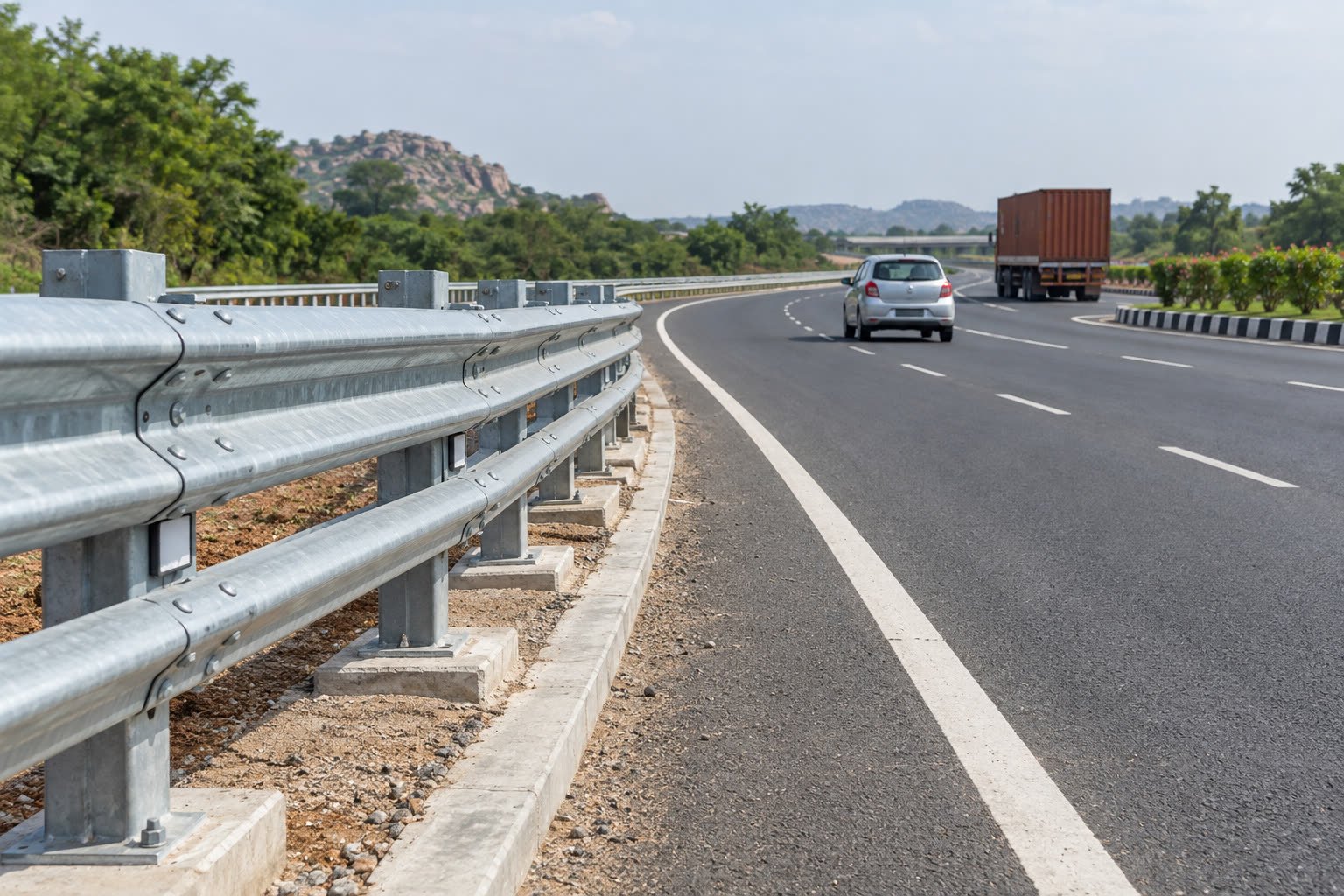
 Representational view of highway crash barriers. Credit: FuelPrice editorial illustration, AI-generated.
What NHAI has changed
Hindustan Times and NewsBytes reported on 28 Sep 2026 that the National Highways Authority of India issued a policy circular after finding that some project sites were not following approved barrier specifications and manufacturer installation methods. The reported update amends NHAI's 17 Dec 2024 policy on the approval and installation of metal beam crash barriers.
For three-beam barriers, the reported specification calls for a 3 mm rail and 3 mm steel posts. The blocking-out spacers and channel posts are to use a 75 mm by 150 mm channel section with 5 mm thickness, with posts installed at 2 metre centres and an overall post length of 2,100 mm. W-beam barriers also need a 3 mm rail and 3 mm steel posts, with the same 75 mm by 150 mm, 5 mm channel profile, 2 metre post spacing and 1,800 mm overall post length.
The reports also say NHAI has specified E350-grade steel conforming to IS 2062 (Part 1):2025. Posts, spacers and fasteners must be hot-dip galvanised with a minimum zinc coating of 0.55 kg per square metre. These are construction and quality-control requirements; they are not specifications that a private driver needs to measure on a routine trip.
Who is affected, and when
The reported circular applies to all future projects and to barriers that have not yet been installed on ongoing projects. That distinction matters. It does not announce that every barrier already installed across India's national-highway network will be removed and replaced immediately.
The responsibility falls first on concessionaires, contractors, manufacturers, authority engineers and road-safety auditors. They must check that the supplied material matches the approved design and that installation follows the manufacturer's method. For highway users, the benefit is expected to come over time as new or unfinished sections use more consistent barrier systems and as quality checks become easier to document.
NHAI's official 18 Dec 2024 release had already said that crash-barrier material should match the specification in the crash-test report and that installation should follow the manufacturer's method. It also described product identification, documented checks and site verification as part of construction accountability. The latest reported update adds more explicit dimensional and material detail to that safety-control approach.
Why crash-barrier quality matters to drivers
A metal beam barrier is intended to help contain or redirect an errant vehicle and reduce the chance of it crossing into a hazard, a drop, another carriageway or opposing traffic. Its performance depends on more than the visible rail. The steel, post depth and spacing, spacers, fasteners, end treatment, anchoring and installation geometry all affect how the system behaves under impact.
That is why a thinner rail or an incorrectly spaced post is not a cosmetic defect. A barrier can look complete while failing to perform as designed if the installed product does not match the tested system. The reported NHAI action is therefore relevant to car drivers, motorcyclists, bus passengers and freight operators even though it does not create a new action at the fuel pump or toll plaza.
There is also an important limit to the news. Better barriers cannot cancel out speeding, fatigue, wrong-side driving, unsafe lane changes or distracted driving. NHAI's road-safety messaging continues to place responsibility on both road design and road-user behaviour. A stronger roadside system reduces risk; it does not make a high-speed road forgiving of reckless decisions.
What changes now and what does not
For drivers, there is no announced change to a toll fee, FASTag balance, fuel price, registration document or national speed limit from this circular. A vehicle travelling on a highway today should follow the signs, lane markings, work-zone controls and speed limits already in force.
What changes is the standard that project teams must apply to specified metal barriers that are yet to be installed. The next useful evidence will be whether NHAI's regional offices, authority engineers and road-safety auditors show consistent compliance in project inspections, pre-opening audits and maintenance records. The circular improves the rulebook; implementation will determine the road-side result.
What highway users can do now
- Do not treat a new-looking barrier as a reason to increase speed. Keep a safe following distance and follow the posted limit, especially near curves, bridges and work zones.
- If a barrier is missing, visibly damaged or ends in an unsafe way, note the highway, direction, nearby kilometre marker and date, then report it through the highway operator's or NHAI's official grievance channel.
- Before a long drive, use the road-trip planner to review the route and likely work-zone areas, and use the toll-charge calculator to separate the safety update from the toll cost of the journey.
- For a trip budget, the fuel-cost calculator can estimate fuel use from distance and efficiency, but it cannot replace checking live road conditions or local diversions.
What to watch next
Watch for the full amended circular or further NHAI instructions on inspection records, approved barrier systems, end treatments and the treatment of defects found before installation. It will also be useful to see whether similar quality checks are reflected in state-highway contracts, although this reported update is an NHAI measure for national-highway projects.
The reader takeaway is straightforward: this is a reported tightening of how future crash barriers are specified and installed, not an immediate toll or vehicle-rule change. It matters because the safety of a highway is built into its roadside hardware as well as its signs and lanes. Drivers still need to control speed and attention, while project authorities need to ensure that the hardware installed beside the road matches the design on paper.
Sources
- Hindustan Times, “NHAI flags improper crash barriers, tightens highway safety standards” (28 Sep 2026)
- NewsBytes, “NHAI tightens Indian highway crash barrier standards after noncompliant barriers” (28 Sep 2026)
- Press Information Bureau, “NHAI Takes Steps to Ensure Adherence to Guidelines for Installation of Metal Beam Crash Barrier on National Highway” (18 Dec 2024)