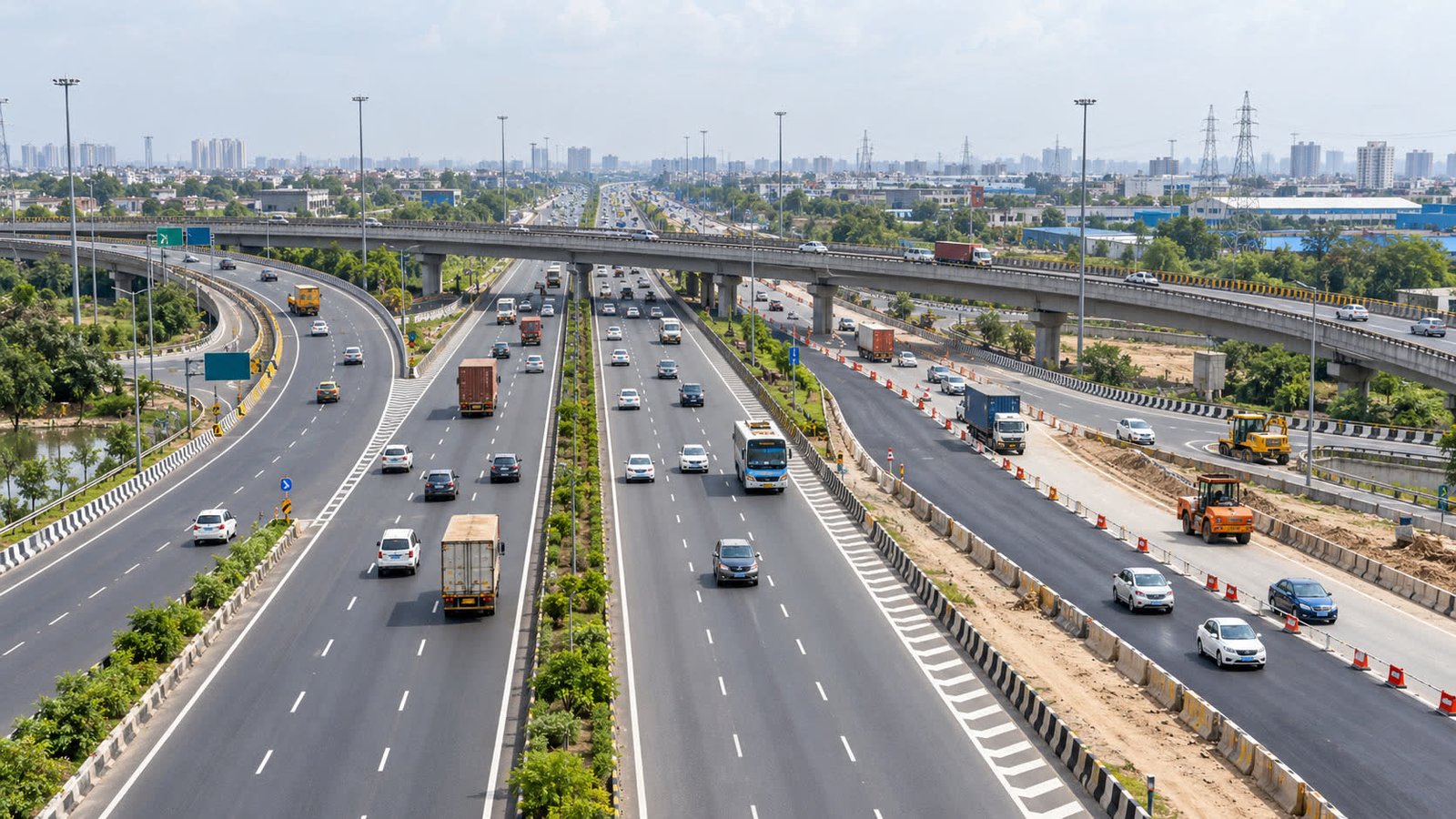
NHAI has widened the entry and exit approaches near ABES College where the Delhi-Meerut Expressway (DME) meets NH-9 in Ghaziabad, taking each approach from one lane to two. The Times of India and GTK reported the change on 18 Oct 2026; it is intended to reduce merging pressure for local commuters, industrial traffic and drivers using the DME–NH-9 connection.
For drivers, the immediate change is more space at the junction, not a new toll or FASTag charge. The wider approaches may reduce queueing at the bottleneck, but no verified time or fuel saving has been published, so route budgets should not assume a fixed saving yet. You can still compare a trip's fuel requirement with the fuel cost calculator and check the wider route in the road-trip planner.
Key takeaways
- Each reported entry and exit approach near ABES College has been widened from one lane to two.
- The junction is where NH-9 and the Delhi-Meerut Expressway converge near Ghaziabad's Ispat Nagar industrial area.
- The reports identify Sanya Vihar, Crossings Republik, Dundahera and Vijay Nagar commuters as likely beneficiaries.
- The current update does not announce a toll-rate, FASTag-validity or vehicle-eligibility change.
- Drivers should follow the new lane markings and allow for changing merge patterns while traffic settles.
What changed at ABES College
The widening applies to the approaches used by vehicles entering and leaving the DME–NH-9 junction near ABES College. The reported layout now provides two entry lanes and two exit lanes instead of one of each. In practical terms, vehicles joining the corridor from the local road and vehicles leaving the expressway should have a wider throat through which to merge.
An NHAI official told The Times of India that Ispat Nagar's industrial traffic and daily commuters were adding pressure where the arterial road meets NH-9 and the expressway. The report said the extra lanes are intended to improve movement on both sides of the expressway. GTK published the same two-lane configuration and the same local-benefit assessment in its separate account of the update.
This is a capacity improvement at a junction. It should not be read as a guarantee that the entire DME or NH-9 corridor will remain clear during peak hours. Queues can still form upstream, at downstream exits, at signals or where heavy vehicles and local traffic converge.
Why the junction matters to Ghaziabad traffic
The two current reports describe nearly 20 km of the DME and NH-9 corridor through Ghaziabad as carrying between 60,000 and 4 lakh vehicles, with regular tailbacks. Those are reported corridor-level traffic figures, not a promise of the number of vehicles present at the ABES approach at every hour.
The location also serves more than expressway through-traffic. The reports point to movement between Ispat Nagar and NH-9, with residents and workers from Sanya Vihar, Crossings Republik and Dundahera using one side of the junction and Vijay Nagar traffic using the other. That mix of local trips, freight movement and longer-distance travel explains why a short entry or exit approach can create a queue that spreads onto the main road.
The NHAI's completed-projects documentation confirms the Delhi–Meerut Expressway and NH-9 as part of the national-highway network in the corridor. The current widening is a local junction intervention within that larger network, rather than a new expressway opening or a change to the route's toll policy.
Which drivers may notice the difference
- Local commuters: Drivers travelling between Crossings Republik, Sanya Vihar, Dundahera and Vijay Nagar may find the entry or exit movement less constrained when traffic is flowing normally.
- Industrial and delivery traffic: Vehicles serving Ispat Nagar may have more room to merge, although large vehicles will still need to maintain lane discipline and allow for turning space.
- DME users: Drivers leaving the expressway near the junction should read the approach signs early and avoid a last-second lane change.
- Through-travellers: A smoother entry or exit does not remove the possibility of congestion elsewhere on NH-9 or the DME, so live traffic conditions still matter.
What to check before using the route
Drivers should treat the first few days of a changed road layout as a transition period. Check the approach signs before reaching the junction, use the lane that matches the intended exit, and do not cross the painted gore area to overtake a queue. If a queue is already forming, a longer alternative can sometimes be easier than forcing a late merge.
There is no reported change to the applicable toll amount or to FASTag use in this update. If the route is part of a longer trip, the toll-charge calculator can help separate the toll estimate from fuel cost. For a fuel budget, use the vehicle's realistic mileage and the latest rate shown on the live fuel prices page rather than assuming that a wider junction will automatically cut consumption.
What to watch next
The Times of India and GTK also reported that NHAI is constructing a six-lane road beginning near the Lal Kuan DME–NH-9 junction. The proposed road is intended to bypass the congested four-lane connection towards Noida and Aligarh and improve access towards the Noida airport through the Eastern Peripheral Expressway. The reports did not give a public opening date for that longer project, so it should be treated as future infrastructure rather than a route available today.
For the ABES junction itself, the useful test will be whether queues shorten during the morning and evening peaks after traffic adjusts to the two-lane approaches. A wider entry and exit can improve flow, but the result will also depend on markings, enforcement, downstream capacity and how heavy vehicles are channelled.
Reader takeaway
The ABES College junction on the DME–NH-9 corridor has received a reported lane-capacity upgrade: one additional lane at the entry and one at the exit. Ghaziabad commuters and freight operators may see easier merging, but they should continue to follow on-road signs and check live conditions. The change is useful for route planning, while any time or fuel benefit should be measured after the new traffic pattern has stabilised.