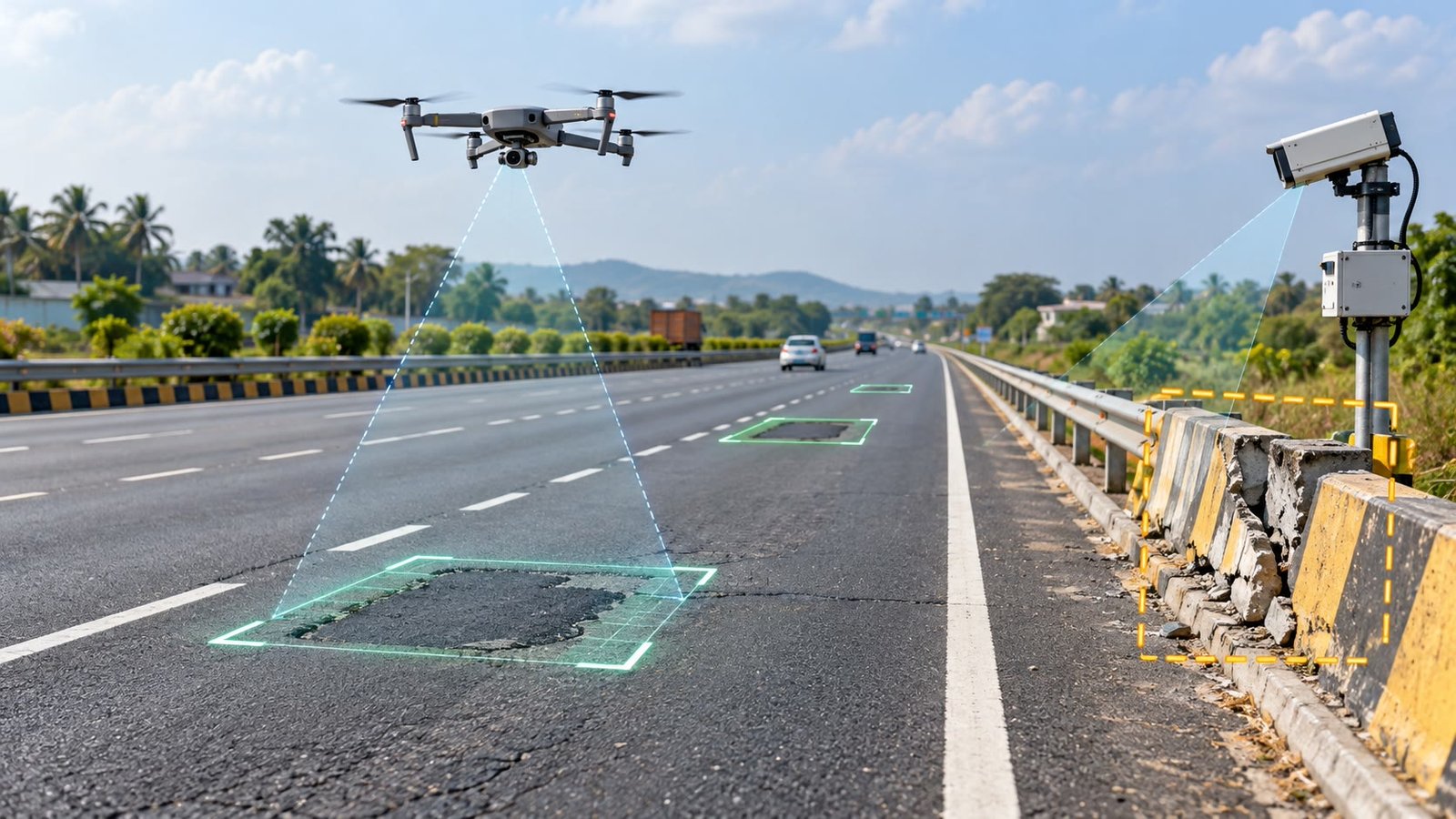
NHAI has outlined a proposed digital monitoring framework that would use webcams, drone surveys and automated defect detection to track highway maintenance, Business Today and PTI reported on 15 October 2026. For drivers, the development could mean faster identification of potholes, damaged barriers and faded markings if the system is implemented and repairs follow; it does not announce a new toll rate or FASTag rule.
Key takeaways
- NHAI has shown highway builders a reported framework built around webcams, drone surveys, automated defect detection and a live compliance dashboard.
- The National Highways Builders Federation (NHBF) wants stricter monitoring to be matched with realistic bidding and adequate operation and maintenance payments.
- The current reports describe an outlined or proposed monitoring approach, not an effective new rule for private motorists.
- For road users, the possible benefit is earlier detection and repair of defects; there is no direct change to toll charges or fuel prices in the reported development.
What NHAI has outlined
According to Business Today, the NHAI Chairman presented NHBF members with an advanced digital monitoring framework for highway maintenance. The proposed system is intended to identify and quantify deficiencies, generate notices and track compliance timelines through a live dashboard. That would give agencies a central view of whether a reported problem has been examined and whether corrective work has progressed.
A separate PTI report carried by Rediff Moneynews also described the presentation to NHBF members and referred to webcams, drone surveys and automated defect detection. The two reports agree on the broad direction: NHAI is seeking more technology-led oversight of highway upkeep, while contractors are being asked to meet tighter performance expectations.
What is confirmed and what is still reported
NHAI has already publicly established the broader direction. Its March 2026 press release described an AI-powered dashcam programme for National Highway operations and maintenance, including image and video assessment, automated identification of defects and integration with the NHAI Data Lake.
The more detailed webcam-and-drone framework discussed in the 15 October reports should still be described as outlined or proposed. The reports do not provide an operational start date, a complete route list, a new motorist penalty or a change to toll collection. Until NHAI publishes implementation details, it would be inaccurate to present the reported workflow as a new nationwide obligation already in force.
Why this matters on an Indian road trip
The practical distinction is between detecting a defect and repairing it. A camera or drone can help locate a pothole, damaged crash barrier, faded lane marking, drainage problem or other maintenance issue, but road quality improves only when an agency has the people, materials, equipment and traffic-management arrangements to fix it. That is why the NHBF’s response matters alongside the technology announcement.
If the monitoring system is implemented consistently and repair follow-up is timely, drivers could see fewer avoidable slow zones, emergency diversions and rough sections on maintained highway stretches. This is a potential service-quality benefit, not a promise that every road defect will disappear or that travel time will automatically fall.
There is no direct trip-cost calculation to change yet. Toll charges remain governed by the applicable fee notification, while fuel use depends on the vehicle, route, traffic and driving conditions. Travellers can compare a route’s toll component with the toll charges calculator and estimate the fuel portion with the fuel cost calculator before leaving.
For journeys where road condition and possible diversions matter, the road-trip planner can help organise route options. Those tools answer the immediate planning question; the NHAI development is about whether road agencies can improve the reliability of the infrastructure behind the route.
Why builders are asking for different contract terms
NHBF has not rejected technology-led monitoring. Its position, as reported by Business Today and PTI, is that tighter scrutiny must be supported by contract terms and payments that reflect the real cost of keeping a highway serviceable. The federation referred to manpower, machinery, materials, pavement repairs, drainage upkeep, road furniture and safety installations.
The concern is that a monitoring dashboard can make deficiencies visible and create faster compliance notices, while a contractor may still be working under terms priced around the lowest initial bid. NHBF therefore wants highway contracts assessed across their full life cycle, with realistic bidding and adequate O&M provisions. It also says contractors will need stronger internal inspections, maintenance planning and a shift from reactive repairs towards preventive upkeep.
For motorists, this contractor debate is relevant because payment and contract design can affect how quickly maintenance work is mobilised. It should not be read as evidence that tolls will rise or fall. Any future fee revision, closure, diversion or user-facing rule would need a separate official announcement.
What to watch next
- An official NHAI notice or operating circular setting out the rollout, coverage and responsibilities.
- How automated defect notices are verified before a contractor is asked to act.
- The repair timeline, evidence requirements and escalation process for unresolved defects.
- Whether revised O&M payment terms accompany the tighter performance monitoring.
Until those details are published, the most accurate reader takeaway is simple: NHAI is moving toward more technology-led highway maintenance oversight, but the 15 October 2026 reports do not change how private motorists pay tolls or buy fuel today.
Sources
- Business Today — “Highway builders seek realistic bidding, higher O&M payments as NHAI tightens monitoring” — 15 Oct 2026
- Rediff Moneynews/PTI — “NHBF Urges Realistic Bidding, O&M Payments as NHAI Boosts Monitoring” — 15 Oct 2026
- NHAI — “NHAI to Introduce AI Powered Dashcam Monitoring System for National Highway Operations & Management” — 20 Mar 2026