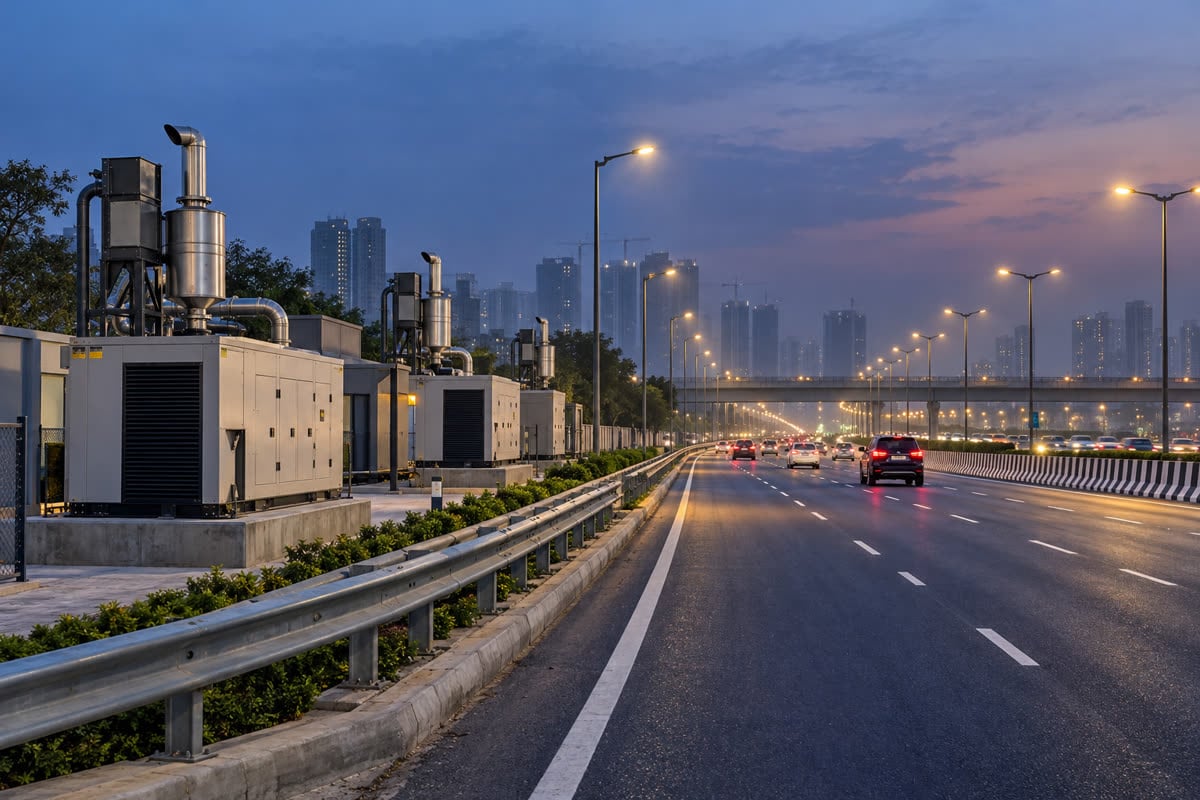
NHAI will install retrofit emission-control devices on 25 diesel generator sets used for lighting and related operations on Package IV of the Dwarka Expressway. The 9 Oct 2026 announcement is an air-quality compliance step for Delhi-NCR; it does not announce a toll increase, a FASTag rule change or a route closure.
Key takeaways
- NHAI plans to fit retrofit emission-control devices on 25 diesel generator sets serving the expressway infrastructure.
- The work covers the 8.7-km Package IV section between Basai and the Kherki Dhaula/Delhi–Gurugram Expressway cloverleaf intersection.
- Installation, testing, commissioning and maintenance support are part of the stated implementation plan.
- For drivers, this is an environmental-compliance update. The 9 Oct announcement does not change toll rates, FASTag balances or petrol and diesel prices.
What NHAI announced
In a 9 Oct 2026 release, the Ministry of Road Transport and Highways said NHAI will install Retrofit Emission Control Devices, or RECDs, on diesel generator sets deployed at Package IV of the Dwarka Expressway. The package is the section connecting Basai to the Kherki Dhaula interchange and the Delhi–Gurugram Expressway cloverleaf intersection.
The generators are used for expressway lighting and other associated operations. That detail matters because the announcement is about stationary equipment supporting a highway, not about changing the fuel or emissions system of cars, bikes, trucks or buses using the road. A same-day Dainik Jagran report from Gurugram also described the 25-generator installation and the 8.7-km package, providing an independent account of the project.
NHAI said the work will cover installation, testing and commissioning of the devices, with maintenance support after installation. It also plans to retain GPS-tagged photographs of each generator and its location as evidence for verification and compliance. The release did not give a completion date or a separate traffic-management schedule.
Why generator controls matter in Delhi-NCR
Diesel generators are a specific air-quality concern in the National Capital Region because they can be used as backup power across infrastructure, commercial and other sites. The Commission for Air Quality Management’s Direction No. 76, dated 29 Sep 2023, places the operation of DG sets in NCR under a regulated schedule and recognises measures such as RECDs and dual-fuel systems for controlling emissions.
NHAI’s announcement places the Dwarka Expressway equipment within that existing compliance framework. It also links the work to winter air-quality preparedness and the Graded Response Action Plan, when restrictions on polluting activities can become more important. The practical point for road users is that the equipment is intended to reduce emissions from the power systems supporting the corridor; it is not a new restriction on private vehicle ownership or a new fuel standard for vehicles.
What it means for people driving
The immediate benefit is environmental rather than a promised saving in rupees or travel time. Cleaner operation of generator equipment near the expressway can improve the local infrastructure environment, but the announcement does not quantify an emissions reduction and does not promise faster journeys. Drivers should therefore avoid reading the project as a toll discount, fuel-price change or congestion-control measure.
There is also no toll revision in the 9 Oct announcement. Anyone planning to use the corridor should check toll information separately through the toll-charge calculator, because an infrastructure-compliance project and a fee notification are different decisions. The same separation applies to trip budgeting: a fuel-cost calculator can estimate the fuel component, while the road-trip planner can help organise the route and stops.
The release does not say that traffic lanes will close during the installation. If contractors need access to a shoulder, service area or lighting equipment, any local traffic control should come through a separate NHAI, expressway operator or police advisory. Until such an advisory appears, there is no verified basis to tell commuters to expect a diversion because of the RECD work.
What changes now and what to watch
- Implementation: NHAI’s stated sequence is installation, testing and commissioning, followed by maintenance support. The announcement does not specify a public completion deadline.
- Verification: GPS-tagged photographs are intended to document the device installed at each generator location.
- Winter preparedness: The project is linked to CAQM’s DG-set controls and NCR air-quality management. Separate GRAP orders can apply to wider activities if air quality deteriorates.
- Driver planning: Watch official traffic advisories for any short-term work-zone control, and check toll and fuel information independently before a longer trip.
The reader takeaway
NHAI’s plan is a targeted pollution-control measure for the power equipment supporting one Dwarka Expressway package. It is relevant to people who travel through Delhi-NCR because better compliance can improve the operating environment around the corridor, but there is no announced change to toll collection, FASTag use, route access or vehicle fuel prices. Those costs and travel conditions should be checked through the relevant official updates and calculators before departure.
Sources
- Press Information Bureau / Ministry of Road Transport and Highways — NHAI to Install Retrofit Emission Control Devices on 25 DG Sets at Dwarka Expressway — 9 Oct 2026
- Dainik Jagran — NHAI initiative to install pollution-control devices on 25 generators on Dwarka Expressway — 9 Oct 2026
- Commission for Air Quality Management — Amendment to Direction No. 76 on regulated use of DG sets in NCR — 29 Sep 2023