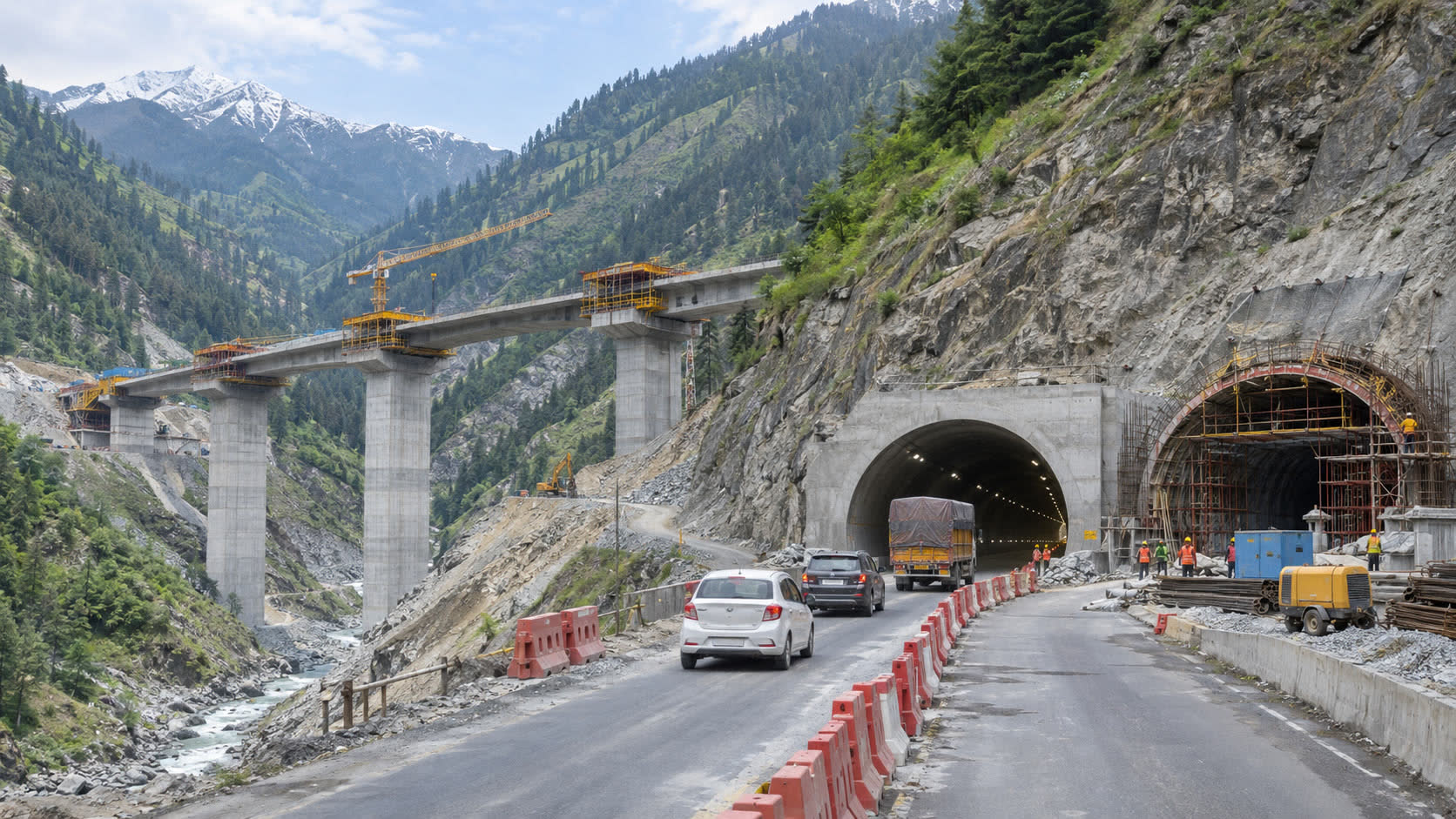
Ramban district administration has directed NHAI and executing agencies to make the Nachilana–Kishtwari Pathar viaduct and the second tube of Panthyal Tunnel operational by the end of November 2026. The direction followed a 21 Nov 2026 inspection of the Ramban–Banihal section of NH-44, but it is a target rather than a confirmed opening notice. Drivers should continue to plan for construction-related delays and changing traffic controls.
Image note: representative illustration of viaduct and tunnel works, not a photograph of the reported NH-44 project. Credit: FuelPrice editorial illustration.
Key takeaways
- The district administration’s 21 Nov 2026 update sets an end-November target for the Nachilana–Kishtwari Pathar viaduct and Panthyal Tunnel’s second tube.
- The target does not confirm that either structure is open; road users need a fresh traffic and road-condition update before travelling.
- The 23 Nov 2026 traffic advisory allowed two-way NH-44 movement subject to weather and road conditions, while warning of slow sections and mountain hazards.
- Private motorists should prefer daylight where possible, leave a time buffer and avoid treating a map’s normal journey time as a guarantee.
- Freight operators should check vehicle fitness, loading and any live restrictions before dispatching goods or tankers through the work zone.
What Ramban has asked agencies to do
During the 21 Nov 2026 inspection, Deputy Commissioner Mohammad Alyas Khan reviewed ongoing four-laning work along the Ramban–Banihal stretch with traffic, NHAI and executing-agency officials. The district administration said the review covered progress on key infrastructure intended to make movement safer and more reliable on the highway connecting the Kashmir Valley with the rest of the country.
The specific direction was to operationalise the Nachilana–Kishtwari Pathar viaduct and the second tube of the Panthyal Tunnel by the end of November 2026. The administration also called for essential commuter facilities, including passenger sheds and toilets, at designated locations. These instructions are important for the route, but they do not by themselves certify that construction, safety checks, traffic arrangements or approvals are complete.
That distinction matters to anyone planning a journey. A structure can have a target date while the connected approach road, traffic management or final safety work is still being completed. Until an official update confirms operational use, travellers should treat the two projects as planned improvements, not as currently available shortcuts.
Why the update matters to road users
The Ramban–Banihal section is a difficult part of the Jammu–Srinagar road corridor because traffic shares a mountainous route with widening work, narrow carriageways and exposure to shooting stones and landslides. Opening a completed viaduct or tunnel tube could remove a bottleneck, but the effect on travel time will depend on the full connected stretch being ready and on the day’s weather and traffic volume.
The latest practical position came from the J&K Traffic Police plan reported for 23 Nov 2026. It allowed passenger vehicles, private cars and goods-carrying heavy vehicles in both directions on NH-44 when weather and road conditions were favourable. It also recorded slow movement around a roughly 30–40 metre single-lane section at Dawal in Udhampur and another constrained stretch between Marog and Kishtwari Pathar.
For drivers, the message is not that the route is closed. It is that an open route may still include regulated movement, queues or a hold while traffic staff manage a work zone. The road-trip planner can help set a route and time estimate, but the estimate should include a margin for mountain-road conditions rather than being used as a fixed arrival promise.
What is still conditional on NH-44
The 23 Nov 2026 traffic update advised passengers and light-motor-vehicle operators to prefer daylight travel and avoid night journeys between Ramban and Banihal because of shooting-stone and landslide risks, ongoing construction and narrow sections. It also asked drivers to maintain lane discipline, avoid unnecessary halts in vulnerable areas and confirm the route status with the relevant traffic control unit before leaving.
This is especially important because traffic plans can change after rain, a rockfall, a vehicle breakdown or a change in work activity. A previous day’s screenshot or a message saying that two-way movement was allowed should not be treated as a live all-clear for the next departure.
Checks for freight and tanker operators
The 23 Nov 2026 advisory also described restrictions affecting Kashmir-bound oil and gas tankers on the Digdol–Khooni Nalla stretch during widening work. It said such tankers were restricted between 07:00 and 19:00, while up-bound tankers could proceed beyond Chenani only between 17:00 and 05:00, subject to the applicable clearance and road conditions. Operators should verify the current instruction before dispatch because these windows are tied to a dated traffic plan.
For goods carriers, a delay has a direct cost even when the toll or fuel rate has not changed. A longer queue can increase idling, driver-hours and the fuel reserve needed to reach the next reliable stop. The fuel-cost calculator can help estimate a revised trip budget, while the live fuel prices page provides current regional rates instead of an old pump-price assumption.
Before dispatch, operators should confirm the commodity and vehicle category, check fitness and loading, brief the driver on the permitted movement window and keep the traffic-control contact details available. Carrying sufficient fuel is particularly relevant on a route where a breakdown or an unplanned stop can add to congestion in a constrained section.
What motorists should do before leaving
- Check the same-day status. Confirm the latest J&K Traffic Police plan and the local traffic-control-unit update before starting the journey.
- Plan for daylight. The current advisory’s night-travel warning applies to the vulnerable Ramban–Banihal stretch, where construction and mountain hazards can change the risk quickly.
- Keep a time buffer. Use the route planner for the broad journey, then allow additional time for one-way regulation, queues and work-zone traffic.
- Do not assume the target date is an opening date. Wait for an official confirmation that the viaduct or tunnel tube is operational and that traffic has been moved onto it.
- Carry fuel and avoid unnecessary stops. A reserve helps when movement slows, while stopping near exposed or shooting-stone-prone sections can create an additional hazard.
What to watch next
The immediate checkpoint is the end-November 2026 target set during the district administration’s inspection. The useful follow-up will be an official confirmation of operational status, any revised traffic arrangement and whether the connected approach works are ready for ordinary passenger and freight movement.
Until that update arrives, the reader takeaway is simple: the viaduct and second tunnel tube may improve reliability on NH-44, but the reported target does not remove today’s need to check the road, plan for delay and follow traffic staff through the Ramban–Banihal work zone.
Sources
- District Administration Ramban (official X) — NH-44 four-laning inspection and November-end operationalisation update — 21 Nov 2026.
- Greater Kashmir — DC Ramban reviews NH-44 four-laning works, directs early opening of key projects — 22 Nov 2026.
- J&K Traffic Police (official X) — Traffic Plan/Advisory for 23-11-2026 — 23 Nov 2026.
- Kashmir Life — Two-Way Traffic Allowed on NH-44, Commuters Advised to Travel During Daytime — 23 Nov 2026.