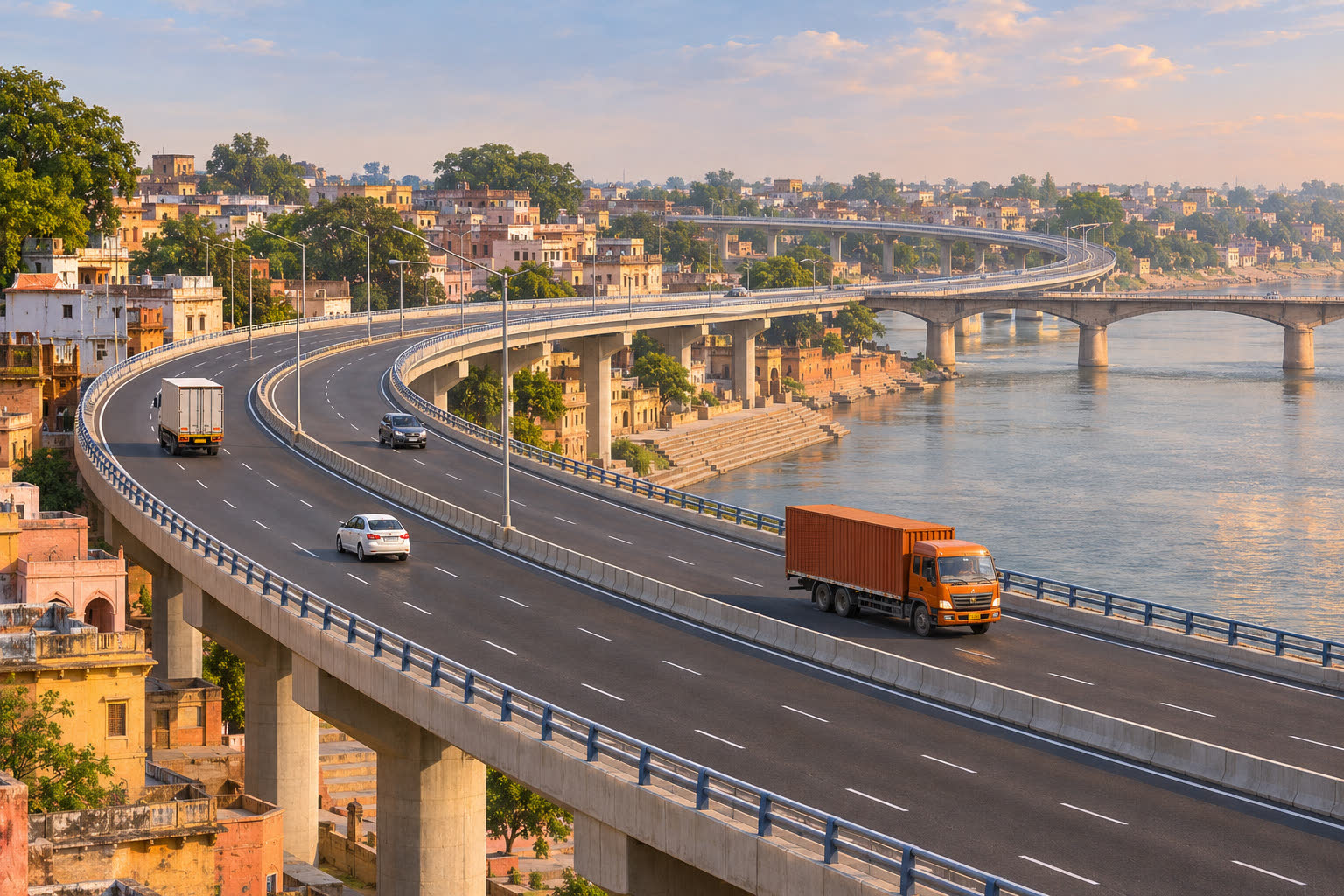
NHAI has received 32 bids across four packages for the proposed Ganga and Varuna elevated corridors in Varanasi, the Ministry of Road Transport and Highways said on 27 Nov 2026. The two projects together cover about 89.2 km and are designed to connect key national highways with the Varanasi Ring Road, but the latest update is still a bid milestone—not an opening date for motorists.
The ministry’s 27 Nov 2026 release, also reported by NDTV in a same-day report, gives the current package-wise bid count, route scope and project estimates. Those figures matter to residents, pilgrims, freight operators and anyone planning a Varanasi trip, but the proposed corridors should not yet be treated as available routes.
Key takeaways
- NHAI received bids for all four packages: 15 for the Varuna corridor and 17 for the Ganga corridor.
- The Varuna corridor is planned at 43.2 km with a 6/4-lane predominantly elevated design and a capital cost of ₹10,998.32 crore.
- The Ganga corridor is planned at 46 km with six lanes and a capital cost of ₹14,447.64 crore.
- The ministry’s travel-time reductions are project estimates. The latest bid update does not announce a construction completion date, opening date or toll tariff.
What changed on 27 Nov
NHAI divided the two corridors into two packages each. The Varuna project received eight bids for Package-I and seven for Package-II. The Ganga project received eight bids for Package-I and nine for Package-II. In total, 32 bids were received for the four packages.
That is a bid-response milestone, not a contract award. The latest release does not name the selected concessionaires or state when construction will begin. In practical terms, the projects have moved beyond the Cabinet approval and tender stage to the point where NHAI can assess the bids, but the timetable for award and construction remains to be announced.
The Cabinet Committee on Economic Affairs approved the two projects in July 2026. The Varuna approval covered a link between NH-31 and the Varanasi Ring Road, while the Ganga approval covered a link between NH-19 and the Varanasi Ring Road along the Ganga. The 27 Nov update concerns the response to the project packages rather than a new sanction.
How the two corridors differ
The project figures below come from the Ministry of Road Transport and Highways’ 27 Nov 2026 release and were cross-checked against NDTV’s same-day report.
| Project | Route and design | Capital cost | Stated travel-time estimate |
|---|---|---|---|
| Varuna Elevated Corridor | About 43.2 km from NH-31 to the Varanasi Ring Road along the Varuna; predominantly elevated 6/4-lane corridor | ₹10,998.32 crore | NH-31 to Kashi Railway Station: about 40 minutes to 20 minutes |
| Ganga Elevated Corridor | About 46 km from NH-19 to the Varanasi Ring Road along the Ganga; six-lane elevated corridor | ₹14,447.64 crore | Average project-area travel: about 60 minutes to 20 minutes; NH-19 to Kashi Railway Station: about 50 minutes to 25 minutes |
The two stated capital costs add up to about ₹25,445.96 crore. That is a calculation from the two official project costs, not a newly announced combined tariff or a payment that drivers will make. The Ganga plan also includes a 910-metre cable-stayed bridge and a 1.32-km extradosed foot-over-bridge-cum-major-bridge, along with loops, ramps, link roads and service roads.
What the plan could mean for drivers and freight
More capacity around a congested city
The proposed corridors are intended to separate more of the through and regional movement from local urban traffic. The Varuna alignment is planned to improve access to Kashi Railway Station, Varanasi Airport, Varanasi City Railway Station, Varanasi Junction, Deen Dayal Upadhyaya Junction, Ramnagar Port and Chandauli. The Ganga alignment is planned to connect NH-19, the Varanasi Ring Road, Ramnagar and BHU while improving access to the airport, railway stations and riverfront destinations.
For a private driver, the benefit would come only after a usable section opens and the connecting ramps and service roads are functioning. Until then, today’s congestion, diversions and journey times remain the relevant conditions. The official operating-speed range of 80–100 km/h and the projected reductions to 20 minutes are design targets, not a promise about a current trip.
Potential logistics benefit, but no immediate toll change
The Ministry says the projects will improve links to logistics nodes and support movement of agricultural produce, industrial goods, construction material and minerals across eastern Uttar Pradesh. That could reduce time spent in urban traffic for some freight movements, but any fuel, operating-cost or delivery-time benefit will depend on the final alignment, access rules, construction schedule and actual traffic conditions.
There is no new FASTag charge, toll exemption or toll rate in this bid announcement. The release also does not state whether or when the completed corridors will carry a user fee. Drivers should therefore avoid treating the project cost or projected time saving as a current toll or fuel saving.
What changes now—and what does not
- Now: NHAI has a response from bidders for all four packages and can proceed with evaluation and the next procurement steps.
- Not yet: the corridors are not announced as open, and the latest release gives no completion date or traffic diversion schedule.
- Still to watch: package awards, construction start notices, detailed traffic-management plans, opening dates and any future toll notification.
What to check before a Varanasi trip
For a trip today, use the current route rather than the proposed corridors when estimating time. The toll-charge calculator can help estimate existing toll costs, while the road-trip planner can help compare a route before departure. Drivers who want to budget the fuel leg can also use the fuel-cost calculator.
The useful trigger for a future route change will be an official opening or traffic notification, not the bid count alone. Until NHAI publishes that next stage, the Ganga and Varuna corridors are best understood as major planned capacity additions for Varanasi and eastern Uttar Pradesh.
Sources
- Press Information Bureau, “NHAI Receives Overwhelming Response from Bidders for Construction of Ganga and Varuna Elevated Corridor Projects in Varanasi”, 27 Nov 2026
- NDTV India, “Ganga, Varuna corridors draw 32 bids in Varanasi; projects to connect Kashi, DDU Junction and Chandauli”, 27 Nov 2026
- Press Information Bureau, “Cabinet approves development of 6/4 lane Elevated Corridor along Varuna River Bank ...”, 15 Jul 2026
- Press Information Bureau, “Cabinet approves development of 6 lane Greenfield Elevated Corridor ... between National Highway-19 and Varanasi Ring Road”, 15 Jul 2026