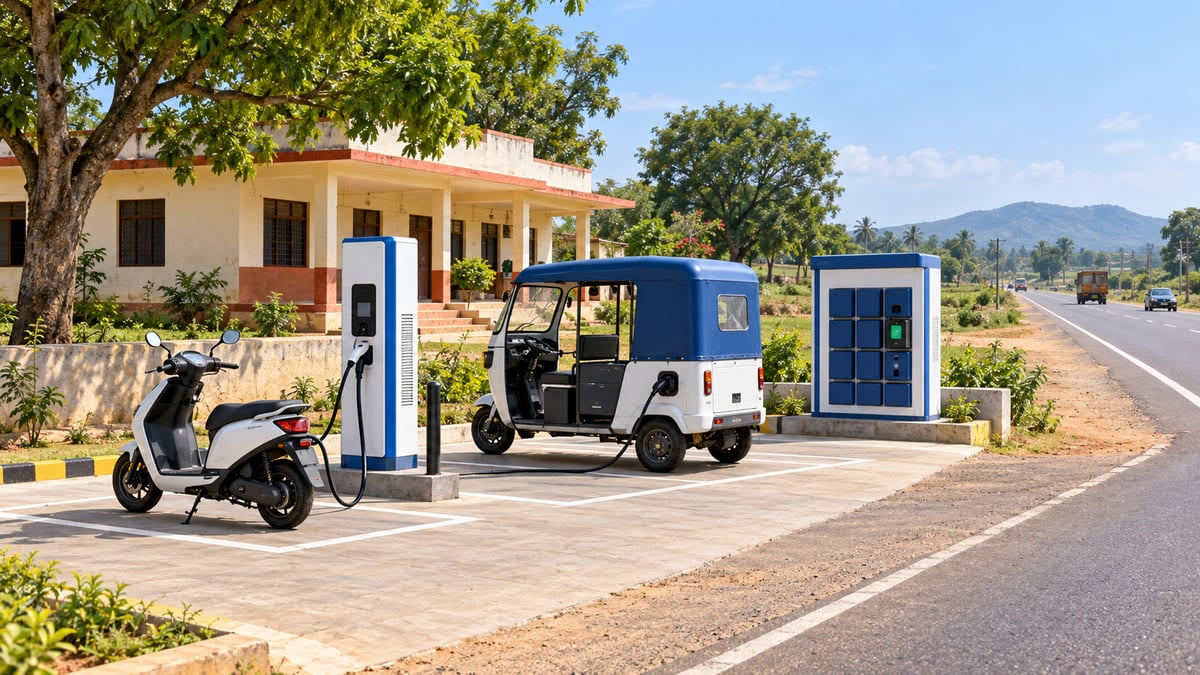
The Ministry of Panchayati Raj has signed a memorandum of understanding (MoU) with Convergence Energy Services Limited (CESL) to develop electric-vehicle charging and battery-swapping stations on suitable Panchayat land across India. Confirmed on 31 October 2026, the arrangement could widen access to charging on rural and highway routes while giving local bodies a potential source of recurring revenue; it does not yet announce a nationwide rollout date or a station count.
Key takeaways
- The Ministry of Panchayati Raj and CESL have signed an MoU for EV charging and battery-swapping infrastructure on Panchayat land.
- Possible sites include Panchayat premises and suitable locations along state and national highways.
- The plan is intended to serve electric two-wheelers, three-wheelers, cars and medium- and heavy-duty vehicles.
- State Panchayati Raj departments will help identify and monitor sites; CESL will assess, install, commission, operate and maintain the facilities.
- Rollout dates, the number of stations, charger specifications, user tariffs and payment arrangements have not been announced.
What the MoU confirms
The official announcement says the Ministry of Panchayati Raj and CESL have agreed to establish EV charging and battery-swapping stations on Panchayat land throughout the country. The proposed locations are not limited to government-office compounds: the plan also covers suitable sites along state and national highways. That gives the announcement a direct mobility angle because rural EV users, delivery operators and inter-city fleets often depend on dependable facilities outside large cities.
CESL is a wholly owned subsidiary of Energy Efficiency Services Limited (EESL), which operates under the Ministry of Power. Under the arrangement, the Ministry will coordinate with state Panchayati Raj departments to identify and monitor suitable sites. CESL will handle site assessment, demand aggregation, supply, installation, testing, commissioning, operation and maintenance. This division of work is important: the MoU sets a route for selecting and running facilities, but it is not itself evidence that a charger is already operating at a particular Panchayat.
Why this matters to EV drivers and fleets
Urban charging networks do not solve every long-distance or rural travel problem. A driver travelling between smaller towns may find a fuel station more easily than a compatible EV charger, while electric three-wheelers and commercial vehicles need locations that support regular working routes rather than occasional destination charging. A Panchayat-side site near a highway, market or transport hub could make charging more visible and convenient if the eventual equipment, power connection and operating hours match local demand.
Battery swapping could add a different option for compatible vehicles. Plug-in charging requires the vehicle to remain connected while energy is transferred; swapping depends on a standardised, compatible battery ecosystem and a stocked station. The public announcement does not specify which battery formats, vehicle models or swapping standards will be supported. Owners should therefore treat the inclusion of swapping as a planned facility type, not as confirmation that every EV will be able to use it.
Drivers planning an electric road trip can follow new locations through a state-wise EV charging station directory as facilities are actually commissioned. A road-trip planner can help map stops, but a route should not be treated as charger-ready until the station's live status, connector compatibility and access hours are confirmed.
What Panchayats may gain
The Ministry has presented the partnership as an opportunity to strengthen own-source revenue for Gram, Block and District Panchayats. In practical terms, Panchayat land could host a mobility service while creating a recurring income stream that may support civic services, local infrastructure or community welfare. Business Standard also reported that the infrastructure is intended to create additional revenue opportunities for rural local bodies across states and Union Territories.
That revenue is a stated objective, not a guaranteed return for every Panchayat. The amount would depend on the site, electricity connection, vehicle demand, commercial arrangement, operating costs and any applicable state or local rules. The Ministry has linked the initiative to the Model Panchayat Tax, Rates and Fees Rules, which are meant to support transparent and accountable local revenue mobilisation. The announcement does not publish a rent, revenue-share formula or minimum utilisation commitment.
What changes now—and what does not
The immediate change is institutional: Panchayat authorities and state departments have a confirmed framework to explore sites with CESL. The next practical steps are site identification, demand assessment, power and safety checks, equipment selection and local approvals. CESL's stated responsibility for supply, commissioning and maintenance suggests that Panchayats are not being asked to build and operate a network alone.
There is no published promise that every Panchayat will receive a station, and no public schedule says when users can begin paying to charge or swap batteries. The release also does not state charger power, connector types, tariffs, app or payment methods, uptime standards or a list of selected sites. Those details matter more to a driver than the signing ceremony, so they should be checked in later state, Panchayat or CESL announcements before a trip is planned around a new facility.
What EV owners and operators should watch
- Site lists: Look for state-wise or Panchayat-wise locations, highway access and the vehicle segments each facility is designed to serve.
- Compatibility: Check connector standards for plug-in charging and battery compatibility for swapping before relying on a station.
- Operating details: Confirm opening hours, payment method, contact support, safety arrangements and live availability.
- Cost: Wait for the applicable tariff or service fee rather than assuming that public land means free charging. For a petrol or diesel comparison on the same trip, use the fuel-cost calculator with a measured vehicle mileage.
- Commercial use: Fleet operators should check whether a site supports the vehicle size, charging duration and repeat demand of their routes.
Reader takeaway
The MoPR-CESL agreement is a confirmed step toward taking EV charging and battery swapping beyond major urban centres, with Panchayat land and highway locations in scope. For rural EV owners, the useful follow-up is not an assumed launch date but the publication of selected sites, equipment details, tariffs and live operating information. Until those details arrive, the MoU should be read as a framework for planned infrastructure, not as proof that a new charger is already available on a particular route.