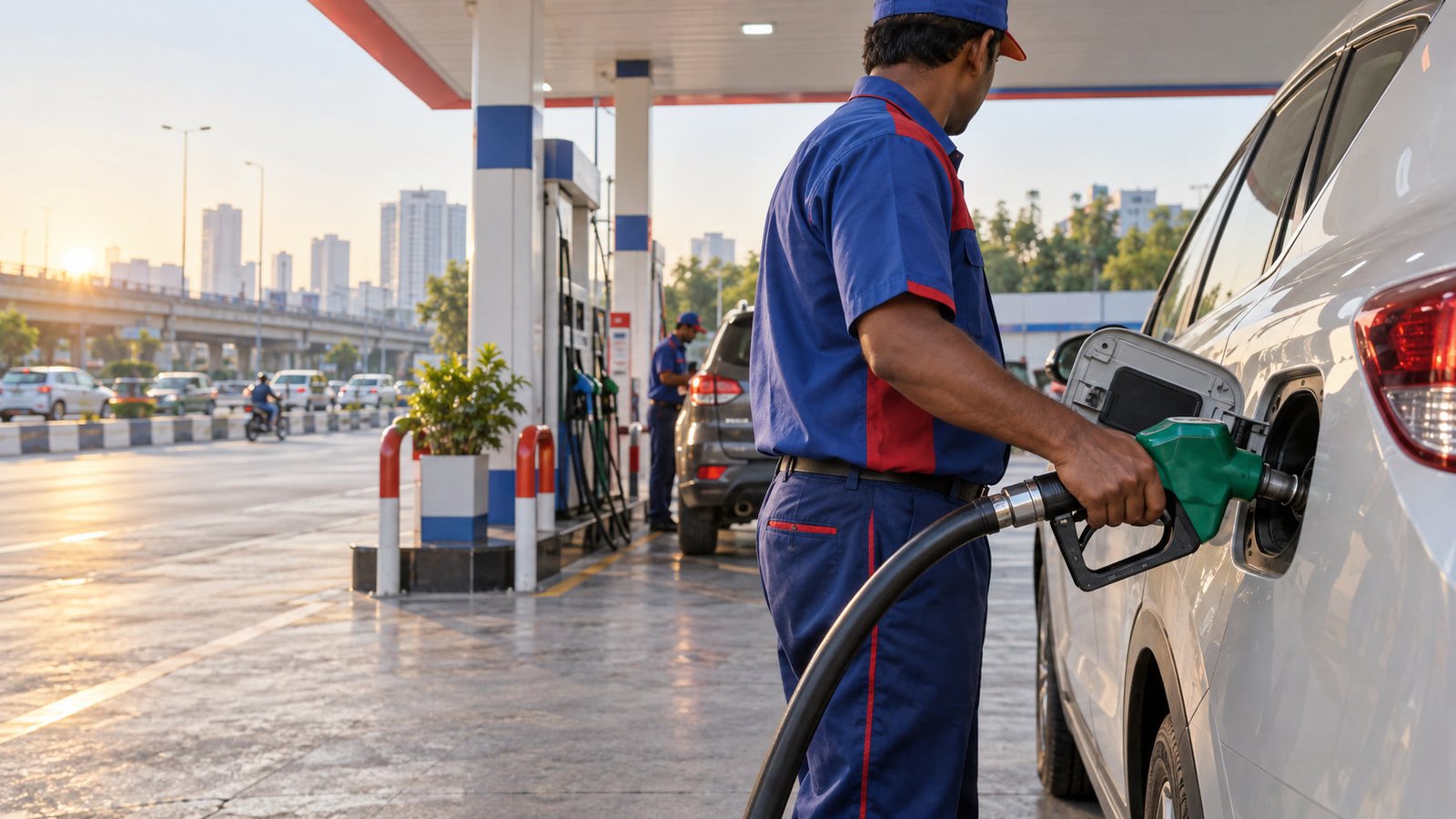
Petrol and diesel prices were unchanged across major Indian cities on 23 Sep 2026 even as Brent crude traded just below $100 a barrel. For drivers, the immediate result was no new day-on-day jump at the pump, but cheaper international crude has not yet translated into a nationwide retail cut.
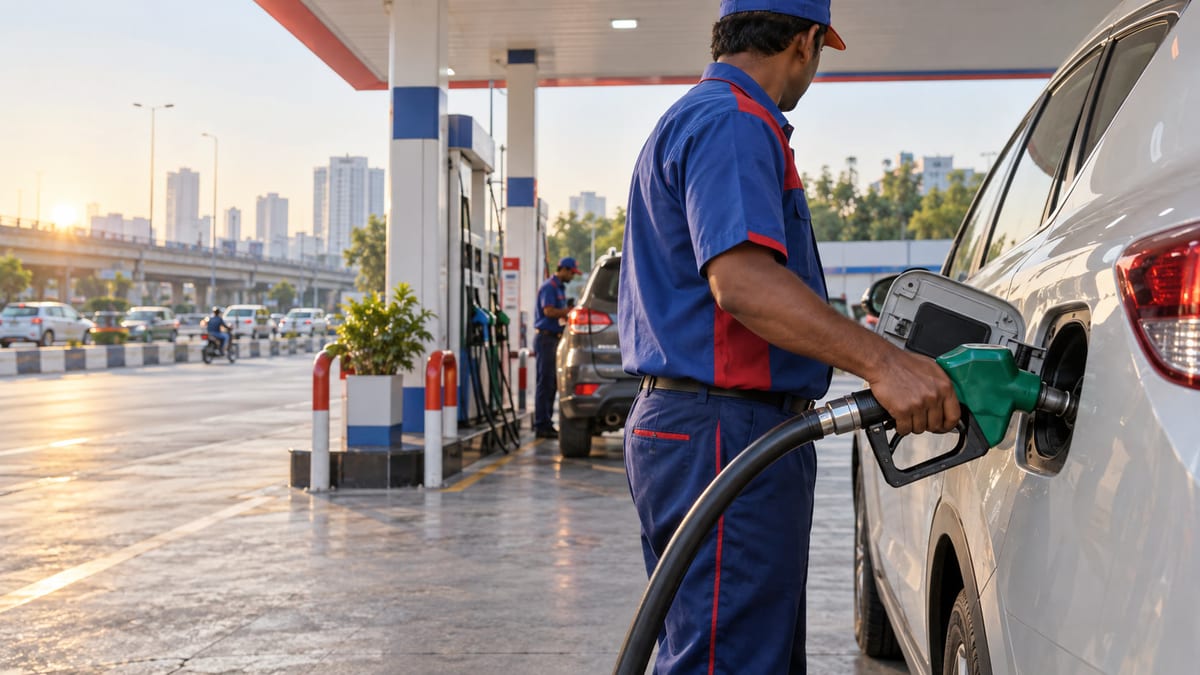 Fuel attendant refuelling a car at an urban Indian petrol station. Credit: FuelPrice editorial image, generated for this article.
Key takeaways
- Petrol and diesel rates held steady in Delhi, Mumbai, Kolkata and Chennai on 23 Sep, according to city-wise tables from Moneycontrol and Business Today.
- Delhi petrol was ₹102.12 per litre and diesel was ₹95.20 per litre; Mumbai petrol was ₹111.21 per litre and diesel was ₹97.83 per litre.
- Brent crude was reported at about $99.18–$99.20 per barrel in early trading, but crude is only one part of the pump-price calculation.
- IndianOil says retail petrol and diesel prices are revised at 6 am each day, so today’s unchanged rate does not guarantee tomorrow’s rate.
Petrol and diesel prices on 23 Sep
Moneycontrol and Business Today published matching petrol and diesel figures for four major cities on 23 Sep 2026. The snapshot below uses those repeated figures and records the reported day-on-day movement as unchanged.
| City | Petrol (₹/litre) | Diesel (₹/litre) | Change on 23 Sep |
|---|---|---|---|
| Delhi | ₹102.12 | ₹95.20 | Unchanged |
| Mumbai | ₹111.21 | ₹97.83 | Unchanged |
| Kolkata | ₹113.51 | ₹99.82 | Unchanged |
| Chennai | ₹107.76 | ₹99.55 | Unchanged |
There is a small source difference for Chennai petrol: NDTV Profit reported ₹107.77 per litre, while Moneycontrol and Business Today both reported ₹107.76 per litre. Because the latter figure is repeated by two independent reports, it is the figure shown in the table. Local pump displays and the latest city listing remain the final check before refuelling; the FuelPrice fuel-prices hub can be used to check the current rate for a city.
The government’s Petroleum Planning & Analysis Cell (PPAC) also lists Delhi’s retail selling price at ₹102.12 per litre for petrol and ₹95.20 per litre for diesel as of 21 Sep 2026. That primary record is consistent with the 23 Sep Delhi figures reported by the news outlets, while IndianOil’s official price page explains that daily changes take effect at 6 am.
Why a crude-price fall has not cut pump rates yet
Brent crude was around $99.18 a barrel in Moneycontrol’s early 23 Sep update and $99.20 a barrel in NDTV Profit’s report. Both outlets linked the recent easing in crude to better supply expectations, including the restart of Saudi Arabia’s East-West pipeline and increased movement through the Strait of Hormuz.
That global benchmark is not the same as the price paid by an Indian motorist. Retail fuel prices also reflect the rupee-dollar exchange rate, refinery and freight costs, dealer margins, and central and state taxes. A lower crude quote therefore improves the input-cost picture but does not automatically produce a same-day reduction at every pump.
OMCs also manage retail revisions against the wider market trend rather than reacting to every intraday move. A single morning’s Brent quote can reverse, and the companies have to account for the cost of crude purchased earlier, currency movement and local taxes. This is why a stable domestic price can coexist with a falling international benchmark.
What unchanged rates mean for a driver’s budget
For a simple illustration, a 20-litre petrol top-up at Delhi’s reported 23 Sep rate would cost ₹2,042.40 before any rounding, while the same quantity in Mumbai would cost ₹2,224.20. These are arithmetic examples based on the published rates, not a recommendation about how much fuel to buy.
For a 100-km trip, a vehicle returning an assumed 15 km per litre would use about 6.67 litres. At Delhi’s ₹102.12 rate, that works out to roughly ₹681 in petrol; the actual amount will vary with traffic, driving conditions, load and the vehicle’s real-world efficiency. Drivers can use the fuel cost calculator to replace that assumption with their own distance, mileage and city rate.
The important change for household and fleet budgets today is therefore stability, not relief. A commuter does not face an additional charge compared with the previous day in the four cities listed above, but the high absolute rate still matters over a month. For example, ten 20-litre top-ups at Delhi’s reported rate would total ₹20,424; the same pattern in Mumbai would total ₹22,242. Actual consumption will depend on the vehicle and usage.
What to check before the next fill
- Check the price for the exact city or district, because state taxes and local costs can create differences within a region.
- Check the time of the latest revision: IndianOil says the daily price cycle takes effect at 6 am.
- Separate fuel price from trip cost. Toll charges, traffic delays and vehicle efficiency can matter as much as a small movement in the pump rate; the road-trip planner helps map the wider journey.
- For a longer drive, enter the route and vehicle mileage in the trip fuel-cost tool rather than using a national average.
What to watch next
The next meaningful signal will be whether Brent’s decline persists and whether the rupee, refining costs and domestic tax settings move in the same direction. A temporary dip below $100 a barrel is not enough to establish a new Indian pump-price trend. Watch for the next 6 am OMC revision and compare it with the city rate shown at the pump.
For now, the practical takeaway is straightforward: petrol and diesel rates were stable on 23 Sep, but motorists should continue to check the local price and calculate the full cost of a trip rather than assume that a global crude move has already reduced their bill.
Sources
- Moneycontrol: Petrol, Diesel, CNG Prices Today, September 23: Did OMCs cut fuel rates as Brent slips below $99? Check city-wise list — 23 Sep 2026.
- NDTV Profit: Petrol, Diesel Prices On September 23: Check New Fuel Rates In Mumbai, Bengaluru, Chennai, Kolkata And More — 23 Sep 2026.
- Business Today: Petrol, diesel prices today, September 23: Check latest rates in Delhi, Mumbai, Chennai, Kolkata & more — 23 Sep 2026.
- PPAC, Ministry of Petroleum and Natural Gas: RSP of petrol and diesel in Delhi as per IOCL outlet — 21 Sep 2026.
- IndianOil: Petrol and Diesel Price — accessed 23 Sep 2026.