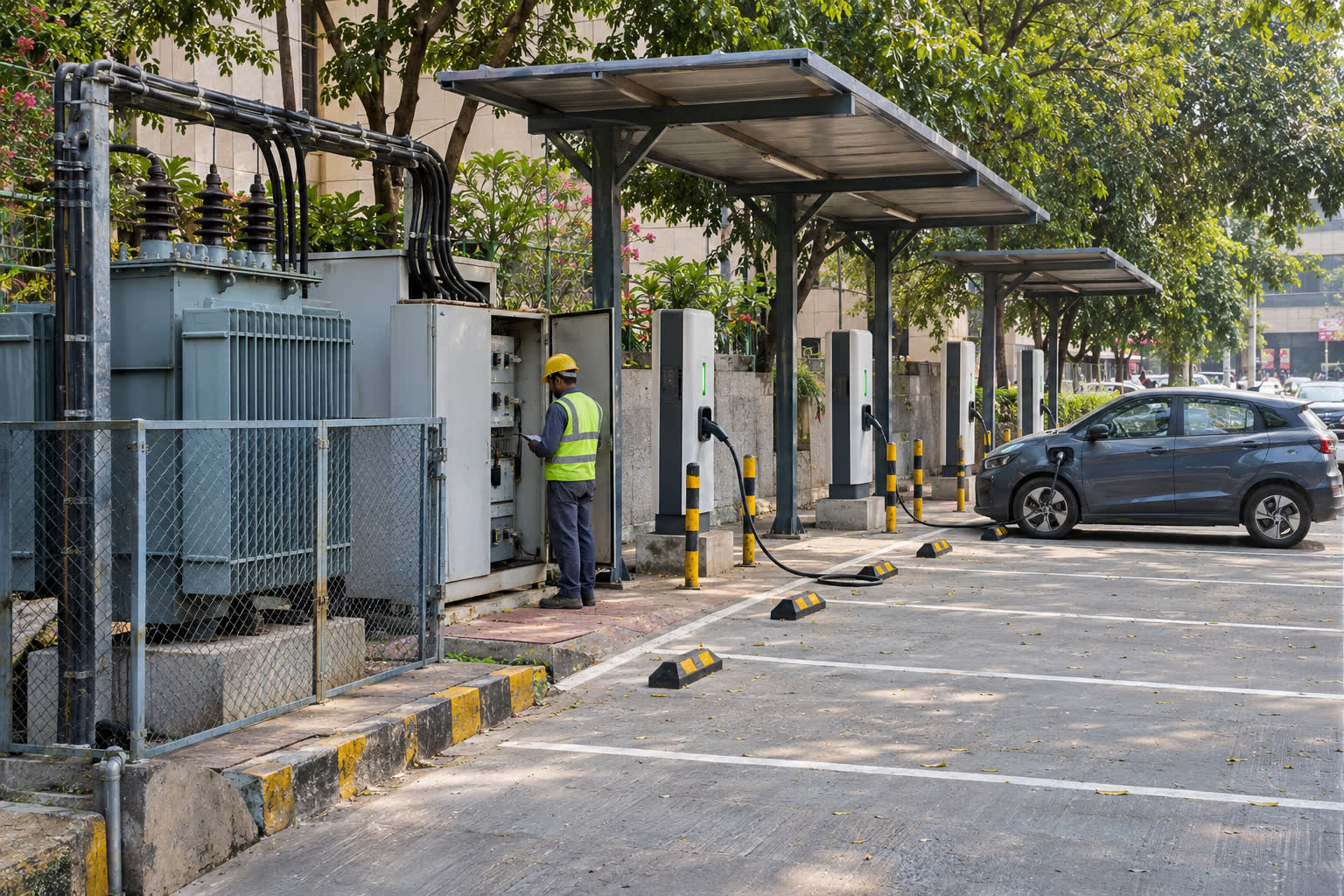
The Centre may consider another round of support for public EV charging if the present allocation is exhausted, but a PM adviser has also identified electricity-distribution connections as a bottleneck. Speaking at SIAM's EV Charging Day in New Delhi on 20 Nov 2026, Tarun Kapoor said coordination and connection costs at DISCOMs need attention; for EV users, the practical question is whether a charger is live and reachable, not just whether it appears on a map.
Key takeaways
- No new EV subsidy or charger mandate was announced at the event.
- PM E-DRIVE has ₹2,000 crore earmarked for nationwide public EV charging; the PIB said ₹851 crore had been approved for 8,147 chargers as of 28 Sep 2026.
- Kapoor said DISCOM coordination and high-capacity power connections can slow charger deployment.
- For buyers and fleets, charger uptime, payment, connector compatibility and route coverage are more useful checks than a headline station count.
What was said at the SIAM event
Kapoor's remarks came at the Society of Indian Automobile Manufacturers' first Growth and Readiness for EV Infrastructure Dialogue, held as part of its National EV Charging Day on 20 Nov 2026. The event page describes the dialogue as a forum on scaling investment, innovation and partnerships for India's charging network.
According to The Economic Times' PTI report, Kapoor said electricity distribution companies, or DISCOMs, can be difficult to coordinate with when charging operators seek new connections. He pointed to the cost of the electrical work behind the meter, especially for higher-capacity sites, and called for a dedicated contact in each DISCOM. The Tribune, quoting ANI, separately reported his statement that the government could provide more funds in a later phase if the current charging allocation is exhausted.
This is a policy signal, not a notified new rule for EV owners. The reports do not announce a new buyer subsidy, a new charging entitlement or a change to the way an EV is registered. The immediate issue is execution: getting suitable sites connected, keeping them usable and making the economics work for operators.
The funding is available; rollout is the test
The PIB's 1 Oct 2026 factsheet puts the total PM E-DRIVE outlay at ₹11,900 crore and says the scheme has been extended until March 2028. It earmarks ₹2,000 crore for public EV charging stations across India. The same factsheet says ₹851 crore had been approved, as of 28 Sep 2026, for 8,147 chargers through three oil marketing companies and 10 states.
That approval figure is not the same as a live-charger count. A site can remain unavailable while it waits for a sanctioned electricity connection, land clearance, equipment, software integration, maintenance or a viable operating model. For a driver who needs a top-up after work or on an inter-city trip, a working station at the right location matters more than a station that is only approved on paper.
Why reliability matters more than a station count
Kapoor also flagged low utilisation at some existing public charging stations, which can make maintenance difficult. That points to two linked problems: expanding the grid connection base and placing chargers where drivers, taxis, delivery vehicles and buses will actually use them.
A network with many lightly used sites can still leave gaps on a regular commute or highway corridor. Conversely, a smaller number of reliable, well-placed stations can deliver more practical value if they have functioning connectors, transparent payment, reasonable waiting times and predictable uptime. The Ministry of Heavy Industries' published EV charging guidelines also identify electricity connections and other regulatory clearances as major deployment challenges, while noting that low utilisation and high electricity tariffs can affect charging-operator viability.
What EV users and fleets can check now
For a private EV buyer, the useful check is route-level access rather than a national station headline. FuelPrice's state-wise EV charging directory can help identify the network around a regular city route, but the listing is only a starting point. Before relying on a site, check its current operating status, connector type, payment method, access hours and whether the location is practical for the vehicle.
For longer trips, the road-trip planner helps frame the route and stopping points. A driver comparing an EV with a petrol or CNG vehicle can also use the fuel-cost calculator to separate energy-cost assumptions from the separate question of whether charging is available when needed.
Fleet and charging-site operators have a different checklist. Their project cost has to include sanctioned load, transformer and upstream electrical work, land and permissions, software and payment integration, maintenance cover and the utilisation needed to keep the site open. The government funding can reduce some infrastructure costs, but it does not remove the need for a viable location or a dependable power connection.
What to watch next
The next evidence will be operational rather than rhetorical: whether approved chargers become live, whether DISCOMs publish clearer connection processes and timelines, and whether the Centre formally announces a new funding phase. State agencies, oil marketing companies and charging operators will also determine whether new sites are concentrated in high-demand urban areas or improve coverage on inter-city routes.
For now, the reader takeaway is simple: India's EV transition needs more than vehicle sales and charger announcements. Reliable electricity connections, functioning equipment and useful route coverage will decide whether an EV works smoothly for a daily commute, a commercial fleet or a road trip.
Sources
- The Economic Times — EV could become one of the largest sectors for power consumption, says PM advisor Tarun Kapoor — 20 Nov 2026
- The Tribune — Govt open to more funds for EV charging infrastructure if needed, says PM adviser Tarun Kapoor — 20 Nov 2026
- SIAM — SIAM EV Charging Day: 1st Growth & Readiness for EV Infrastructure Dialogue — 20 Nov 2026
- Press Information Bureau — PM E-DRIVE Scheme factsheet — 1 Oct 2026
- Ministry of Heavy Industries — Draft EVPCS Guidelines under PM E-DRIVE — July 2025