Prime Minister Narendra Modi on 2 Nov urged startups, IITs and entrepreneurs to build all-weather household solar systems that can also charge electric two-wheelers and cars. For Indian EV owners, the message is a fresh policy signal toward rooftop-powered charging, but the address was an appeal for innovation rather than a new national charger mandate or an announced change to vehicle-running costs.
Key takeaways
- PM Modi asked innovators to develop household solar models that can support cooking and home charging for electric scooters, bikes and cars.
- The idea connects rooftop generation, storage and EV charging, but it does not automatically change the rules for an existing EV owner.
- PM-Surya Ghar remains the relevant published rooftop-solar support scheme; its portal and current eligibility should be checked separately from the summit speech.
- Before estimating savings, households need to check parking, electrical capacity, solar output, charging timing, safety equipment and a public-charging fallback.
What PM Modi said on 2 Nov
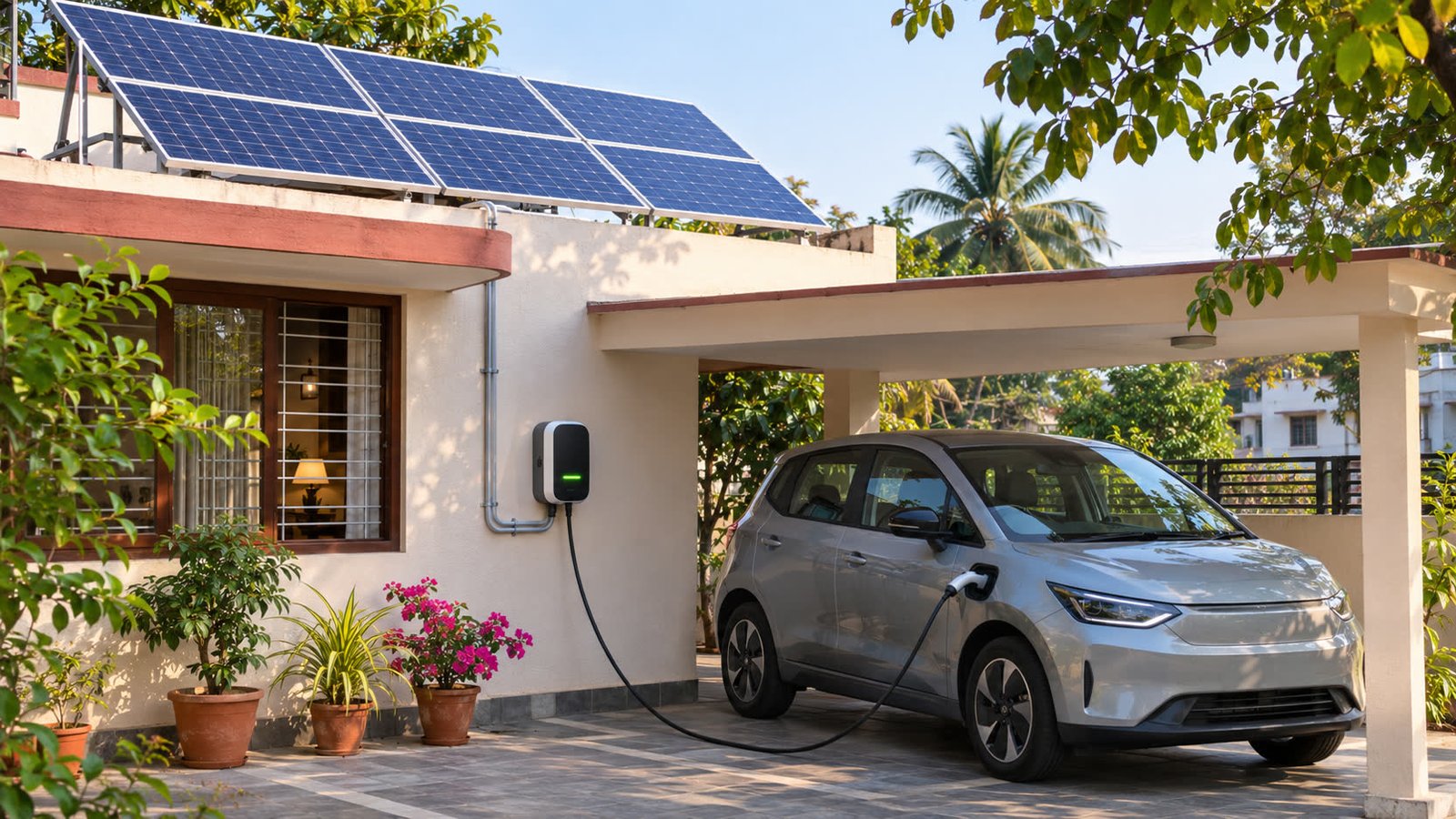
At the Bharat Renewable Energy Summit and Expo 2026 in New Delhi, the Prime Minister urged startups, IITs, innovators and entrepreneurs to design round-the-clock, all-weather solar models that meet more of a household's energy needs. The examples in the official account included rooftop solar cooking and charging electric two-wheelers and cars at home.
That wording matters. It describes a direction for technology and household energy use, not a rule requiring every home to install panels or every EV owner to fit a particular charger. The Prime Minister also linked the concept to energy security and said such systems could save middle-class families thousands of rupees every year. That is an attributed policy argument, not a guaranteed saving for every household.
What the message means for EV owners
Solar can reduce grid dependence, but the setup decides the result
An EV charged at home can draw power from the grid, rooftop solar generated during the day, stored solar energy, or a combination of the three. A driver whose car is parked at home while the panels are producing may be able to use more direct solar power. A driver who returns after sunset needs grid power or storage unless the charging schedule changes.
The useful calculation is not simply the size of the solar array. It is the vehicle's stated energy consumption multiplied by the distance driven, adjusted for charging losses and compared with the household's tariff and actual solar generation. Shade, roof orientation, weather, inverter performance, battery storage and local grid rules can all change the result. The Prime Minister's reference to round-the-clock and all-weather systems is therefore important: panels alone do not guarantee overnight charging.
For a petrol or diesel comparison on a regular commute, the fuel cost calculator can show how the assumptions change when distance, fuel efficiency and pump price change. It is a comparison tool, not a promise that solar charging will be cheaper for every home.
Public charging remains important for many households
Apartment residents, tenants and drivers without a dedicated parking bay may not be able to install a private charger or rooftop system. For them, public charging availability, charging time and access permissions remain part of the ownership decision even if rooftop solar expands.
FuelPrice's EV charging station directory can help locate the public-charging option that covers the gap between home charging and longer journeys. A charger shown on a directory is not a guarantee of live availability, so users should still confirm access, connector compatibility and payment terms before setting out.
Existing rooftop-solar support is the relevant context
The published national scheme connected to household rooftop solar is PM-Surya Ghar: Muft Bijli Yojana. The Cabinet approval dated 29 Feb 2024 set an overall outlay of ₹75,021 crore for rooftop solar in one crore households and described free electricity of up to 300 units per month for eligible households. Its published central financial assistance was ₹30,000 for a 1 kW system, ₹60,000 for 2 kW and ₹78,000 for 3 kW or higher, subject to the scheme's conditions.
Those are scheme-level figures, not a new EV-charger subsidy announced on 2 Nov. The Ministry of New and Renewable Energy said in its 2 Nov 2026 release that PM-Surya Ghar had crossed 65 lakh installations, and Moneycontrol separately reported the same milestone on 3 Nov. The installation count shows that rooftop solar is moving beyond a pilot, but it does not mean every solar household can charge an EV without a bill: vehicle charging adds demand, and the outcome depends on generation, timing, tariffs and the arrangement approved by the local distribution company.
The summit address also did not announce a nationwide deadline for home EV chargers, a compulsory rooftop installation, a revised central subsidy or a new net-metering rule. Households should use the official PM-Surya Ghar portal for current eligibility and application information rather than treating the speech as an approval notice.
What households should check before estimating savings
- Parking and wiring: confirm that the vehicle can be parked close enough to a safe charging point and ask a qualified installer to check the existing wiring, earthing, protection devices and sanctioned electrical load.
- Charging schedule: compare when the car is normally parked with when the rooftop system produces power. If those periods do not overlap, include grid charging or storage in the estimate.
- System design: ask how the inverter, charger, battery, backup circuit and protection equipment work together. The system should be designed around the household's real load, not just the vehicle's battery size.
- Approval and maintenance: check the state distribution company's process for rooftop interconnection, metering and any apartment or housing-society permission. Confirm who handles servicing and what is covered after installation.
- Trip backup: for longer journeys, map public chargers before departure and use the road-trip planner to check the route, stops and expected travel time.
What to watch next
The next meaningful development would be an official implementation document, not another broad statement. EV owners should watch for updates from the Ministry of New and Renewable Energy, the Ministry of Power, state distribution companies and the PM-Surya Ghar portal on charger standards, rooftop interconnection, apartment approvals, storage and tariffs.
Until those details arrive, the practical takeaway is simple: home solar charging is an option that may fit some households, not a nationwide requirement or a guaranteed saving. PM Modi's 2 Nov message is relevant because it puts EV charging inside the rooftop-solar conversation. The decision for an individual owner still turns on parking, wiring, daily usage, local electricity rules, system performance and access to public chargers.
Sources
- Prime Minister of India, “PM inaugurates Bharat Renewable Energy Summit & Expo 2026”, 2 Nov 2026.
- Press Information Bureau and Ministry of New and Renewable Energy, “Prime Minister Shri Narendra Modi inaugurates Bharat Renewable Energy Summit & Expo 2026”, 2 Nov 2026.
- Moneycontrol Hindi, “PM Modi's Solar Push: छत से बनेगी बिजली, पकेगा खाना, चार्ज होगी EV”, 3 Nov 2026.
- Prime Minister of India, “Cabinet approves PM-Surya Ghar: Muft Bijli Yojana for installing rooftop solar in One Crore households”, 29 Feb 2024.
- Moneycontrol, “PM Surya Ghar Muft Bijli Yojana: Check eligibility, rooftop solar subsidy of up to Rs 78,000 and how to apply”, 2 Nov 2026.