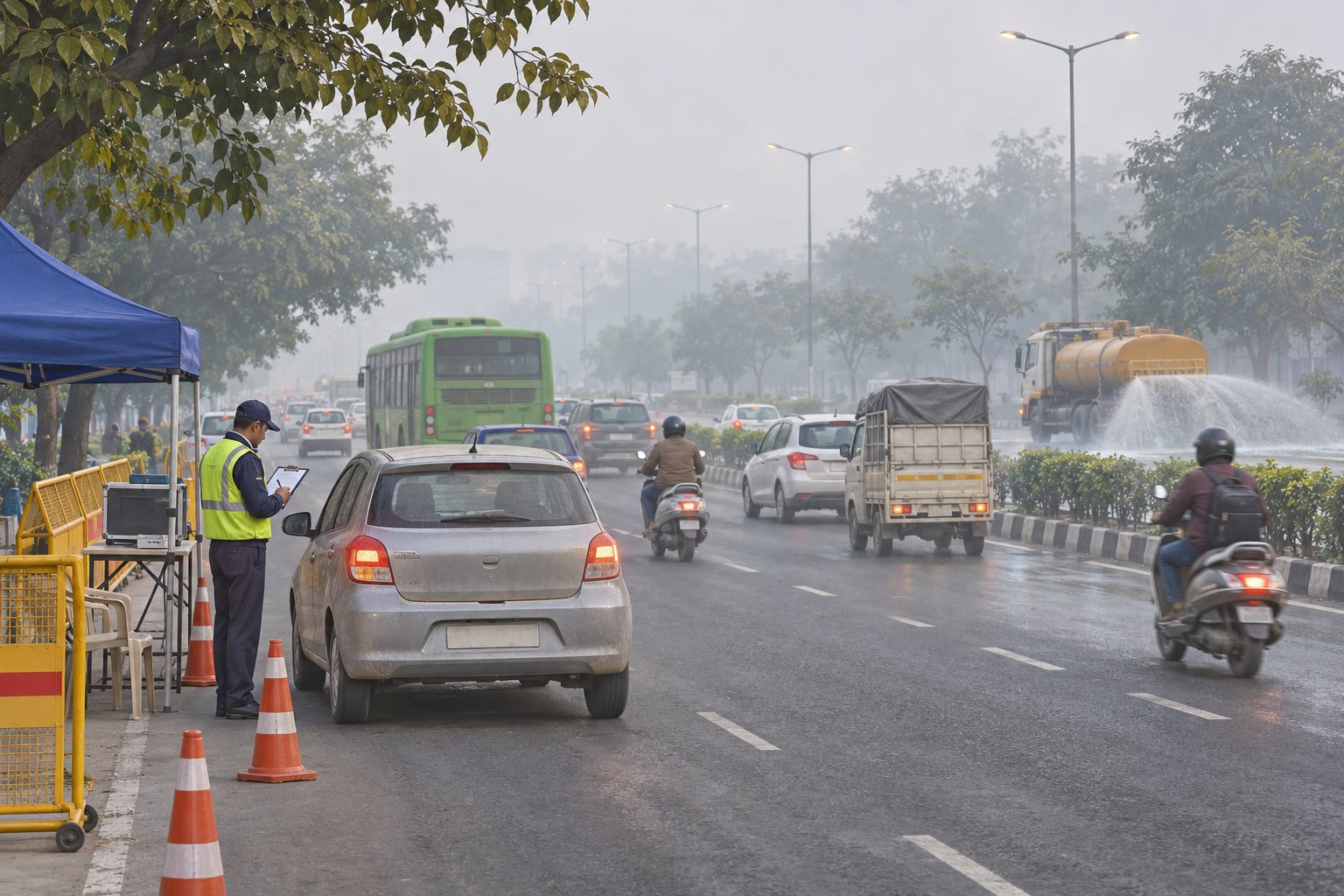
CAQM invoked Stage II of the Graded Response Action Plan (GRAP) across Delhi-NCR with immediate effect on 2 Nov 2026 after Delhi's AQI reached 324 at 4pm. For drivers, the immediate change is tighter enforcement of pollution and vehicle checks; it is not a fresh blanket ban on every petrol or diesel car.
Key takeaways
- GRAP Stage II is now active across Delhi-NCR after the capital entered the "very poor" air-quality band.
- Officials are intensifying checks for valid Pollution Under Control (PUC) certificates and visibly polluting vehicles.
- Road cleaning, water sprinkling, traffic management and higher public-transport availability are part of the response.
- The separate 1 Nov entry restrictions on non-BS-VI petrol and diesel vehicles registered outside Delhi continue to apply.
What changed on 2 Nov
Delhi's air quality deteriorated quickly at the start of November. Moneycontrol, citing the CAQM order and official data, reported that the city's AQI rose from 117 on 31 Oct to 261 on 1 Nov and then to 324 at 4pm on 2 Nov. Hindustan Times also reported that CAQM moved the entire National Capital Region to Stage II after reviewing forecasts from the India Meteorological Department and the Indian Institute of Tropical Meteorology.
Under the revised GRAP framework, Stage II covers the AQI range of 301 to 400, classified as "very poor". The Ministry of Environment, Forest and Climate Change said in its 29 Sep 2026 release that the revised schedule has eight actions under Stage II, alongside the measures that remain active from Stage I. The stage is an emergency response that can be reviewed as air-quality readings and forecasts change; it is not a permanent change to vehicle registration rules.
What drivers will notice
More PUC and vehicle-emission checks
CAQM's Stage II measures include stricter checking of valid PUC certificates and action against vehicles that are visibly emitting smoke. A valid PUC certificate matters, but it does not replace a vehicle's emission-standard requirement. Drivers entering Delhi-NCR therefore need to keep both the vehicle's compliance documents and PUC status in order.
The first day of the winter enforcement plan shows why border and road checks may take longer. Moneycontrol reported that, according to official data through 5pm on 1 Nov 2026, nearly 15,000 vehicles had been checked, 1,539 had been turned back at border points and 566 challans had been issued for PUC-related violations. Those figures describe the wider winter enforcement operation, not a prediction that every Stage II day will produce the same volume.
Dust control and traffic management
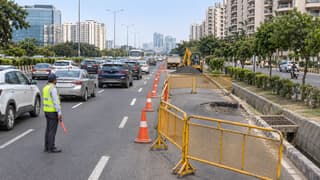
Agencies have been directed to intensify mechanical road cleaning, water sprinkling and the use of dust suppressants, especially on busy corridors and congestion points. Traffic police are also expected to manage busy intersections more closely. These measures can change traffic flow temporarily, so a familiar route may take longer even when no new toll or fuel charge has been announced.
The response also asks agencies to increase the availability of Metro, RRTS, CNG buses and electric buses where feasible, while offices have been encouraged to arrange shared transport. For a private-vehicle user, that means the practical impact of Stage II is more enforcement and possible congestion rather than an automatic order to stop driving.
Which vehicle rules remain separate
The 1 Nov winter entry rules are still the main restriction for vehicles crossing into Delhi. Petrol and diesel vehicles registered outside Delhi that do not meet BS-VI standards are barred from entering Delhi from 1 Nov 2026 through 31 Jan 2027, unless an official exemption applies. BS-VI-compliant, CNG and electric vehicles are exempt from that particular restriction, subject to the applicable documents and other rules.
These details are separate from Stage II. In practice, a valid PUC certificate does not make a non-BS-VI vehicle eligible for entry, and a BS-VI vehicle can still face action if its PUC certificate is missing or invalid. The earlier Delhi-NCR non-BS-VI entry rules article covers the vehicle categories and border restrictions in detail.
Interstate buses entering Delhi under the relevant permit categories must run on BS-VI diesel, CNG or electricity, while trucks travelling through Delhi to another destination are directed to use the peripheral expressways. Commercial operators should check the permit, emission category and route conditions before dispatch rather than treating a CNG or BS-VI status as a blanket exemption from every traffic control.
How to plan a Delhi-NCR trip now
- Check the PUC certificate, registration details and any permit documents before leaving. Keep the physical papers available or ensure the digital versions are accessible.
- Allow extra time for border checks, traffic diversions and road-cleaning activity. The FuelPrice road-trip planner can help compare timing and route options before departure.
- If a detour or longer queue changes the journey distance, use the fuel-cost calculator to compare the trip's running-cost effect. This is a planning estimate, not a prediction of the exact fuel consumed in traffic.
What to watch next
The next update will be whether CAQM keeps Stage II in force, revokes it as air quality improves or escalates the response if forecasts worsen. Drivers should watch the latest CAQM and Delhi traffic advisories before a time-sensitive trip, because the stage-based measures and the separate vehicle-entry rules can change on different orders.
Sources
- Ministry of Environment, Forest and Climate Change — CAQM Approves Revised GRAP Schedule; Tightens Measures for Vehicles, Dust and Pollution Control — 29 Sep 2026
- Moneycontrol — Delhi raises pollution curbs to ‘GRAP-II’ as air quality deteriorates — 2 Nov 2026
- Hindustan Times — GRAP-II pollution curbs imposed in Delhi-NCR as air quality dips further — 2 Nov 2026