At least eight roadside workers were killed and others were injured when a speeding car struck a group near Alisher village on Punjab’s Lehragaga–Jakhal road on 18 Oct 2026, according to police-based reports. The incident is still developing, and the reported toll ranges from eight to nine; for people using rural highways, it is a stark reminder to slow down at work zones and keep a clear buffer around roadside crews.
- The crash happened near Alisher village on the Lehragaga–Jakhal road in Sangrur district.
- Indian Express, The Tribune, News On AIR and a PTI report carried by ThePrint reported eight deaths, while an ANI update cited a nine-death toll.
- Reports said the vehicle was identified or abandoned at the scene and that the driver had left; police were searching for the driver.
- No confirmed route-closure or diversion notice was available in the reports reviewed, so travellers should check local traffic updates before leaving.
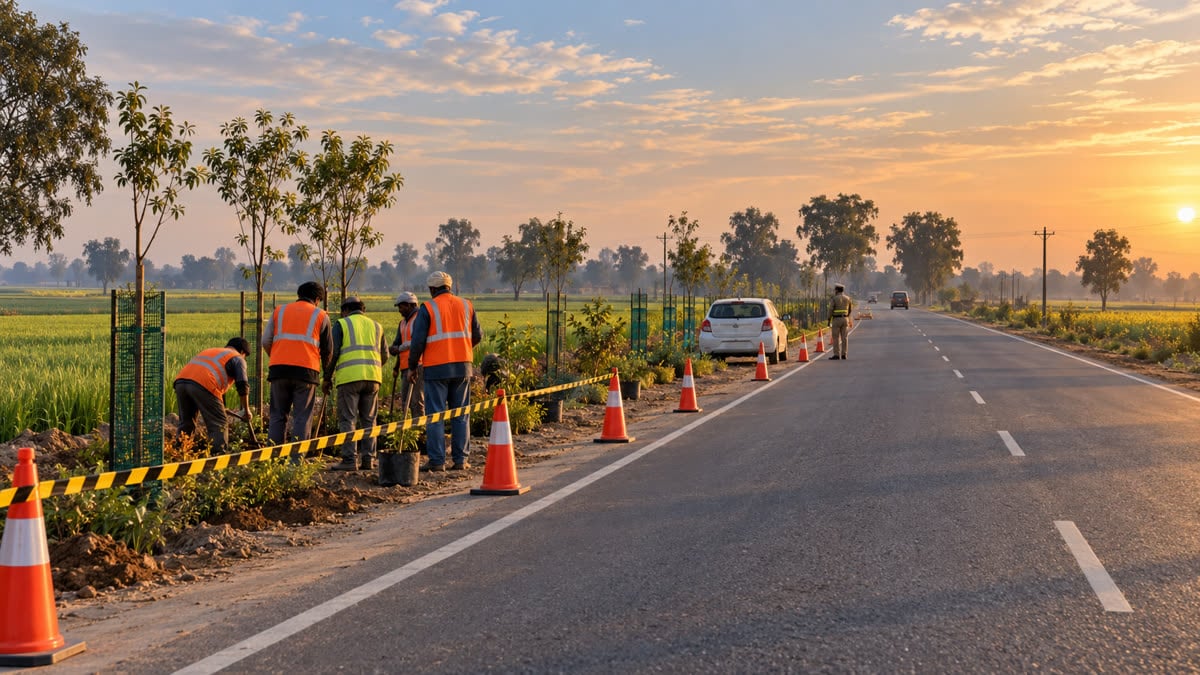
Image note: The hero is an illustrative road-work safety visual, not a photograph from the Sangrur incident.
What happened on the Sangrur road
The Indian Express reported that the car ran over roadside workers near Alisher village on Sunday, 18 Oct 2026, while they were taking a break after horticulture work. The Tribune placed the incident on the Lehragaga–Jakhal road and said the group included workers enrolled in a rural employment programme. Both reports said the car came from the Jakhal side and struck people sitting or working beside the road.
The details that are not yet settled matter just as much as the confirmed facts. The reports describe the vehicle as speeding or out of control, but they do not establish the full sequence of events or assign final responsibility. They also differ on the precise number of people injured and on how the vehicle was left at the scene. Those details should remain attributed until police and hospital records are consolidated.
News On AIR, quoting Sangrur Superintendent of Police Palwinder Singh Cheema, said the injured had been shifted to different hospitals, the vehicle had been identified and police would pursue the driver. The Tribune reported that the driver abandoned the car and fled. The Indian Express said the driver had not been arrested when its report was filed. Taken together, the confirmed position is that a police search was under way; the final legal status should be checked against a later police update.
Why the death toll is being reported differently
Early casualty figures changed as hospitals received injured workers. The Indian Express and The Tribune reported eight deaths. News On AIR also reported eight, and a PTI report published by ThePrint quoted the Sangrur deputy commissioner as saying eight workers had died. Separately, an ANI report carried by Asianet Newsable quoted the Lehragaga police station house officer as saying nine people had died.
That is a material conflict, so this article uses “at least eight” rather than presenting nine as settled fact. The final count should come from an updated police or district-administration statement after hospitals complete their records. The same caution applies to the injured count: news reports placed it at different levels, while all agreed that several people needed hospital treatment.
What this means for people driving the route
This is a road-safety incident, not a toll-fee, fuel-price or permanent route-change announcement. The reports reviewed do not establish a continuing closure of the Lehragaga–Jakhal road or publish a formal diversion. A driver planning to use the corridor should therefore check current local police or district traffic information before departure rather than assume that the road is either fully blocked or completely clear.
The larger lesson is the exposure of roadside work crews to ordinary traffic. A rural highway can look open and fast even when people, tools, plants or parked vehicles are close to the carriageway. A driver who sees cones, reflective clothing, a temporary barrier, a stopped vehicle or people working on the shoulder should treat that as a live hazard and reduce speed before reaching it.
Practical checks before and during the trip
- Plan for a lower speed as soon as warning cones, barricades or workers appear. Do not wait until the last few metres to brake.
- Keep a wide lateral gap from the shoulder and be ready for a worker, motorcycle or parked car to move unexpectedly into the lane.
- Avoid overtaking beside a work zone, especially where the opposite lane is carrying oncoming traffic or visibility is limited by dust, darkness or glare.
- Do not use a phone while approaching the work area. The extra attention needed to read the road is more important than maintaining normal cruising speed.
- If an incident has just occurred, slow down, leave room for ambulances and follow police instructions rather than stopping in the travel lane to watch.
For a longer journey, the FuelPrice road-trip planner can help organise the route and planned stops. Once the route is known, the fuel cost calculator can estimate the fuel budget; if a local diversion adds distance, update the route before relying on that estimate. The live fuel prices page can then be used to check the rate relevant to the planned trip. None of these tools is a substitute for a current police or district traffic advisory during a developing incident.
What to watch next
The next useful update should answer four questions: whether the casualty count is final, how many injured workers remain in hospital, whether the driver has been located and whether the administration has issued any route or work-zone safety direction. Those are the facts that can change the practical advice for travellers.
Until then, the responsible takeaway is simple. Treat roadside workers as a warning that the road environment has changed, slow down early and keep the shoulder clear. For drivers on the Sangrur corridor, the immediate priority is safe passage and current local information—not speculation about a final number that authorities have not yet reconciled.
Sources
- News On AIR: Punjab: 8 workers killed in road accident — 18 Oct 2026
- The Indian Express: 7 women among 8 killed, 10 critical as speeding car runs over workers by roadside in Sangrur — 18 Oct 2026
- The Tribune: 8 workers mowed down by speeding car in Punjab’s Sangrur; 13 injured — 18 Oct 2026
- ThePrint/PTI: Eight workers mowed down by speeding car in Punjab’s Sangrur; 12 injured — 18 Oct 2026
- Asianet Newsable/ANI: Punjab: 9 MGNREGA labourers killed as speeding car rams into them — 18 Oct 2026