Renault India CEO Stéphane Deblaise has said a combined hybrid and CNG share of up to 50% could be possible over the next two to three years, while stressing that Renault has set no formal powertrain target. The comments came after the company introduced the Duster Strong Hybrid in India, giving buyers a petrol-electric option that does not need an external charger.
This is a materially new development after FuelPrice’s earlier Renault Duster hybrid launch report: the important update is Renault’s wider view of how Indian buyers may split between petrol, diesel, hybrid, CNG and electric vehicles.
Key takeaways
- Renault India’s CEO said hybrid and CNG together could reach up to 50% over two to three years, but called it a possibility rather than a target.
- Business Standard separately reported that Deblaise expects strong hybrids eventually to reach at least the market share of CNG cars.
- Renault is positioning strong hybrids as a diesel alternative for larger vehicles and CNG as a stronger fit for smaller cars.
- The Duster Strong Hybrid uses a 1.8-litre petrol engine, two electric motors and a 1.4 kWh battery, with an ARAI-certified 29 km/l claim.
What Renault said about India’s powertrain mix
In remarks reported on 17 Oct 2026, Deblaise said hybrid and CNG could together account for up to 50% over the next two to three years. Autocar Professional attributed the statement to the Renault India CEO’s interview with the Press Trust of India, while Punjab Kesari published the same broad forecast in Hindi. The qualification matters: Deblaise also said Renault had not set a formal target.
Business Standard’s 18 Oct 2026 report used a more measured formulation. It said Deblaise expects strong hybrids eventually to command at least the same share of India’s passenger-vehicle market as CNG-powered cars, while noting that adoption will depend on the number of models offered and any government incentives. These are management views and expectations, not an official government forecast or a guaranteed sales mix.
Renault’s reported segmentation is also practical. Deblaise said hybrids are likely to play a larger role in vehicles longer than four metres, while CNG may have greater potential in the sub-four-metre segment. That reflects different buyer priorities: larger SUV users may value effortless long-distance driving and fuel efficiency, while compact-car users often focus on running cost and access to fuel stations.
Why the Duster hybrid is the immediate test
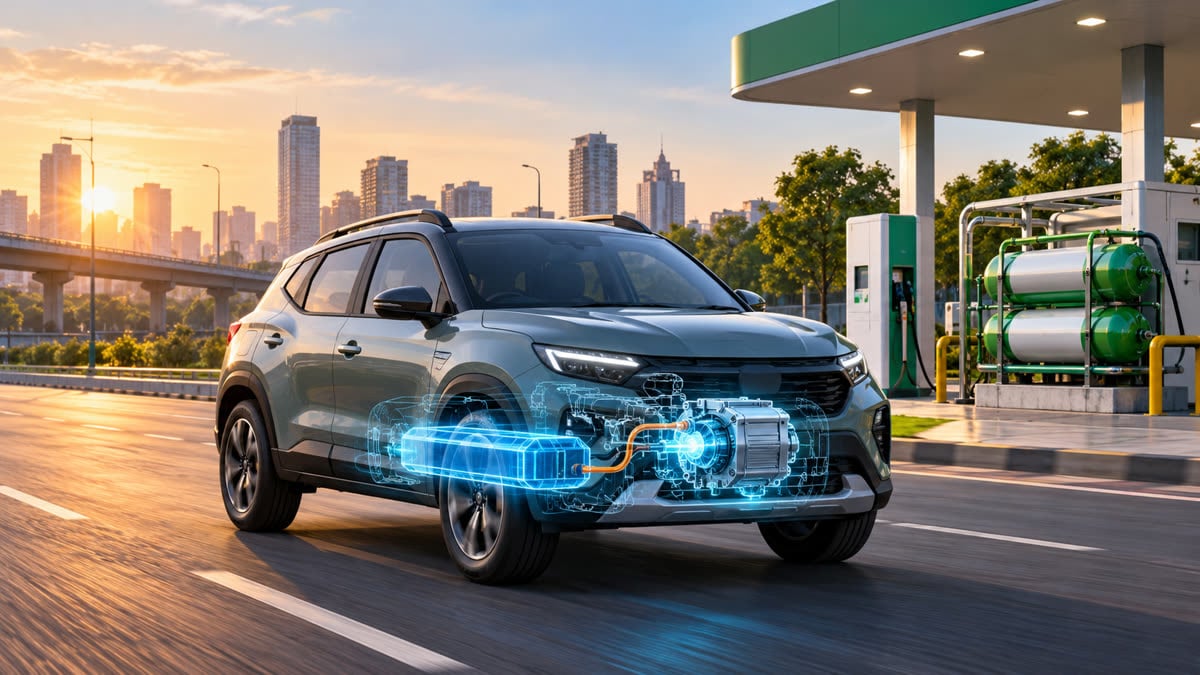
Renault’s own 9 Oct 2026 press release confirmed the Duster Strong Hybrid E-Tech 160’s 29 km/l ARAI-certified efficiency claim and described a system built around a 1.8-litre petrol engine, two electric motors and a 1.4 kWh battery. The company says the battery is replenished while driving through the engine and regenerative braking, so the vehicle does not require a plug-in charging point.
Autocar Professional reported the 17 Oct 2026 India launch, with the hybrid positioned against other strong-hybrid midsize SUVs. The purchase price is only one part of the comparison: buyers also need to consider annual distance, city-versus-highway use, service access and the difference between a certified test-cycle figure and real-world mileage.
For a simple illustration, the claimed 29 km/l figure implies about 34.5 litres for a 1,000-km month before traffic, driving style, air-conditioning use and load affect consumption. Multiply that fuel volume by the current petrol rate in your city using the live fuel-price page; for a route-specific estimate, the fuel-cost calculator can show how distance and mileage change the result.
What the strategy means for Indian drivers
Hybrid offers an in-between route
A strong hybrid can provide electric assistance and regenerative braking without requiring a home wall box or a public charging stop. That may matter to drivers who cover mixed city and highway routes, live in rented accommodation or do not have a predictable charging point. It does not make the vehicle an EV, however: petrol remains part of the energy chain, and the certified efficiency figure should not be treated as a promise of monthly fuel spend.
CNG still depends on the route
CNG can be attractive for drivers with reliable access to stations and a regular commute near established city networks. The trade-offs include refuelling availability on longer routes, queues at busy stations, vehicle packaging and the way a factory-fitted system affects usable space. Renault has indicated that future factory-fitted CNG models are part of its plan, but it has not announced a complete model-wise price list or launch schedule in the reports reviewed for this article.
EVs remain a different ownership case
Battery-electric cars remove tailpipe fuel use but shift the planning question to home charging, public charging access, range and charging time. Drivers comparing the options can check the state-wise EV charging directory before treating a low running-cost estimate as practical for their own routes.
What buyers should check next
- Separate the claimed efficiency figure from an expected real-world figure, especially if most driving is in heavy traffic.
- Compare the powertrain’s purchase premium with the kilometres driven each month; a low fuel bill does not automatically recover a higher upfront price quickly.
- Check whether a planned route has dependable CNG stations or charging points before choosing a vehicle around infrastructure that may not be available when needed.
- Read the variant-level equipment, warranty and service terms rather than assuming every hybrid or CNG feature is standard across a range.
What to watch next
Renault has said it plans to expand its powertrain choices, including future factory-fitted CNG models, while Business Standard reported that a battery-electric model is being considered for 2027 or 2028. Those are reported plans, not confirmed launch dates or prices. The more immediate signal is that Renault is testing whether a strong hybrid can widen the Duster’s appeal without relying on diesel or requiring external charging.
Reader takeaway
The 50% figure is a management forecast, not a promise that half of India’s cars will become hybrid or CNG in a fixed timeframe. For drivers, the useful question is narrower: compare the way each powertrain handles your distance, traffic, fuel access and charging options, then use current local prices and realistic usage rather than a headline efficiency number alone.
Sources
- Autocar Professional — “Renault India CEO Says Hybrids, CNG Could Account for 50% of Sales in 2–3 Years”, 17 Oct 2026
- Business Standard — “Renault CEO sees strong hybrids matching CNG’s market share in India”, 18 Oct 2026
- Fortune India — “Renault bets on hybrid to widen Duster market as CNG, localisation drive India strategy”, 17 Oct 2026
- Punjab Kesari — “Renault में हाइब्रिड, CNG की हिस्सेदारी दो-तीन साल में 50% पहुंचने की उम्मीद: इंडिया CEO”, 17 Oct 2026
- Renault India — “New Renault Duster Strong Hybrid E-Tech 160 Delivers ARAI-Certified 29 km/L Mileage”, 9 Oct 2026
- India Today — “Renault Duster strong hybrid E-Tech 160 launched at Rs 16.99 lakh, claims 29kmpl efficiency”, 17 Oct 2026