Singapore and Saudi Arabia announced on 26 October 2026 a joint intent to establish a crude-oil storage arrangement at Singapore's Jurong Rock Caverns, with operations expected from the second half of 2027. For fuel and freight markets, the significance is not an immediate price cut: it is a new Asian storage point designed to keep Saudi crude closer to regional buyers if supply routes are disrupted.
Key takeaways
- The announcement is a proposed arrangement, not a completed storage contract; Singapore's Energy Market Authority, JTC Corporation and Saudi Aramco exchanged a memorandum of understanding as a first step.
- Storage operations are expected to begin in the second half of 2027, subject to negotiations and implementation work.
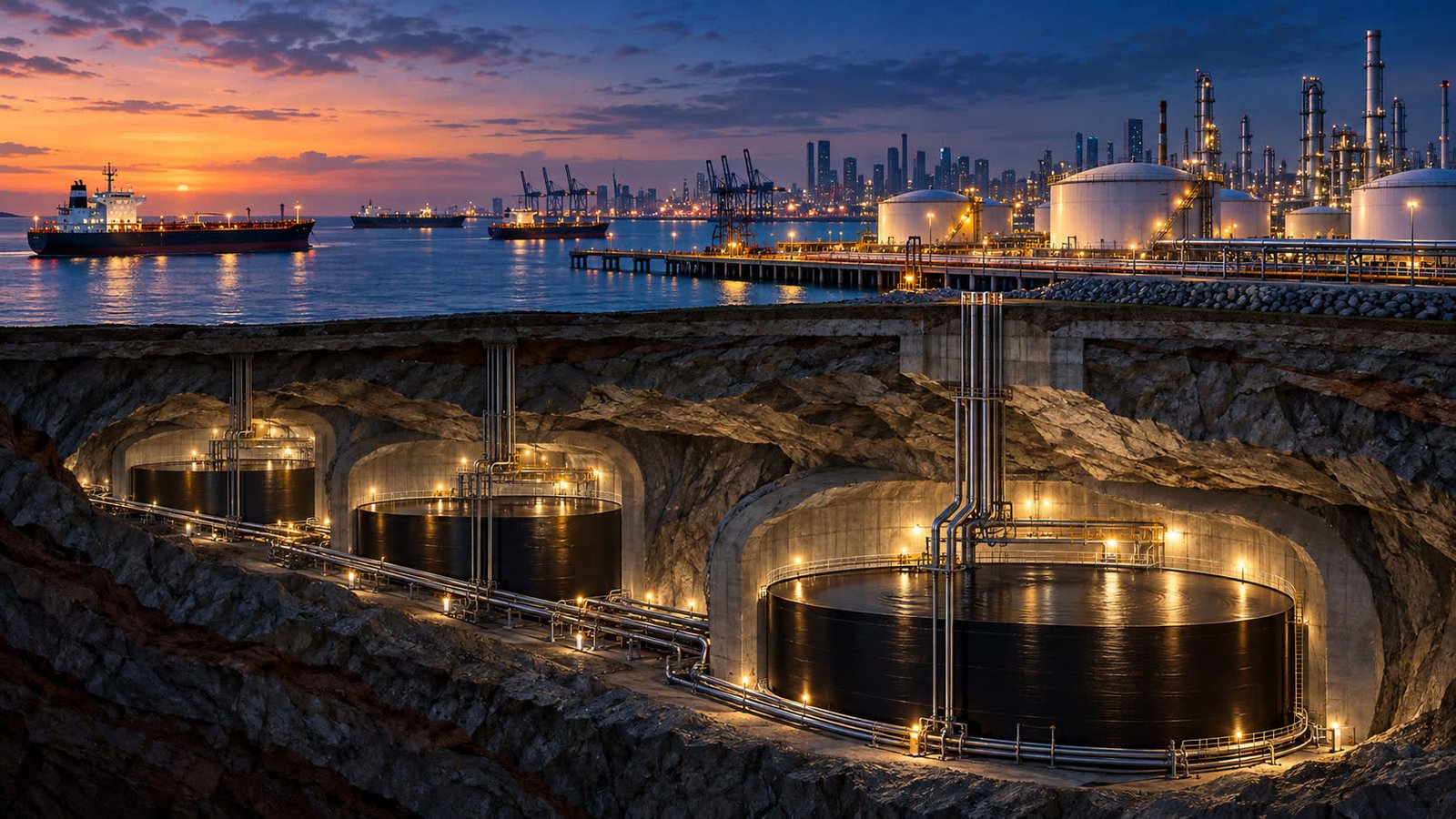
- Jurong Rock Caverns is about 150 metres underground and can hold around 1.47 million cubic metres, or roughly 9 million barrels, of liquid hydrocarbons in total. The amount intended for Saudi crude has not been announced.
- Singapore's wider energy plan includes five new natural-gas-fired power plants by 2031 and a 26% increase in generation capacity from about 12 GW today.
- The move does not change retail petrol or diesel prices today. The near-term market still depends on current production, shipping, refining and inventories.
Image note: The hero is an illustrative editorial artwork showing an energy hub and underground storage; it is not a photograph of the actual Jurong Rock Caverns.
What the announcement actually says
Singapore's Ministry of Energy, Trade and Industry and Saudi Arabia's Ministry of Energy said they intend to establish the arrangement at Jurong Island. At the Singapore International Energy Week, Singapore's Energy Market Authority and JTC Corporation exchanged an MOU with Saudi Arabian Oil Company, or Saudi Aramco. The official wording calls this a first step towards the arrangement, rather than a final commercial agreement.
The proposed plan would place Saudi crude in the Jurong Rock Caverns, with storage expected to start in the second half of 2027. Singapore says the stored crude would support its energy needs during a supply disruption, while also making the Saudi crude supply chain in Southeast Asia more resilient. The two energy ministries said they will coordinate implementation, and Singapore's energy minister said negotiations are targeted for completion in the coming months.
That distinction matters for readers who follow fuel markets. The announcement confirms a policy and commercial direction, but it does not publish the volume Saudi Aramco would place in the caverns, the release conditions, the ownership terms or the precise role of Singapore's government in any drawdown. Those details will determine how much protection the arrangement provides during an actual shortage.
Why storage matters for Asian fuel security
Reuters reported on 26 October that Asia imported about two-thirds of its oil supplies from the Middle East before the current regional war disrupted shipments through the Strait of Hormuz. That level of dependence makes location important: a barrel held closer to the region's refineries can be more useful during a shipping interruption than a barrel that still has to cross a risky route.
Storage is a buffer, not new production. It can give refiners and buyers more time to manage a disruption, but it cannot by itself replace lost output, restore a closed route or guarantee a lower pump price. The result for consumers would depend on how much crude is available, whether it can be released, the cost and availability of tankers, refinery capacity and the price of finished products such as diesel and gasoline.
Singapore is already a major refining, trading and shipping centre, so the proposed arrangement adds a resilience layer to an existing regional hub. It also follows a wider pattern of Asian countries examining where crude can be stored and how emergency supplies can be accessed. For the day-to-day numbers that drivers see, the live fuel-prices hub remains the relevant place to check current pump rates rather than treating a future storage plan as a present discount.
What the Jurong facility can hold
JTC says the Jurong Rock Caverns sit about 150 metres below ground and can store up to 1.47 million cubic metres of liquid hydrocarbons. That is roughly 9 million barrels, a capacity figure independently reported by Reuters. The facility can handle crude oil and condensate, among other liquid hydrocarbons.
The roughly 9-million-barrel figure describes the facility's total capacity, not the volume confirmed for Saudi Arabia under this announcement. No allocation was published on 26 October. This is an important guardrail against reading the facility size as an immediate addition to regional supply: the arrangement is still being negotiated, and the crude would be stored for use or trading under terms that have not yet been released.
Singapore is building a wider energy-resilience system
The crude-storage announcement arrived alongside Singapore's Five-Year Energy Infrastructure Plan. The Energy Market Authority said five new natural-gas-fired power plants are expected to operate between 2026 and 2031, expanding electricity-generation capacity by around 26% from approximately 12 GW today. Singapore's peak electricity demand was 8.6 GW as of August 2026 and could reach between 9.9 GW and 13 GW by 2031, according to the authority and CNA.
The same plan would raise LNG regasification capacity from 10 million tonnes per annum to 15 Mtpa when a second LNG terminal at Jurong Port becomes operational by 2030. Singapore also plans a larger grid and more energy storage. The demand drivers include semiconductor manufacturing, data centres and wider use of electric transport, so the plan connects oil security with the electricity system that will support charging and other mobility services.
For EV users, this is a longer-term infrastructure signal rather than an immediate charging benefit. Availability still depends on the local network and project delivery; readers planning an electric journey can browse the state-wise EV charging directory for the locations currently listed by FuelPrice.
What changes for fuel users and transporters
Nothing in the 26 October announcement changes a petrol, diesel or jet-fuel price at the pump today. It also does not announce new crude production, an OPEC quota change or an immediate release from the caverns. Storage operations are not expected until the second half of 2027, and the commercial terms remain unfinished.
For transporters, the practical lesson is to separate crude security from finished-fuel availability. Crude must still be refined into diesel or gasoline, and a disruption can affect product markets even when crude is available if refinery runs, shipping insurance or port access are constrained. A fleet manager estimating a current route should therefore use the fuel-cost calculator with a dated local fuel price, then update the calculation if an actual supply or price notice changes the route's cost.
For households and drivers, the deal is best read as an investment in resilience that may matter during a future shock, not as a promise of cheaper fuel. Its value will depend on whether the final arrangement provides timely access to usable barrels and whether other parts of the supply chain can move and refine them.
What to watch next
The next meaningful updates should answer four questions: how much Saudi crude will be stored, who can authorise a release during a disruption, when the final commercial documents will be completed, and whether the arrangement is followed by similar storage or supply partnerships elsewhere in Asia. The commissioning date and any public rules for access will matter more than the headline capacity alone.
Singapore and Saudi Arabia have confirmed the direction of travel, but not the final operating details. For global readers tracking the effect of geopolitical disruptions on crude, refined fuels, shipping and vehicle running costs, the worldwide fuel and energy news archive provides the relevant follow-up coverage as new terms or market data emerge.
Sources
- JTC, Singapore Government — “Singapore and the Kingdom of Saudi Arabia announce joint intent to establish a crude oil storage arrangement in Singapore” — 26 Oct 2026
- Reuters, via MarketScreener — “Saudi Arabia to store oil in Singapore to bolster Asia supply security” — 26 Oct 2026
- JTC, Singapore Government — “Jurong Rock Caverns” — facility information accessed 26 Oct 2026
- Energy Market Authority, Singapore — “Five-Year Energy Infrastructure Plan to Meet Unprecedented Future Demand” — 26 Oct 2026
- CNA — “Singapore launches five-year energy infrastructure plan to meet growing demand, sets new solar target” — 26 Oct 2026
This article is for general information only and is not financial, insurance or legal advice.