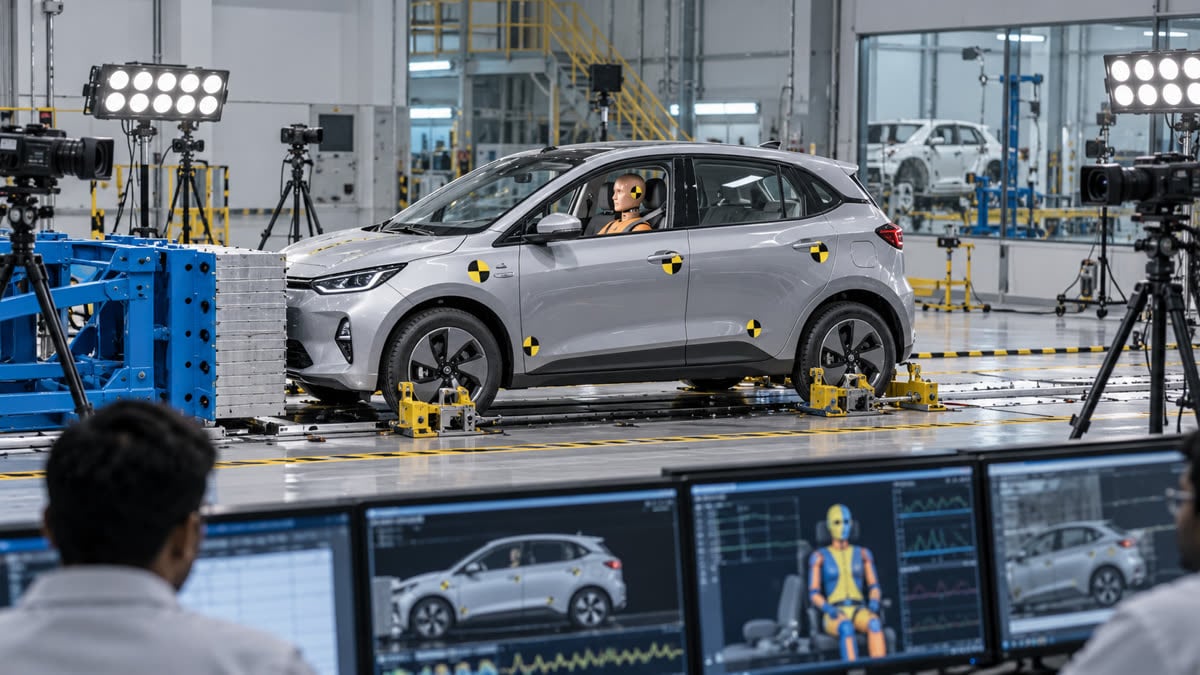
Skoda Auto Volkswagen India (SAVWIPL) and the Automotive Research Association of India (ARAI) have signed a Memorandum of Understanding (MoU) for a proposed advanced crash-test facility at Chakan, Pune. The planned site is intended to test battery-electric and internal-combustion vehicles, expand domestic capacity for Bharat NCAP assessments and support export homologation, but it is not yet an operational centre and no opening date has been announced.
Key takeaways
- SAVWIPL will transfer a land parcel beside its Chakan manufacturing plant to ARAI for the proposed facility.
- The planned centre is intended for both battery-electric vehicles (BEVs) and internal-combustion-engine (ICE) vehicles.
- It is expected to add testing capacity for Bharat NCAP work and safety validation for export markets.
- The MoU does not change the current crash rating of any car, create a new test obligation for owners or announce a commissioning date.
What SAVWIPL and ARAI have agreed
The MoU was exchanged in Pune on 30 Oct 2026, according to same-day reports from Autocar Professional, TOI Auto and AutoGuide India. Under the arrangement, SAVWIPL is providing a strategic land parcel next to its Chakan plant. ARAI is expected to use the site to establish an Advanced Crash Test Facility (ACTF).
The proposed facility is aimed at future mobility vehicles rather than a single Skoda or Volkswagen model. The reported scope covers BEVs and ICE cars, with the testing centre intended to add domestic capability for crashworthiness assessment, Bharat NCAP testing and homologation work linked to export markets. The reports do not disclose the land area, project cost, construction schedule or expected date of operations.
That distinction matters. An MoU records an agreed collaboration and intended use of the land; it is not the same as a completed building, a live testing programme or a published vehicle rating. The next meaningful confirmation will be an official update on development and commissioning, not the signing itself.
Why the proposed facility matters
India already has vehicle testing and crash-assessment infrastructure. ARAI’s published description of its full-vehicle crash-test facility lists frontal, side and rear-impact work, development testing for NCAP ratings and safety validation activities. The Chakan proposal therefore points to additional or expanded capacity, particularly as manufacturers bring more electric models and export-focused products into local development programmes.
For vehicle makers, more testing capacity close to engineering and manufacturing sites could make it easier to validate vehicles during development. The companies and ARAI have described the project as a way to support faster validation, stronger local engineering and compliance with domestic and overseas safety requirements. Those are stated aims of the collaboration, not a guarantee that every future car will reach a particular star rating or launch sooner.
For drivers and buyers, the effect is indirect and longer term. A stronger testing ecosystem can make safety assessment more accessible, but it does not by itself make a vehicle safer on the road or replace a published result for the exact model being considered. The proposed lab also does not alter insurance cover, registration requirements or the charging network for an EV.
EV buyers assessing ownership beyond crash protection can use FuelPrice’s state-wise EV charging directory to understand route coverage. The EV battery warranty guide covers a separate ownership question: how battery warranty terms, years and state-of-health conditions differ from a vehicle safety rating.
What Bharat NCAP means for buyers today
ARAI’s AIS-197 standard describes Bharat NCAP as a consumer-facing assessment covering adult occupant protection, child occupant protection and safety-assist technologies. The standard says participation is voluntary for vehicle manufacturers, while the Ministry of Road Transport and Highways or the Government of India may recommend a model for assessment. ARAI’s current facility information also identifies NCAP-related testing among its capabilities.
The Chakan MoU does not announce a revision to that framework. It also does not mean that every new EV or ICE car will automatically be tested at the proposed site. A rating will still depend on the vehicle model selected for assessment, the applicable protocol and the results that are formally published.
What to check when comparing a car’s safety
The announcement is useful background, but buyers still need to separate a future testing facility from the evidence available for a car on sale. A practical comparison checklist is:
- Find the exact published result: check whether the Bharat NCAP or other crash result applies to the same model, body style and equipment configuration rather than assuming that a brand-wide claim covers every variant.
- Separate rating from compliance: regulatory type approval and a consumer crash rating are related to vehicle safety but are not the same document or claim.
- Check the safety equipment on the exact variant: compare the manufacturer’s current specification for restraint systems, electronic safety aids and other safety equipment, because equipment can vary across versions.
- For an EV, assess the wider ownership plan: look at charging access, service support and battery warranty terms alongside the crash-test information. The road-trip planner can help map charging and driving stops for a proposed inter-city route, but live charger availability still needs separate checking.
These checks do not predict a future rating. They help keep a proposed infrastructure announcement in perspective while a buyer compares the information already available for a specific vehicle.
What happens next
The immediate next steps are likely to be land transfer, facility planning and construction, followed by equipment installation and any required approvals. None of those milestones has been assigned a public completion date in the reports reviewed for this article.
Readers should therefore treat the ACTF as a proposed addition to India’s safety-testing capacity. The useful updates to watch are an official commissioning announcement, details of the tests the facility can conduct and the first formally published results connected to the centre. Until then, the MoU is a capacity and infrastructure development, not a new rule for existing vehicle owners.
FAQs
Is the new Chakan crash-test facility open now?
No. The announcement covers an MoU and a proposed facility. The construction and operational timeline has not been announced.
Will the MoU change my car’s Bharat NCAP rating?
No immediate change is announced. A rating belongs to the vehicle assessment that is actually conducted and published; the land agreement itself does not alter an existing result.
Does this make Bharat NCAP mandatory for all cars?
No such change is stated in the announcement. The AIS-197 framework describes manufacturer participation as voluntary, while allowing the government to recommend a model for assessment.
Sources
- Autocar Professional — Skoda Auto Volkswagen India and ARAI to Set Up Crash Test Facility in Chakan — 30 Oct 2026
- TOI Auto — Škoda Auto Volkswagen India Gives Land To ARAI For A New Crash Test Facility In Chakan — 30 Oct 2026
- AutoGuide India — Škoda Auto Volkswagen India and ARAI partner to strengthen Crash Testing Infrastructure — 30 Oct 2026
- ARAI — Full Vehicle Crash Test Facility — accessed 30 Oct 2026
- ARAI — AIS-197 Automotive Industry Standard for Bharat NCAP — accessed 30 Oct 2026