Stellantis India is working toward a 24-month vehicle-development cycle under its FaSTLAne 2030 plan, while preparing 12 Jeep and Citroën products for India, according to the company’s plan and recent reports by Business Standard and Mint. That is a target, not a promise of fixed launch dates or prices, but it could shorten the wait between new models and major updates for Indian buyers.
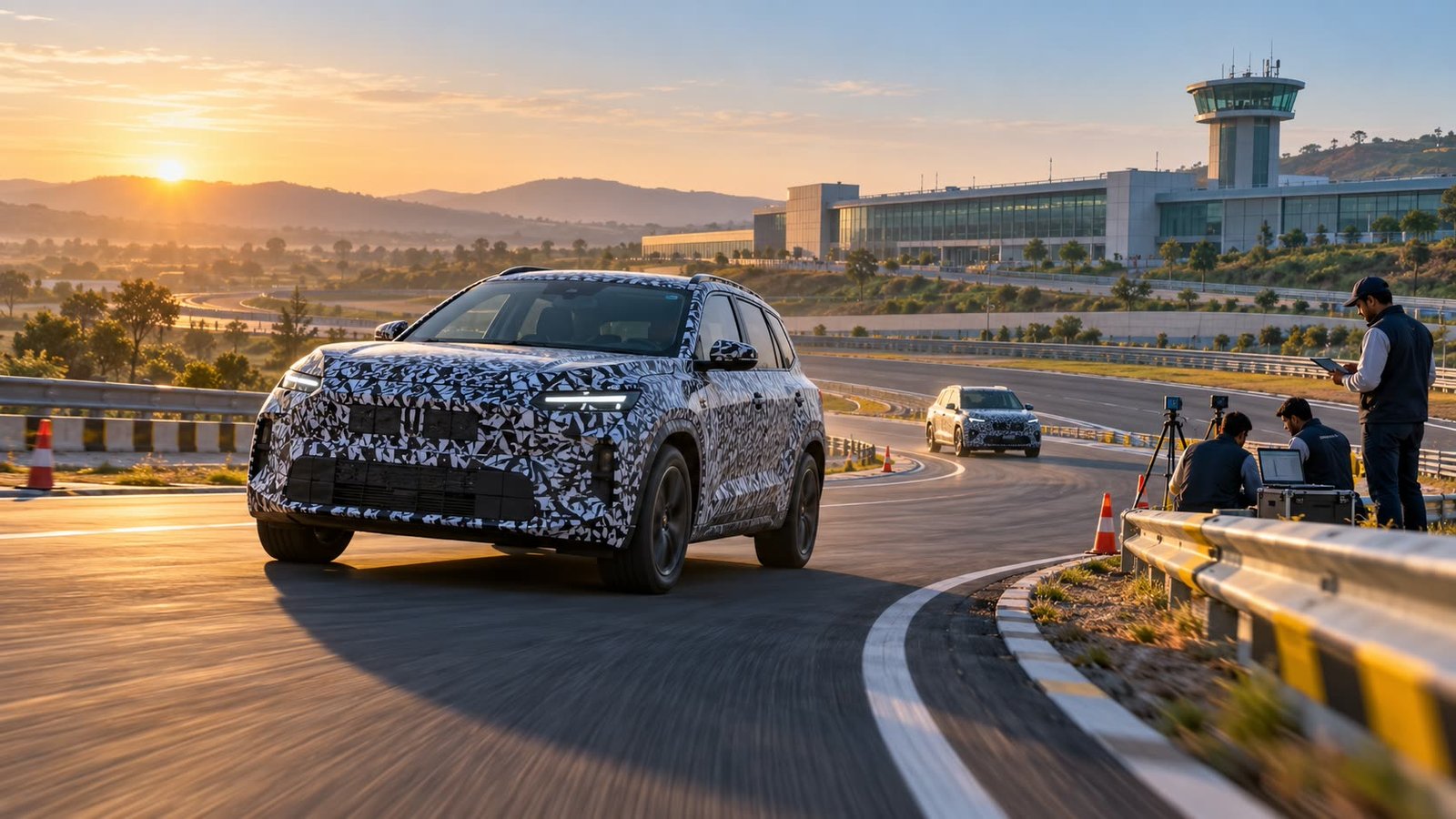
Illustrative image: an unbranded automotive proving-ground and prototype-validation context, not a photograph of a specific Stellantis model.
Key takeaways
- Stellantis’ 21 May 2026 global plan targets a 24-month vehicle-development cycle, compared with up to 40 months in the company’s stated current baseline.
- Business Standard reported on 20 October 2026 that Stellantis India is preparing 12 Jeep and Citroën products over the next three years: seven new products and five major upgrades.
- The India roadmap includes about ₹4,000 crore of additional investment over three years, with the first product expected by the second quarter of 2027, according to Business Standard and Mint.
- The company is combining Indian engineering, sourcing and manufacturing with a multi-energy approach that includes petrol, hybrid and electric powertrains.
What Stellantis India has confirmed
The immediate news is the development-speed target. In its official FaSTLAne 2030 release dated 21 May 2026, Stellantis said it wants to bring product-development cycles down to 24 months from up to 40 months. In a separate interview with PTI, quoted by Business Standard on 20 October 2026, Stellantis India managing director and chief executive Shailesh Hazela described the ambition as moving from 48 months to close to two years.
Those baselines are not identical, and that distinction matters. The safest reading is that 24 months is the target, while the starting point depends on whether the company is referring to a global process, an India programme or a particular model. It does not mean an Indian showroom will receive a new car exactly two years after an announcement.
The company’s official material also describes the broader plan as a forward-looking target. Product timing, investment and partnership commitments remain subject to planning assumptions, approvals and execution. That makes the 24-month figure useful as a direction of travel, but not as a delivery guarantee.
What the India product roadmap includes
Stellantis India has said it will add 12 products across Jeep and Citroën over roughly three years. Business Standard’s 20 October 2026 report described the mix as seven new products and five major upgrades; Mint’s 16 October 2026 report also said the first product is planned for the second quarter of 2027. The reports do not provide a complete public model-by-model calendar.
The plan is backed by approximately ₹4,000 crore of additional India investment over three years, as reported by Business Standard and Mint. The spending is intended to support new products, localisation and customer experience. Stellantis has also said that its India engineering and manufacturing base will contribute to vehicles for more than 50 overseas markets, not only to cars sold domestically.
The powertrain message is deliberately broad. The reported roadmap covers internal-combustion, hybrid and battery-electric possibilities rather than committing every new product to one technology. For buyers, that means a future Jeep or Citroën announcement will still need to be assessed model by model for engine, battery, transmission, charging and service details.
What it could mean for Indian buyers
More frequent updates, but no instant price benefit
A shorter engineering cycle can help a manufacturer refresh products more quickly, respond to safety or emissions requirements and tailor features for local demand. It can also reduce the time between an India-focused design decision and a production vehicle. None of that, by itself, confirms a lower ex-showroom price or a cheaper monthly ownership cost. Those outcomes will depend on volumes, localisation, taxes, financing and the final equipment list.
When a new petrol or hybrid model is officially priced, a buyer can compare its expected monthly fuel spend using the fuel cost calculator. The calculation should use the certified efficiency figure, an expected driving distance and the applicable date-stamped fuel price; it should not be treated as a promise of real-world mileage.
Localisation may matter more than the headline timeline
Stellantis has said it wants deeper local engineering and sourcing. Greater local content can make parts availability and production planning more resilient, but the effect on prices is not automatic. Buyers should wait for the official variant list, warranty terms, service coverage and on-road quote before comparing a future model with an existing rival.
Fuel type will also change the ownership calculation. Petrol and hybrid buyers can check current city and state benchmarks through the live fuel-price hub, while EV buyers will need to consider home charging, public charging access and route planning. FuelPrice’s state-wise EV charging directory is useful for checking the infrastructure question separately from the vehicle’s claimed range.
What to check before a booking decision
- Confirm whether the vehicle is an all-new product or a major upgrade, and whether the announced date is a target or an on-sale date.
- Compare the full variant-wise price, not just an expected starting price. Registration, insurance, accessories and delivery charges can change the on-road figure.
- For petrol or hybrid vehicles, compare certified efficiency with the likely use pattern. For EVs, check battery warranty, charging time, usable range and service support.
- Check whether the India-built vehicle is intended for local sale, export, or both; the production mix can affect availability and waiting periods.
- Recheck the final specifications when the company opens bookings. A roadmap announcement is not a substitute for an official price list or technical sheet.
What to watch next
The next concrete milestone is the first product under the roadmap, which recent reports place in the second quarter of 2027. The company has not publicly matched each of the 12 products to a confirmed name, price or launch date in the sources reviewed for this report. The useful signals to watch are an official booking announcement, homologation details, a production start, and confirmation of which powertrain and platform will be used in India.
The development-speed target also needs to be judged by execution. A faster cycle can improve choice only if it is supported by dependable service, parts supply, transparent pricing and powertrain infrastructure. For now, the announcement gives Indian buyers a roadmap to monitor, not a reason to assume that any particular Jeep or Citroën will arrive early or at a specific price.
Reader takeaway
Stellantis India’s 24-month target is meaningful because it links faster product development with a larger India pipeline and more local engineering. But the practical buyer question remains model-specific: wait for the confirmed launch date, specifications, warranty and on-road price before calculating the ownership cost.
Sources
- Stellantis — “Stellantis Unveils €60 Billion Strategic Plan to Accelerate Growth and Profit” — 21 May 2026
- Business Standard / PTI — “Stellantis India aims to halve vehicle development time, boost localisation” — 20 October 2026
- Mint — “Global auto once fled India; but some MNCs are now changing the script” — 16 October 2026