NITI Aayog and GIZ India signed an implementation agreement on 3 Nov 2026 to accelerate the decarbonisation of India's road-freight sector. The government said the work will focus on charging infrastructure, innovative financing and an enabling regulatory framework; for Indian fleet operators, it signals policy and infrastructure work ahead, not an immediate subsidy, purchase mandate or change to diesel and petrol prices.
Key takeaways
- The agreement was signed on 3 Nov 2026 and the Press Information Bureau published the announcement on 4 Nov 2026.
- The government names three connected gaps for electric medium- and heavy-duty freight vehicles: charging, finance and regulation.
- NITI Aayog and GIZ are working under Phase II of the Nationally Determined Contribution-Transport Initiative for Asia, supported by Germany's International Climate Initiative.
- WRI India, the International Council on Clean Transportation India and Agora Energiewende are among the implementing partners.
- The announcement does not set a national truck-conversion deadline, announce a purchase subsidy or give a start date for fleet pilots.
What the agreement actually does
The agreement formalises collaboration between NITI Aayog and the Deutsche Gesellschaft für Internationale Zusammenarbeit, known as GIZ, under NDC-TIA II. The regional initiative is backed by the German Government's International Climate Initiative and is intended to support India's Nationally Determined Contribution targets and longer-term climate goals.
The PIB release describes the agreement as a framework for accelerating road-freight decarbonisation. It is not a new law, a vehicle-registration rule or a retail-fuel notification. That distinction matters for transport businesses: the document starts a programme of policy and technical work, but it does not by itself change the operating conditions of every truck on Indian roads.
Why electric trucks need more than a vehicle launch
Electric trucks operate on a different planning cycle from private cars. A fleet manager has to match a vehicle's range and payload with a route, loading schedule, depot access and charging time. A truck that cannot charge reliably at the right point may need a different operating plan, even if its energy cost looks attractive on paper.
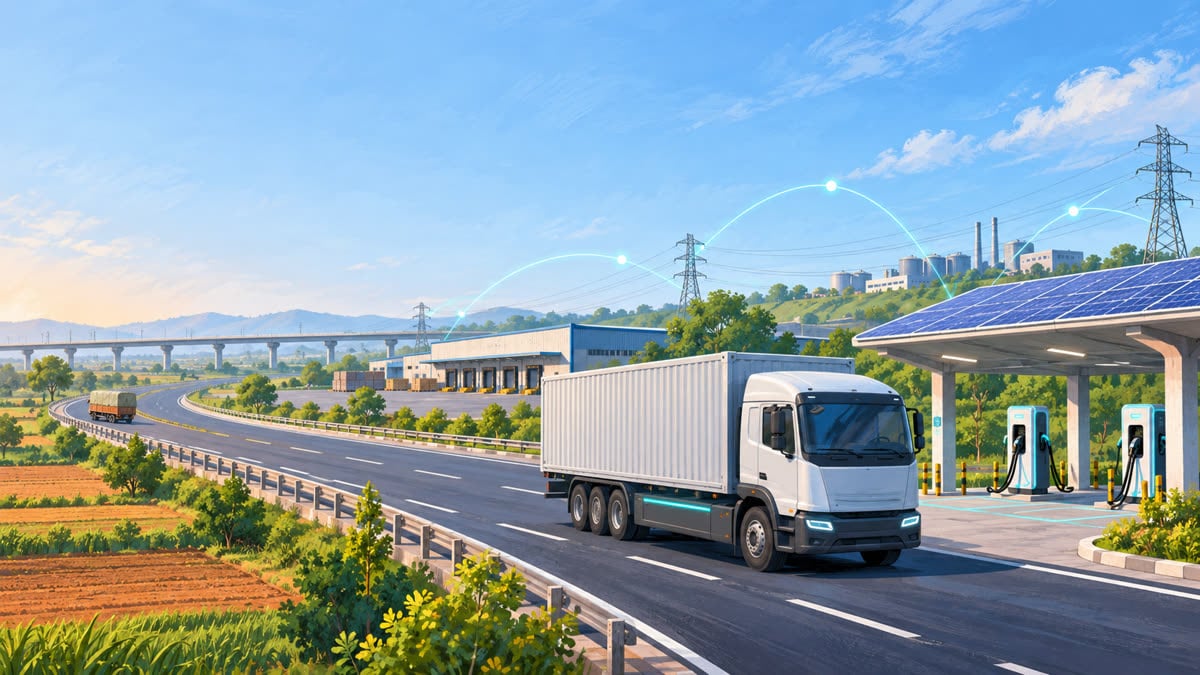
That is why the announcement groups infrastructure, finance and regulation together. Charging locations and grid connections influence utilisation; financing terms influence the upfront burden; and rules covering approvals, safety, access and data can determine whether a pilot can move from a demonstration to regular freight service. The government says electrification of medium- and heavy-duty freight vehicles remains at an early stage, so the immediate challenge is building an ecosystem that works for commercial routes.
What GIZ's roadmap could mean for fleets
In its own update, GIZ India said its roadmap for the next two years will use NITI Aayog's E-FAST platform for policy dialogue, support policies for zero-emission trucks and explore whether specific routes could help electric trucks operate more efficiently. It also listed better freight-transport data, digital tools for smarter routes, pilot approaches and training for government officials.
These are enabling steps rather than a promise that every corridor will receive chargers or that every operator will qualify for finance. For a transporter assessing an electric truck, the useful questions remain practical:
- Can the vehicle complete its regular route with charging at loading, unloading or rest points?
- How would charging time, payload and downtime change the cost of a working day?
- What finance, service, warranty and battery-residual-value terms would apply to the specific vehicle?
- Would the route's current diesel cost and toll pattern justify a powertrain change under the operator's own utilisation?
Operators can compare the fuel side of a route with the fuel cost calculator.
The state-wise EV charging directory can help identify public charging coverage that may be relevant to a planned corridor. These tools cannot predict a future truck pilot, but they can provide a current baseline for route planning.
What changes now for private drivers and buyers?
Nothing in this agreement immediately changes a private driver's petrol or diesel purchase, FASTag payment or toll calculation. The official announcement does not introduce a consumer EV subsidy, a mandatory electric-truck sales share, a nationwide conversion date or a new road-user charge.
Passenger-EV owners may eventually benefit if freight corridors gain more high-capacity charging infrastructure, but that is a possible downstream effect, not a promise in the agreement. The programme is centred on road freight and on the barriers to electrifying medium- and heavy-duty vehicles. It should not be read as evidence that electric cars will become cheaper to charge or that a specific model will receive a new incentive.
What to watch next
The next useful signals will be follow-on details rather than the signing itself. Fleet operators and charging companies can watch for E-FAST consultations, route-feasibility work, pilot locations, data or digital-tool releases, financing mechanisms and any regulatory proposal that explains who can participate.
For private road users planning a long trip, the road-trip planner remains useful for comparing route distance and time while the policy work develops. A future freight-charging corridor may improve the wider network, but no current user should assume a saving, faster journey or guaranteed availability until a specific project is announced and operating.
Reader takeaway
The NITI Aayog-GIZ agreement makes charging, finance and regulation explicit workstreams for India's electric-freight transition. For transporters, it is a reason to track infrastructure and operating-cost changes; it is not, on its own, a direction to buy or switch vehicles. The next concrete information will come from pilots, route studies and rules that show how the partnership will work on the ground.
Sources
- Press Information Bureau, “NITI Aayog and GIZ India Sign Implementation Agreement under NDC-TIA II to Accelerate Road Freight Decarbonisation,” 4 Nov 2026
- GIZ India, “Green Freight” partnership update, 5 Nov 2026
- International Transport Journal, “NITI Aayog and GIZ launch decarbonization initiative in India,” 5 Nov 2026
- Cargo Connect, “NITI Aayog and GIZ Partner to Accelerate Electric Truck Adoption in India,” 5 Nov 2026