TVS Motor said its electric two-wheeler sales rose 133% year on year to 1,86,186 units in Q2 FY27, and management is preparing to lift monthly EV two-wheeler capacity from about 60,000–65,000 units to around 80,000. The 28 Oct 2026 update matters to Indian buyers because more capacity could improve the availability of TVS electric scooters, but the company has not given a firm completion date or promised shorter waiting periods.
Key takeaways
- TVS Motor reported 1,86,186 electric two-wheeler sales in the quarter ended September 2026, up 133% from 80,009 units a year earlier.
- Management said current monthly EV two-wheeler capacity is about 60,000–65,000 units, including domestic sales and exports.
- The next planned capacity level is around 80,000 electric two-wheelers a month; this is a capacity plan, not a confirmed delivery forecast.
- The company also reported record Q2 revenue of ₹17,103 crore and profit after tax of ₹1,377 crore for FY27.
- Buyers should treat availability, delivery timing, charging access and on-road price as separate checks; higher factory capacity does not guarantee stock in every city.
What TVS Motor announced
In its 28 Oct 2026 Q2 FY27 release, TVS Motor reported revenue from operations of ₹17,103 crore for the July–September 2026 quarter, up 44% from ₹11,905 crore in the same quarter of FY26. Profit after tax increased 52% to ₹1,377 crore from ₹904 crore, while total two- and three-wheeler sales reached about 1.9 million units, up 27% year on year.
The EV part of the result was the sharper change. Electric two-wheeler sales climbed to 1,86,186 units in Q2 FY27 from 80,009 units in Q2 FY26. TVS described this as 133% growth. The company’s own management commentary also put domestic electric two-wheeler growth at 129% for the quarter, compared with 84% for the industry, although that comparison should not be read as a guarantee that the same pace will continue through the rest of the financial year.
The capacity plan is still a proposal in progress
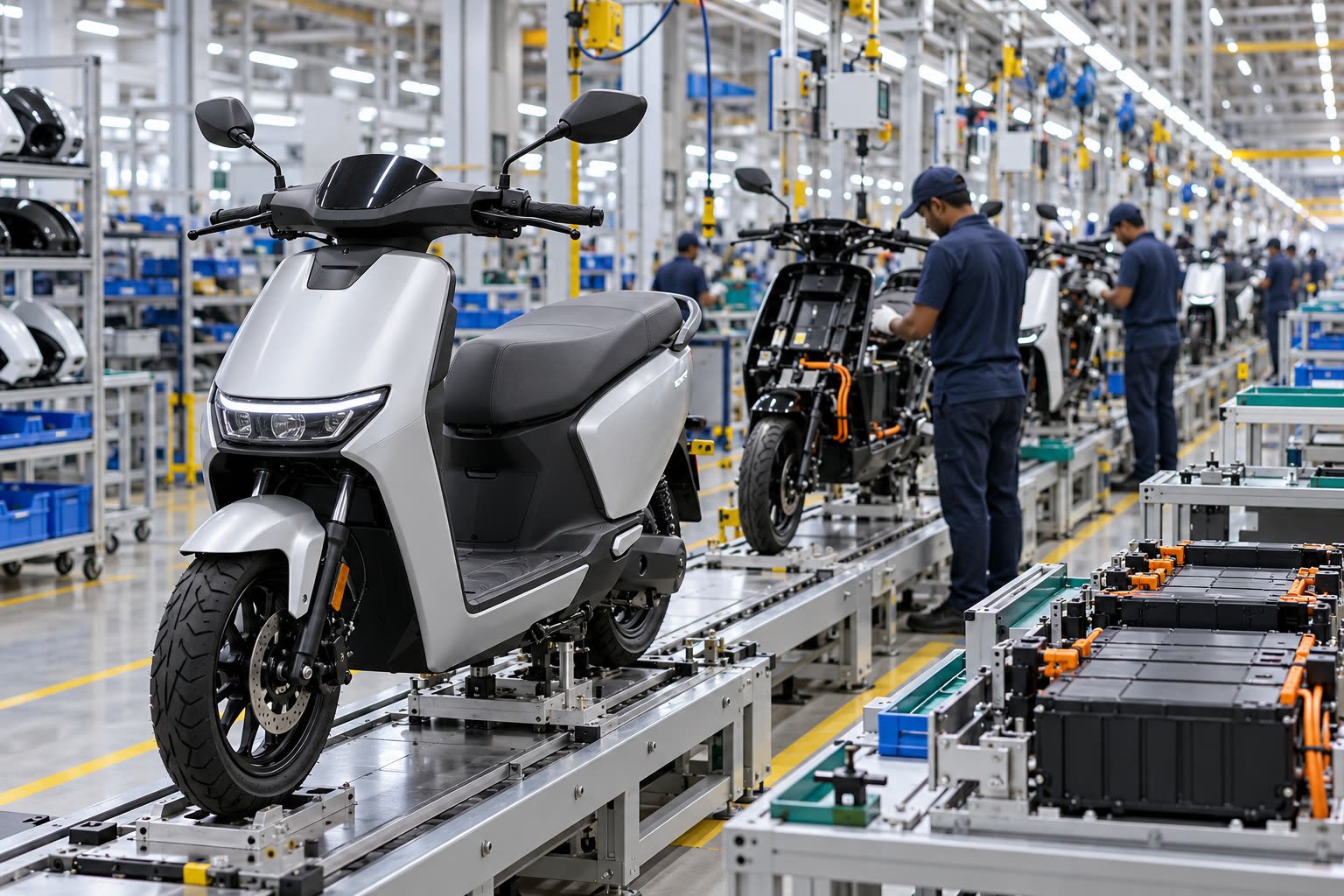
During the post-results analyst call, TVS Motor management said the business was operating at roughly 60,000–65,000 electric two-wheelers a month across domestic and export markets. It has planned the next level at about 80,000 units a month, and said work on the expansion is already under way.
That distinction matters. The 80,000 figure is a planned monthly capacity level, not a commitment to sell 80,000 scooters every month. It also is not a delivery promise for a particular model or city. Independent reporting on the call said TVS had not provided a specific completion date for the proposed EV capacity. The company’s 28 Oct release reported the sales and financial results but did not give a deadline for reaching the higher monthly capacity.
For buyers, capacity is best understood as a potential supply-side improvement. If production catches up with demand, dealerships may have more consistent access to popular variants and fewer gaps between bookings and deliveries. However, inventory can still differ by state, dealer, colour, battery configuration and export allocation.
What it means for iQube and Orbiter buyers
Management linked the EV expansion discussion to customer response for the iQube and Orbiter electric scooters. Reporting on the call said Orbiter availability had increased and that the model had also started moving into export markets. That points to a wider product and market push, but it does not establish a uniform waiting period or price for either scooter.
A buyer comparing an electric scooter should therefore separate the company’s national capacity plan from the dealer’s current offer. Check the exact variant, on-road price, delivery estimate, warranty terms and the location of service support. A quoted delivery date is a dealer-level commitment; it is not created automatically by a manufacturer’s future capacity target.
Charging access is another practical part of the decision. Readers can use FuelPrice’s state-wise EV charging directory to see whether public charging is available around their regular routes and destinations. For longer rides, the road-trip planner can help organise the journey before comparing the scooter’s claimed range with actual stops.
Why exports and scale matter
TVS is not expanding only for the domestic scooter market. Management said electric two-wheeler exports were 6,930 units in Q2 FY27, compared with 1,726 units in Q2 FY26. Total international two- and three-wheeler sales were about 5.39 lakh units in the September 2026 quarter, up 35% year on year.
Export demand can absorb part of the additional output, so a larger factory number does not translate one-for-one into extra Indian showroom stock. At the same time, greater volume can spread fixed manufacturing and supply-chain costs across more vehicles. That may support wider model availability over time, but the company has not announced a buyer price cut linked to this capacity plan.
For an ownership comparison, a petrol scooter’s trip baseline can be estimated with the fuel cost calculator, while an EV comparison should include home-charging electricity, public charging fees, servicing and financing costs where applicable. The relevant number for a buyer is the total cost for the intended daily distance, not the manufacturer’s quarterly sales figure alone.
What to watch next
- Whether TVS gives a firm timeline for reaching about 80,000 monthly EV two-wheeler capacity.
- Whether iQube and Orbiter stock improves consistently across cities rather than only at selected dealers.
- How the company balances domestic supply with exports as electric two-wheeler demand grows.
- Whether future price or variant changes alter the total cost of ownership for buyers.
Reader takeaway
TVS Motor’s Q2 figures show strong electric two-wheeler momentum and a stated plan to add capacity. The useful buyer takeaway is conditional: more output could make popular scooters easier to find, but the benefit will be real only when the planned capacity becomes regular production and reaches the relevant dealer network. Until then, compare the exact vehicle offer, charging plan, service access and total running cost for the route you actually use.
Sources
- TVS Motor Company, “TVS Motor Achieves Highest ever Revenue with 44% Growth in Q2 2026-27” — 28 Oct 2026
- The Financial Express, “TVS Motor Q2 profit rises 52% to record Rs 1,377 cr; beats estimates” — 28 Oct 2026
- Autocar Professional, “TVS Motor to Expand Annual Two-Wheeler Capacity to 8.3 Million Units, Monthly EV Capacity to 80,000” — 28 Oct 2026