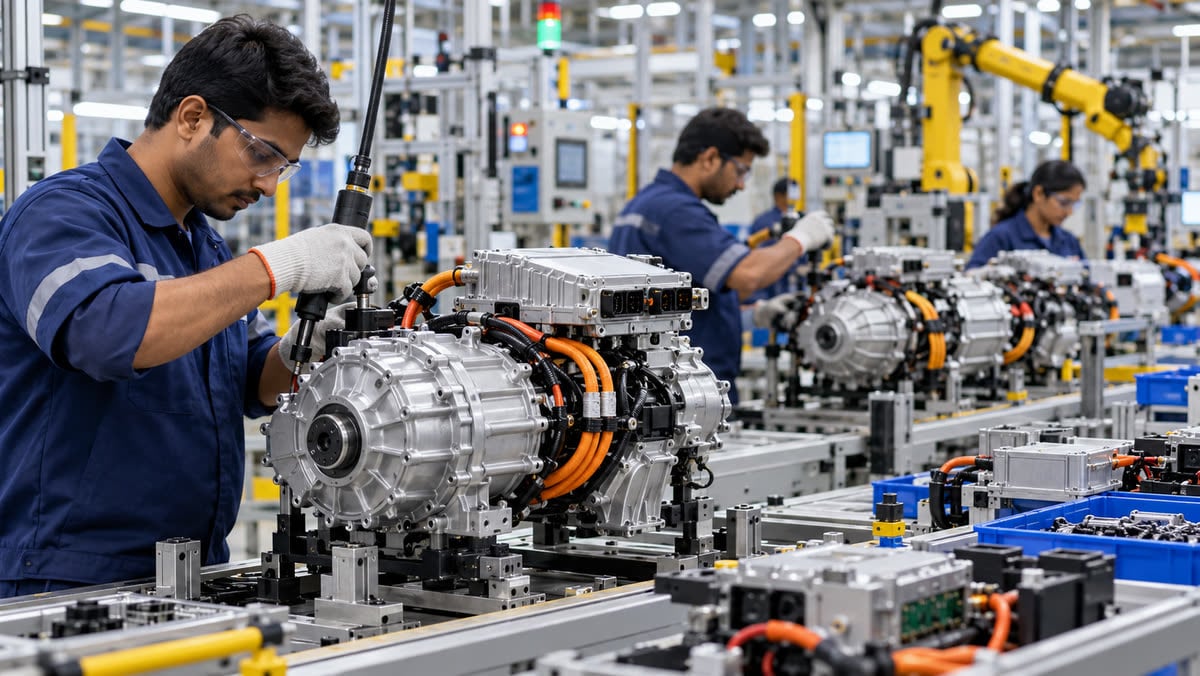
ET Sustainability reported on 23 Oct 2026, citing a BusinessLine interaction, and ICICI Direct Research on 22 Oct 2026 described Uno Minda's reported target of about ₹40,000 crore in revenue by FY30, the financial year ending March 2030. The target would be close to twice the company's FY26 revenue base, with electric-vehicle drive units, seating systems, sunroofs and electronics at the centre of the expansion.
For Indian vehicle buyers and owners, the more immediate number is the company's planned ₹1,750 crore capital expenditure for FY27, or April 2026 to March 2027. It points to added component capacity and localisation over time, but it is not an announcement of an immediate vehicle-price cut, longer EV range or wider public charging access.
Key takeaways
- The ₹40,000 crore FY30 revenue figure is a reported, directional target, not formal company guidance.
- Uno Minda's FY27 capex plan is about ₹1,750 crore, covering growth projects, sustaining investment and land acquisition.
- EV powertrains, vehicle electronics, seating, sunroofs and alternative-fuel systems are part of the expansion.
- More local components could improve supply resilience and feature availability, but the effect will depend on plant ramp-ups and OEM orders.
What Uno Minda is planning
The reported strategy is a move up the automotive value chain. Instead of supplying only individual parts, Uno Minda is expanding into systems that can be supplied to passenger vehicles, two-wheelers and commercial vehicles. The product mix spans electric drive units, motors and inverters, complete seating, infotainment, sunroofs, lighting and other electronics.
ICICI Direct's 22 Oct 2026 research note said the company was aiming to nearly double revenue from about ₹19,700 crore in FY26 to ₹40,000 crore by FY30 through EV components, technology partnerships and new manufacturing facilities. ET Sustainability's 23 Oct 2026 report carried the same broad target, while noting that the ₹40,000 crore figure is a directional extrapolation rather than formal guidance. That distinction matters: it describes an ambition to be executed over several financial years, not revenue already secured.
Where the investment is going
Uno Minda's FY26 earnings-call transcript, dated 18 May 2026, confirms a planned FY27 capex of approximately ₹1,750 crore. The company said about ₹1,100 crore would be directed to growth projects and ₹650 crore to sustaining capex, with the remaining allocation linked to land acquisition. ET Sustainability reported the same split on 23 Oct 2026.
The company also said seven of its 11 ongoing projects were expected to either start production or enter ramp-up during FY27. Two new product areas—EV powertrain systems and sunroofs—were expected to begin commercial operations during that financial year, subject to project execution. An independent Autocar Professional report dated 18 May 2026 also recorded the seven-of-11 milestone and the two new segments. The official transcript does not turn those milestones into guaranteed customer deliveries, so the next evidence to watch is commissioning, production ramp-up and disclosed OEM programmes.
What it could mean for vehicle users
EV buyers and owners
A larger domestic supplier base could eventually mean more locally made motors, inverters, controllers and charging hardware in vehicles sold in India. That may support supply resilience and make it easier for manufacturers to add features across price segments. It does not, by itself, establish the final price, battery range, warranty terms or service cost of any vehicle. Those depend on the automaker's design, sourcing, tax treatment and retail strategy.
It also does not add public chargers. An EV owner planning a trip still needs to check the actual route network, connector type and operating status. FuelPrice's state-wise EV charging directory is the relevant check for charging locations, while the reported component expansion remains a medium-term industry development.
Petrol, diesel, CNG and hybrid users
The plan is not EV-only. ET Sustainability reported that Uno Minda wants components and systems that can serve internal-combustion, electric, hybrid, CNG and hydrogen-powered vehicles. This powertrain-agnostic approach matters because Indian buyers will continue to choose across technologies while manufacturers balance emissions rules, fuel availability, purchase price and operating cost.
For a like-for-like ownership comparison, readers can use the fuel-cost calculator with dated petrol, diesel or CNG inputs. A supplier's expansion should not be treated as proof that one powertrain will be cheaper for every driver.
Fleet and road-trip planning
For fleet operators, more localised components can be relevant to procurement and long-term parts availability, but there is no new fleet rule or mandated technology in this update. Operators should wait for confirmed vehicle programmes, delivery timelines and service arrangements before changing a replacement schedule.
Private drivers planning longer journeys should treat the story as an industry-watch item rather than a route change. The road-trip planner can help compare a current vehicle's fuel or charging needs; the new factories described in the reports do not alter today's tolls, fuel prices or charging stops.
What to watch next
The next useful checkpoints are approval and commissioning of the proposed EV-drive projects, the pace at which the seven projects enter production or ramp-up, and the customer models that actually use the new systems. Reported project potential is not the same as a consolidated order book, and Uno Minda's FY30 ambition will depend on converting capacity into profitable, repeat production.
For readers, the practical takeaway is limited but clear: India is building more capability around EV and technology-rich vehicle components, while the near-term buying decision remains specific to each vehicle's quoted price, running cost, warranty and service support. No immediate change to those consumer terms has been announced in this report.
Sources
- ETSustainability, “Uno Minda bets on EV drives, seating and electronics to nearly double revenue by FY30” — 23 Oct 2026.
- ICICI Direct Research, “Uno Minda aims to double revenue to ₹40,000 crore by FY30 via EV and tech push” — 22 Oct 2026.
- Uno Minda, “Q4 FY26 Earnings Call Transcript” — 18 May 2026.
- Autocar Professional, “Uno Minda Plans ₹1,750 Crore Capex as FY27 Expected to Be Execution-Heavy” — 18 May 2026.