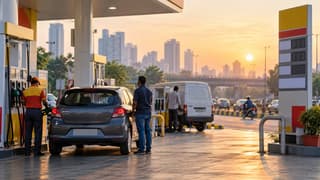
The government on Monday hiked excise duty on petrol and diesel by Rs 2 per litre.
At a time when global crude prices are on a steady decline, the hike signals a fresh focus on ramping up govt revenues for possible capital expenditure after tax relief given in the Union Budget 2025 . It may be noted here that the added cost won't have to be borne by the 'aam aadmi'. But they are set to pay Rs 50 per LPG cylinder more, starting tomorrow.
Interestingly, fall in global crude prices has not yet translated into a fuel price relief for Indians, yet. However, Oil minister Hardeep Singh Puri hinted at a 'wait and watch' approach with respect to a cut in petrol and diesel prices . “Today I can tell you seriously.
If the audience asks when will fuel prices come down further, I would say if this trend (low crude prices) continues, there is reasonable expectation (of a fuel price cut),” Puri said.
Also Read: Govt increases excise duty on petrol, diesel by Rs 2 per litre; consumers not to be hit In February, Nirmala Sitharaman had slashed personal income tax for the middle class, leaving a dent in the Centre’s direct tax revenue estimates.
The Modi government also scrapped windfall taxes, giving major relief to oil companies like Reliance Industries , Nayera etc. Live Events As for the latest excise hike, Puri said the extra Rs 2 duty will add to the general kitty, and it will be utilized for reimbursing the LPG losses of the same (oil marketing) company.
History is testament to the fact that the Modi government has, never in the 11 years of their rule, passed the benefit of low global oil prices , even when crude oil prices had fallen below zero in 2020, for the first time in history.
A look back at the excise duty trajectory Between November 2014 and January 2016, the government had raised excise duty on petrol and diesel nine times, capitalising on a global crude oil crash.
In that 15-month period, excise duty on petrol rose by Rs 11.77 per litre, while that on diesel jumped by Rs 13.47 per litre.
This helped excise collections surge from Rs 99,000 crore in FY15 to a whopping Rs 2.42 lakh crore by FY17.
Since then, fuel tax policy has swung with the tide of global crude prices.
The Centre slashed excise by Rs 2 in October 2017 and again by Rs 1.50 in 2018.
But in July 2019, it was back up by Rs 2 per litre.
In March 2020, the government hiked excise duty by Rs 3 per litre on both petrol and diesel, and in a dramatic step, raised it again by Rs 13 and Rs 16 per litre respectively by May 2020.
However, much of that was rolled back over the next two years as global crude prices surged to record highs, pushing petrol rates in Delhi to Rs 105.41 per litre and diesel to Rs 96.67 at their peak.
Notably, just before the 2024 general election announcement, the Centre had trimmed fuel prices by Rs 2 per litre as a populist relief measure.
Why is Modi govt increasing petrol, diesel excise duties even when global oil prices are decreasing?
The government has increased excise duty on petrol and diesel by Rs 2 per litre to boost revenues despite falling global crude prices. This move aims to offset the financial impact of recent tax cuts and windfall tax reliefs. India's oil minister suggests potential future fuel price reductions if low crude prices persist.