Battery swapping can reduce the time an electric scooter waits for energy, but it works only when the vehicle, battery, software and operator network match. This guide shows how to compare swapping with home or public charging and calculate the real rupee cost; the most important check is who owns the battery, which models the station accepts and what happens when a compatible pack is unavailable.
Key takeaways
- HPCL says battery swapping is presently suitable for two- and three-wheelers in India, not a universal replacement for every electric vehicle.
- An EVreporter interview published on 10 Nov 2026 reported about 5,981 HPCL EV charging facilities and 176 battery-swapping stations as of 1 Nov 2026. The figure is an operator-reported network signal, not a promise that a compatible, working station is near every rider.
- Swapping may use a Battery-as-a-Service model: the vehicle price, battery ownership, subscription, deposit and per-swap fee must be read together.
- Mechanical fit is not enough. Battery form factor, voltage, connector, battery-management communication, software authorisation and the exact operator partnership must all match.
- Before a trip or purchase, verify the station list, live availability, opening conditions, fallback charging, warranty and what happens to a damaged or low-performing battery.
1. What battery swapping means
A battery-swapping station stores charged packs in a managed cabinet. The rider presents an eligible vehicle or account, returns a depleted pack and receives a charged pack approved for that vehicle family. The returned battery is then charged and checked for its next use. The process separates the vehicle from the time needed to charge its own battery.
That is different from a scooter with a removable battery. A removable pack may be taken indoors and charged with its own equipment, but it is not automatically interchangeable with a pack from a public station. Public swapping depends on a common battery design and a controlled software and safety system.
NITI Aayog’s draft battery-swapping policy describes Battery-as-a-Service, or BaaS, as a model in which the battery can be provided separately from the vehicle for a recurring fee. This can change the upfront price, but it does not make the battery free. The rider still needs to compare the service fee, subscription, deposit, minimum usage, battery replacement terms and the cost of reaching a station.
2. What the latest India network signal tells riders
The current news trigger is HPCL’s expansion of EV charging and battery-swapping infrastructure. EVreporter’s 10 Nov 2026 interview with an HPCL executive reported approximately 5,981 EV charging facilities and more than 176 battery-swapping stations as of 1 Nov 2026. ESG Broadcast published the same operator-reported count. HPCL’s own 22 Oct 2026 results release separately reported 5,880 EV charging stations as of 30 Sep 2026.
These figures should not be added together or treated as a nationwide availability guarantee. The dates and labels differ: “stations”, “facilities” and “battery-swapping stations” may describe different counting boundaries. A large network can still be unusable for a particular scooter if the operator, battery family or station status does not match.
HPCL’s EV-charging page says battery swapping is currently suitable for two- and three-wheelers and maintains a location list for its EV infrastructure. Start with the FuelPrice EV station directory, then confirm the operator’s own app or helpdesk before leaving. Do not infer that every EV-charging entry also offers battery swapping.
| Option | How energy reaches the vehicle | Dated India signal | Where it fits |
|---|---|---|---|
| Home charging | Your own cable sends electricity into the scooter’s fixed or removable battery. | No shared-network count; your cost comes from the electricity tariff on the bill. | Riders with secure parking, a compatible socket and enough time between trips. |
| Public cable charging | A public AC or DC charger sends energy into the vehicle’s own battery. | HPCL’s official 22 Oct 2026 results release reported 5,880 EV charging stations as of 30 Sep 2026. | Vehicles with the connector, payment access and route coverage for that charger. |
| Battery swapping | A depleted approved pack is exchanged for a charged pack from a station inventory. | EVreporter and ESG Broadcast reported 176 HPCL swap stations as of 1 Nov 2026. | Compatible two- and three-wheelers, especially high-use routes and fleets. |
| Policy and standards | Interoperability requires common pack, connector, communication and operating rules. | NITI Aayog’s draft policy was dated 20 Apr 2022; the 06 Dec 2023 Rajya Sabha answer also identified standardisation as a challenge. | Use the vehicle and operator’s written compatibility list, not a national-network assumption. |
3. How to calculate the real cost
A swap quote is not comparable with a home-charging bill until both are expressed per real kilometre. Include the energy or service fee and then add the fixed costs that follow the vehicle, battery or account.
- Home charging cost per km: electricity rate per kWh × energy used for the route ÷ kilometres travelled.
- Swap cost per km: per-swap fee plus platform fee plus the monthly fee allocated to that month’s kilometres, divided by the real distance delivered by the swapped pack.
- Ownership cost: add a battery deposit, battery lease, replacement contribution, insurance treatment, servicing and any minimum-use condition if the operator’s agreement includes them.
- Time and backup cost: count the distance to the station, waiting or queue risk and the cost of a fallback charge when a station is offline or out of compatible packs.
Worked illustration, not a market quote: suppose an electric scooter uses 3 kWh for 100 km and the owner’s effective home electricity rate is ₹8 per kWh. Home energy cost is 3 × ₹8 = ₹24 per 100 km. Now suppose a swap operator quotes ₹100 for a pack that delivers 70 km on the rider’s actual route. The swap service cost is ₹100 ÷ 70 = about ₹1.43 per km, or ₹143 per 100 km. If a ₹300 monthly subscription is spread over 600 km, it adds ₹300 ÷ 600 = ₹0.50 per km. The illustrative swap total becomes about ₹1.93 per km, or ₹193 per 100 km, before deposits or travel to the station.
The example does not say swapping is expensive or cheap. Its purpose is to show why the operator’s quote, the rider’s real range and the fixed monthly fee must be visible together. For a petrol-scooter baseline, use the dated city rate on the live fuel-prices page and the fuel-cost calculator; do not compare a quoted swap fee with an undated fuel price.
4. Compatibility checks before paying or enrolling
Battery swapping is a closed technical ecosystem unless the vehicle and operator explicitly support the same pack. Ask for written answers to these points:
- Exact vehicle eligibility: record the make, variant, model year and battery type accepted by the station. “Electric scooter” is not a sufficient compatibility description.
- Pack and communication match: check the battery family, dimensions, connector, voltage range, battery-management system and software authorisation. A pack that slides into a compartment may still be electronically rejected.
- Who owns the battery: confirm whether it is included in the vehicle price, leased through BaaS, supplied against a deposit or billed on every exchange.
- Fee schedule: ask for per-swap charges, subscription, minimum billing, taxes, deposit refund conditions and the treatment of an incomplete or failed swap.
- Coverage: identify stations on the daily route, at the destination and on the return route. Confirm the operator, access hours, app login and payment method at each location.
- Battery condition: ask how state of health, charge level, damage, water exposure and fault history are checked before a pack is issued.
- Warranty and service: read who handles a battery fault, vehicle fault, missed range, replacement delay and roadside recovery. Keep the answer in the sale or service documents.
- Fallback charging: check whether the scooter can use a home or public charger when the swap network is unavailable, and whether using that fallback affects the agreement.
5. Safety and reliability are part of the price
A fast exchange is useful only when the pack and station are managed safely. The Government’s e-AMRIT FAQ lists lack of standardisation, unsuitable pack design and higher lifetime cost among the barriers that have limited battery-swapping adoption. Those are practical ownership risks, not reasons to assume every swap system is unsafe.
- Use an OEM-authorised or operator-authorised battery. Do not force a pack into a slot or use an adapter that the vehicle maker has not approved.
- Do not accept a pack that is visibly swollen, cracked, wet, unusually hot or showing a warning. Ask the operator to record the fault rather than carrying it away.
- Check that the station identifies the vehicle and battery before release, and keep the transaction receipt or pack reference.
- Ask the seller to identify the applicable safety approval for the vehicle and battery system. MoRTH’s AIS 156 document includes requirements dealing with electrical protection, water effects, functional safety and thermal-propagation risk for covered rechargeable energy-storage systems.
- Prefer a route with a second charging or swap option. A station count does not show live uptime, spare-pack availability or whether the service works for a privately owned scooter.
6. When swapping makes sense versus charging
The best fit depends on usage, not on the novelty of the technology.
- High daily kilometres: swapping can reduce waiting time when a compatible station sits on a regular delivery, commute or fleet route.
- Overnight parking: home charging may be simpler when the scooter can be plugged in safely and daily distance fits one charge.
- Mixed travel: public cable charging can be the more flexible fallback for a vehicle with a fixed battery, while a swappable model still needs a charging plan for gaps in the swap network.
- Private ownership: a lower entry price under BaaS must be weighed against recurring fees, operator dependence and the terms for leaving the service.
- Inter-city use: map both directions and a backup stop with the road-trip planner. A network that works in one city may not cover the destination or the exact battery system.
7. What to check before the first swap or long trip
- Write down the exact scooter variant, battery family and supported operator from the manufacturer’s documents.
- Obtain the complete fee sheet, including per-swap cost, monthly charge, deposit, tax, minimum use and failed-swap treatment.
- Calculate cost per real kilometre using route range, not only the brochure range or the battery’s nominal capacity.
- Find two compatible stations near the route and confirm live status, access hours, payment method and pack availability.
- Check battery ownership, warranty, health checks, fault reporting and roadside support before signing a BaaS or subscription agreement.
- At the first exchange, keep the receipt and note the battery reference, charge indication and any warning shown by the scooter.
- Plan a cable-charging or transport fallback, especially for a new route, a low-traffic station or a private scooter with limited network access.
- Review the total monthly mobility budget, including charging or swapping, insurance, service, parking and the petrol alternative where relevant.
Frequently asked questions
Is battery swapping cheaper than charging an electric scooter?
Not automatically. Swapping may reduce downtime, but the comparison must include the per-swap fee, subscription, deposit, station travel and the real kilometres delivered by the pack. Use your own electricity tariff and the operator’s written fee schedule in the same per-kilometre calculation.
Can any electric scooter use a battery-swapping station?
No. The scooter, battery pack, connector, software and operator account must be compatible. HPCL says its swapping infrastructure is presently suitable for two- and three-wheelers, but that does not make every electric two-wheeler eligible.
Does Battery-as-a-Service mean the battery is free?
No. BaaS can separate the battery from the vehicle purchase, but the cost may appear as a subscription, per-swap fee, deposit or replacement condition. Compare the complete contract with the price and warranty of a vehicle whose battery is included.
How do I find a usable swap station?
Use the EV station directory as a starting point, then verify the exact operator, scooter eligibility, live status, payment method and access conditions in the operator’s own channel. Keep a second option for the route.
Sources
- EVreporter, “HPCL Expands EV Charging Network to 5,981 Facilities, including 176 Battery-Swapping Stations,” 10 Nov 2026
- ESG Broadcast, “HPCL reports 5,981 EV charging facilities, 176 battery-swap sites,” 10 Nov 2026
- Hindustan Petroleum Corporation Limited, “HPCL Announces Q2 FY27 Results: Strong Refining and Sales Performance Amidst West Asia Crisis,” 22 Oct 2026
- Hindustan Petroleum Corporation Limited, “EV Charging and Battery Swapping Stations,” accessed 12 Nov 2026
- Ministry of Road Transport and Highways, “Battery Swapping Policy for EVs,” Rajya Sabha answer, 06 Dec 2023
- NITI Aayog, “Draft Battery Swapping Policy,” 20 Apr 2022
- e-AMRIT, “Frequently Asked Questions on Electric Vehicles,” accessed 12 Nov 2026
- Ministry of Road Transport and Highways, “AIS 156 Amendment 2: Specific Requirements for Electric Power Train Vehicles,” accessed 12 Nov 2026
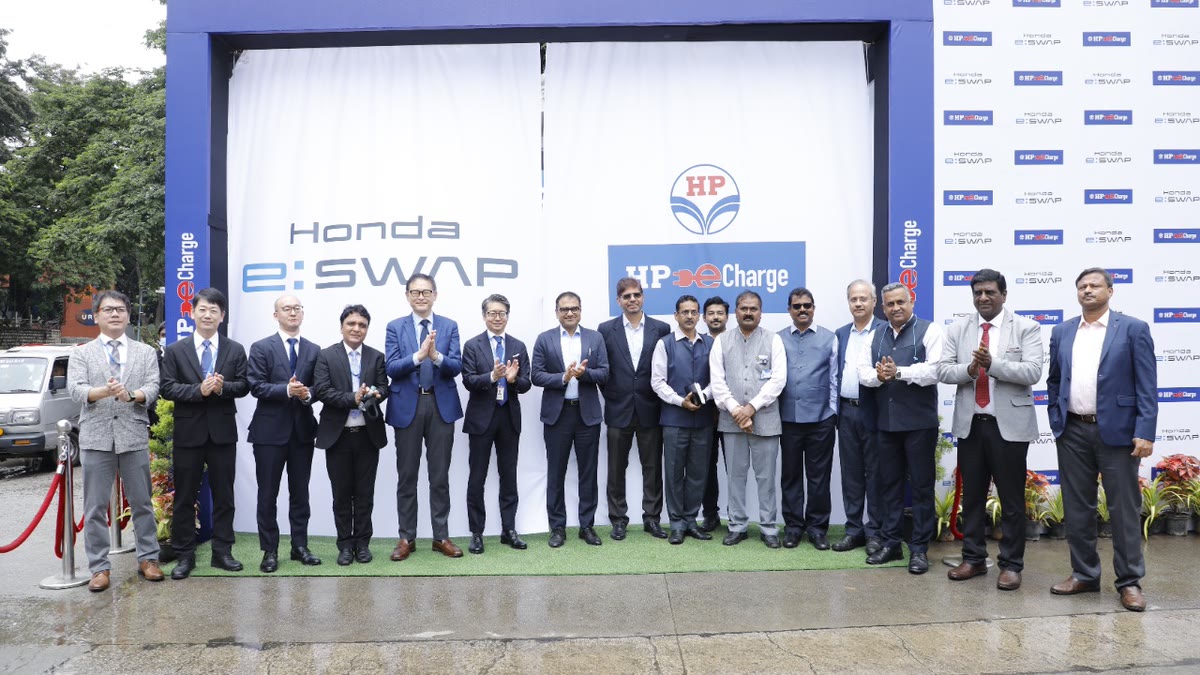
- Hindustan Petroleum Corporation Limited, “HPCL & Honda Join Hands to Boost Electric Mobility in India,” 10 Aug 2022; official photograph used for the hero image