Type 2 AC is the everyday charging connection for many Indian EVs, while CCS2 adds DC fast charging; neither a charger's label nor its maximum kW guarantees that your car will accept that rate. The practical check is to match the vehicle inlet, the car's onboard AC limit, the battery's DC limit and the station's price before you leave.
Key takeaways
- Type 2 normally refers to AC charging; CCS2 combines an AC Type 2 connection with additional DC pins for faster public charging.
- The Ministry of Power's 17 September 2024 guidelines list light-EV AC charging up to 7 kW, parkbay AC around 11/22 kW and DC charging from 50 kW to 250 kW for cars and heavy vehicles.
- Charging speed is limited by the weakest link: the vehicle inlet, onboard charger or battery, the station's connector and the live power available.
- As of November 2026, Delhi's planned 180 sites and 540 chargers show why connector and power compatibility matters before using an expanding public network.
- Public charging cost is not only the electricity tariff. It can include a service charge, land cost and GST; the 2024 national guidelines set service-charge ceilings through 31 March 2028, subject to annual review.
Type 2, CCS2 and kW: the three labels to separate
EV charging becomes easier to compare when three different ideas are kept apart:
- Connector or inlet: the physical and electrical interface between the car and the charger. A Type 2 inlet is used for AC charging. A CCS2 inlet is a combined Type 2-style upper section with two extra DC contacts below it.
- Power: the charger rating in kilowatts (kW). A higher number means more potential power, not a guaranteed charging rate for every vehicle.
- Energy: the electricity added to the battery in kilowatt-hours (kWh). Charging cost is generally calculated from the kWh supplied, while charging time depends on the kW accepted.
The Bureau of Energy Efficiency's EV FAQ lists CCS at a minimum 50 kW for fast four-wheeler charging and Type 2 AC at a minimum 22 kW in its charging-infrastructure table, while the Ministry of Power's newer 2024 Indian Standards annexure uses power levels and BIS connector standards.
Type 2 vs CCS2: what each connection is for
| Connection | Electricity delivered | Official power reference | Where it usually fits | Primary check |
|---|---|---|---|---|
| Type 2 AC | AC reaches the car; the onboard charger converts it to battery DC. | Parkbay AC around 11 kW or 22 kW in the Ministry's 17 September 2024 Annexure I. | Home, office, apartment or slower public charging. | Vehicle's maximum AC input and whether a cable is supplied. |
| CCS2 DC | DC is supplied by the station through the combined inlet, so the car's onboard AC charger is bypassed. | DC Power Level 3: 50 kW to 250 kW; Power Level 4: 250 kW to 500 kW for buses and trucks, as listed in the same annexure. | Public fast charging and highway top-ups. | Vehicle's maximum DC rate, station availability and live tariff. |
| Light-EV AC or DC | Lower-power charging for compatible two- and three-wheelers and some small EVs. | Power Level 1 AC up to 7 kW and light-EV DC up to 12 kW in the 2024 annexure. | Dedicated light-EV bays and city charging. | Vehicle category, inlet standard and connector gun. |
The figures in this table are from the Ministry of Power guidelines issued on 17 September 2024 and should be read as equipment and power references, not as a promise that every station has every connector.
How to estimate charging time
A useful first estimate is:
Charging time in hours = energy to add in kWh ÷ usable charging power in kW.
For an illustrative 30 kWh battery, moving from 20% to 80% means adding 60% of 30 kWh, or 18 kWh. The ideal energy math looks like this:
| Available power | Illustrative calculation | Ideal time for 18 kWh | What can change the result |
|---|---|---|---|
| 7 kW AC | 18 ÷ 7 | About 2.6 hours | AC conversion losses, the vehicle's AC limit and battery temperature. |
| 22 kW AC | 18 ÷ 22 | About 0.8 hour | The car may accept only 7 kW or 11 kW even when the station offers 22 kW. |
| 60 kW DC | 18 ÷ 60 | About 0.3 hour | DC charging usually tapers as the battery fills; the car may be limited below 60 kW. |
BEE's FAQ gives a broad example in which an approximately 30 kWh car reaches 80% in under one hour on a 50 kW fast charger, while a 15-amp slow or moderate connection takes around eight hours for a similar 80% target. The actual session depends on the battery's state of charge, temperature, the vehicle's battery-management system, the station's load sharing and whether the charger is working at its advertised power. Treat these figures as general guidance as accessed on 28 November 2026.
Why a 120 kW charger may not charge at 120 kW
- A vehicle with a lower AC onboard charger will not use a 22 kW AC station at 22 kW.
- A car whose DC limit is 50 kW will normally remain near that limit even at a 60 kW or 120 kW CCS2 station.
- Peak power can be available only during part of the session. Near a high state of charge, the battery may accept less power to protect the cells.
How EV charging cost is built in India
For home charging, BEE's method is battery capacity in kWh multiplied by the applicable state electricity tariff. The Ministry of Power's 2024 guidelines say owners can use an existing home connection, request a separate metered EV connection or seek a higher sanctioned load when the existing load is insufficient; domestic electricity rates apply at home.
For public or community charging, the national guideline says the customer fee can contain the electricity supply tariff, a service charge, land cost and GST. The following service-charge ceilings, valid until 31 March 2028 and subject to annual review, exclude GST and land cost:
| Public charging type | Solar hours, 9 am–4 pm | Non-solar hours, 4 pm–9 am | What the amount is |
|---|---|---|---|
| AC slow | ₹3 per kWh | ₹4 per kWh | Service-charge ceiling, not the complete bill. |
| DC fast | ₹11 per kWh | ₹13 per kWh | Service-charge ceiling, not the complete bill. |
Worked rupee example: If a session adds 20 kWh during solar hours, the guideline ceiling alone works out to ₹60 for AC service charge (20 × ₹3) or ₹220 for DC service charge (20 × ₹11), before the electricity supply tariff, any land component and GST. These are the national guideline ceilings as of November 2026, not a quote from a particular operator. An illustrative home calculation using a local tariff of ₹8 per kWh would be 24 kWh × ₹8 = ₹192; replace ₹8 with the tariff on the actual electricity bill.
Before starting a public session, check the displayed per-kWh rate, service fee, minimum charge, parking or idle fee, payment method and whether the price changes by time of day. Use the EV station directory to shortlist compatible locations, then confirm live availability and the operator's tariff.
Why the current Delhi expansion makes compatibility important
Delhi's public network is a useful current example of how charger choice is becoming more segmented. ET Infra reported on 25 November 2026 that a plan covers 180 locations and 540 chargers, including 12 kW chargers with two guns for electric two- and three-wheelers, 60 kW chargers with two guns for N1 goods carriers and four-wheelers, and 120 kW fast chargers. The Times of India independently reported the same 180-site, 540-point plan on 27 November 2026 and also described the 12 kW, 60 kW and 120 kW mix.
Reports differ on the estimated project cost, so that figure is omitted. A site can have several power levels, but a driver still has to match the car's inlet, vehicle category, maximum accepted power and the charger available when they arrive.
The Ministry of Power also requires public stations to display charger type, AC or DC capacity, availability, rates and additional fees. Check the connector and kW details before adding the stop to your route in the road-trip planner.
Compatibility and safety checklist
- Read the vehicle manual and charging flap: record whether the car supports Type 2 AC, CCS2 DC or another approved inlet, and note the maximum AC and DC input power.
- Separate cable from connector: confirm whether the AC station has a fixed cable or whether the car must carry a compatible Type 2 cable. Do not assume a socket and a tethered gun work the same way.
- Filter the station listing: check AC or DC, connector type, kW rating, number of guns, operating hours, payment method and current availability.
- Plan for the weakest link: calculate time using the car's accepted power, not only the station's headline kW. Keep enough battery for a diversion if the selected bay is occupied or offline.
- Check the bill before authorising: note the per-kWh price, service charge, GST, idle or parking charge and any minimum amount. Save the session receipt.
- Check home electrical capacity: the Ministry permits existing domestic connections, but a higher charger load may require a sanctioned-load increase. Use proper earthing, protection and wiring; do not use a damaged socket, cable or connector.
- Finish the session correctly: stop charging through the charger or app, wait for the lock to release, then remove and return the gun. If the station shows a fault, do not keep charging; contact the operator or vehicle manufacturer.
For a mixed petrol-and-EV household or fleet, the Fuel Cost Calculator can sit beside the EV charging calculation when comparing a route's energy budget.
The live fuel-price pages help keep the petrol or diesel side of that comparison dated rather than relying on an old pump price.
Frequently asked questions
Is a Type 2 charger the same as CCS2?
No. Type 2 generally describes the AC connection. CCS2 adds two DC contacts below the Type 2-shaped upper section, allowing compatible cars to use DC fast charging through the combined inlet.
Can every EV use a 120 kW charger?
No. The car must support the station's connector and the vehicle's battery and charging system set the maximum accepted power. A higher-rated charger may still work at a lower rate, but compatibility and the operator's terms should be checked first.
Is home charging always cheaper than public charging?
Not automatically. Home charging uses the applicable domestic tariff, while public charging adds the operator's service fee and may add land cost and GST. Compare the complete per-kWh bill and the time value of a faster DC stop rather than comparing only the charger label.
How do I find a compatible EV charger near me?
Start with the vehicle manual and note the connector and maximum AC or DC power. Use a station directory or operator map that shows connector, kW, availability and tariff, then confirm the details shortly before departure because live status can change.
Sources
- Ministry of Power — Guidelines for Installation and Operation of Electric Vehicle Charging Infrastructure-2024 (17 Sep 2024; accessed 28 Nov 2026).
- Bureau of Energy Efficiency — Frequently Asked Questions on Electric Vehicles (accessed 28 Nov 2026).
- Mahindra — XUV 3XO EV Owner's Manual, Charging System (1 Sep 2026; accessed 28 Nov 2026).
- ET Infra — Delhi Government to Install 540 Public EV Chargers Across 180 Locations (25 Nov 2026).
- The Times of India — Delhi Plans 180 New EV Charging Stations, 540 Points (27 Nov 2026).
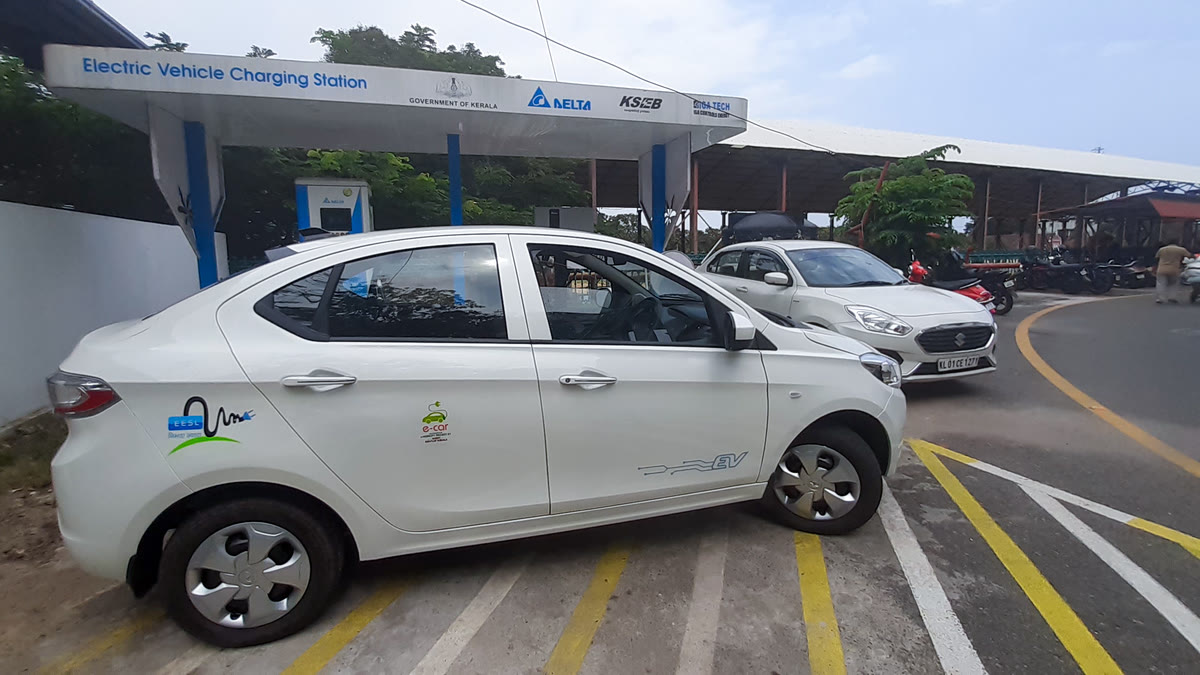
- Wikimedia Commons — Electric Car and Electric Vehicle Charging Station at Government Secretariat, Thiruvananthapuram (photograph by Shagil Kannur, 26 Aug 2020; CC BY-SA 4.0).