When fuel prices move, the quickest durable response is to measure your car's actual km/l and remove the habits or maintenance issues that waste fuel. This guide explains how to do that in Indian driving conditions, turn a mileage change into rupees and build a repeatable checklist without promising a fixed saving for every car.
Recent reports of CNG price increases in Mumbai and five Uttar Pradesh cities show why the calculation matters, but this is not a rewrite of those price stories. The lasting skill is knowing your own car's fuel use, understanding which checks can change it and updating the calculation when your local price changes.
Key takeaways
- Measure mileage with a consistent full-to-full fuel test instead of relying only on the dashboard or brochure figure.
- Use the tyre-pressure label or owner's manual, not the tyre sidewall maximum, when checking inflation.
- Smooth acceleration, early anticipation of stops, the correct gear and less idling can reduce avoidable fuel use without unsafe slow driving.
- Remove unnecessary load, inspect the air filter and brakes, and follow the manufacturer's maintenance schedule before chasing expensive fixes.
- Calculate fuel cost from your current city price and measured km/l; the same car can cost different amounts in different cities.
Why mileage math matters when fuel prices change
On 1 November 2026, Hindustan Times and The Indian Express reported that Mumbai CNG moved up by ₹1 per kg to ₹90 per kg. The Times of India and Navbharat Times reported that Green Gas Limited raised CNG rates in five Uttar Pradesh cities from the same date, with Unnao seeing a ₹2.25 per kg increase and the other listed cities a ₹1 per kg increase. These are local distributor revisions, not a single nationwide rate, and they may change again.
The practical response is to keep the input in your budget current. Use the live fuel prices page for the city and fuel type you actually use, then record the date beside the price. Do not compare a mileage result from one month with a fuel bill from another month without separating the price change from the efficiency change.
First, measure your real-world mileage
Use the full-to-full method
Official fuel-consumption figures are produced under standard test conditions, while traffic, road surface, load, air-conditioning use and driving style affect a car on the road. The Bureau of Energy Efficiency explains that laboratory fuel-consumption testing is not the same as the everyday consumption of an individual model. Autocar India and a Ford India owner's manual both describe a consistent full-tank method for estimating fuel economy.
- At a familiar pump, fill the tank using the same practical cut-off each time. Record the odometer or reset the trip meter.
- Drive normally through the mix you want to measure. Keep a note of whether the period was mostly city traffic, highway driving or a combination.
- At the next refill, note the distance travelled and the litres added. Avoid treating the fuel-gauge needle or a single short top-up as a precise measurement.
- Calculate mileage as kilometres travelled divided by litres added. For example, 420 km divided by 28 litres is 15 km/l; this is an illustrative calculation, not a claim about every car.
- Repeat the test under similar conditions. One unusually clear Sunday or one severe traffic jam can distort a comparison.
For a rupee view of the same result, the fuel cost per kilometre guide uses the same basic relationship: price per litre divided by actual km/l. Repeating the test makes it easier to see whether a change in tyre pressure, route or driving style produced a real difference.
Keep the comparison fair
- Check and record tyre pressure when the tyres are cold, and use the value on the driver's-door label or in the owner's manual.
- Keep the route, passenger load, air-conditioning setting and driving pattern broadly comparable when testing two periods.
- Use the same pump and dispenser where practical. Consistent filling is more useful than pretending a dashboard readout is a laboratory result.
- Keep fuel receipts or a simple phone note with date, litres, odometer and city. This creates a useful history when fuel prices or maintenance change.
Turn mileage into a rupee number
For a dated illustration, the Petroleum Planning and Analysis Cell lists Delhi petrol at ₹102.12 per litre as the Indian Oil retail selling price on 30 October 2026, and the Hindustan Times city listing shows the same Delhi price on 1 November 2026. Retail prices vary by city and can change, so replace this input with the price shown for your own location.
The table assumes 1,000 km in a month and uses four illustrative mileage readings. The distance and km/l values are inputs for comparison, not national averages or a promise that your car will reach any particular figure.
| Measured mileage | Fuel for 1,000 km | Petrol cost at ₹102.12/litre | Cost per km |
|---|---|---|---|
| 12 km/l | 83.33 litres | ₹8,510 | ₹8.51 |
| 15 km/l | 66.67 litres | ₹6,808 | ₹6.81 |
| 17 km/l | 58.82 litres | ₹6,007 | ₹6.01 |
| 20 km/l | 50 litres | ₹5,106 | ₹5.11 |
Worked example: If the same 1,000-km month changes from 15 km/l to 17 km/l, the illustrative petrol bill falls from ₹6,808 to about ₹6,007 at the stated Delhi price. That is about ₹801 for the month, or about ₹9,611 over 12 similar months. The result is arithmetic, not a guaranteed saving: a different city price, route, distance, load or air-conditioning pattern will change it.
For a real trip, put your measured mileage and the current price into the fuel cost calculator. The output is more useful when it is based on your own full-to-full result rather than a brochure number.
Checks that can improve fuel economy
1. Set tyre pressure correctly
Under-inflated tyres create more rolling resistance, so the engine has to work harder. Maruti Suzuki's car-care guidance and Autocar India's mileage method both identify tyre pressure as a practical fuel-efficiency check. Measure when the tyres are cold, follow the vehicle label and check the spare where applicable.
- Do not use the maximum pressure moulded into the tyre sidewall as the normal setting for your car.
- Do not overinflate to chase a mileage number; handling, braking and tyre wear matter more than a small test result.
- If pressure keeps falling, inspect for a puncture, valve problem or wheel issue instead of repeatedly adding air.
- If the car pulls to one side or the tread wears unevenly, ask for a tyre, alignment and brake inspection.
2. Accelerate and brake smoothly
Hard launches and late braking turn fuel into heat and repeated acceleration. A safer fuel-saving habit is to look further ahead, lift off early when traffic is slowing and maintain a legal, steady pace when conditions allow. There is no universal “best speed” for every road: traffic, speed limits, gears, gradients and safety come first.
- Use progressive throttle input after a signal or speed breaker.
- Anticipate red lights and queues without coasting unpredictably or blocking other road users.
- In a manual car, select a higher gear only when the engine is not struggling; do not ride the clutch.
- In an automatic, avoid repeated unnecessary throttle-brake inputs in slow traffic and leave safe following distance.
3. Avoid unnecessary idling and warm-up
An idling engine still consumes fuel. A modern car normally does not need a long stationary warm-up before a gentle drive, but the owner's manual and weather conditions still matter. Switch off during a safe, prolonged wait where restarting is appropriate; never turn the engine off in a moving traffic situation where it would reduce control or safety, and never idle in an enclosed space.
4. Remove unused load and roof equipment
Extra mass and external carriers increase the work required to move a vehicle, especially in stop-and-go use or at higher speeds. Remove tools, water cans, luggage and roof accessories that are not needed for the journey. Do not remove safety equipment or compromise the vehicle's legal and safe carrying capacity for a mileage experiment.
5. Maintain the parts that affect running resistance
Follow the service schedule for the specific model and fuel type. A dirty air filter, incorrect engine oil, dragging brake, poor wheel alignment or a warning light can affect how efficiently the car uses fuel. Maruti Suzuki advises using the specified lubricant and maintaining the air filter; Autocar India also lists maintenance and tyre pressure among the factors that influence real-world efficiency.
- Use the viscosity and specification in the owner's manual, not a thicker oil simply because it is available.
- Ask the workshop to investigate a sudden mileage drop rather than accepting it as normal ageing.
- Check whether the brakes release properly and whether the wheels rotate freely during a scheduled inspection.
- Keep the fuel cap and fuel system free from leaks; fuel loss is a safety issue as well as a cost issue.
6. Treat air-conditioning and traffic as test conditions
Air-conditioning load, congestion, gradient and route choice can change the result even when the car and driver are unchanged. Compare like with like: a city commute with the AC on should not be used to judge a free-flowing highway run with the AC off. Use the shortest safe route, but do not choose a dangerous road or drive below a safe traffic speed just to improve a dashboard number.
For an outstation journey, use the road-trip planner to compare the distance and route before leaving. A slightly longer route that avoids repeated stop-and-go traffic may change the total fuel bill, but the time, toll and road-safety trade-off should also be considered.
What to check or do this week
- Write down the current odometer reading, fuel price, tyre pressures and dashboard mileage.
- Check the door-label pressure on cold tyres and inspect the tread, spare and visible leaks.
- Remove unnecessary boot or roof load before the next comparable commute.
- Run one full-to-full measurement and save the date, litres, kilometres and driving mix.
- For a manual car, notice clutch riding and late braking; for an automatic, notice repeated throttle-brake cycles.
- Check the service record for the air filter, engine oil, brake inspection and scheduled maintenance.
- Repeat the same route or route type and compare cost per kilometre, not just the dashboard average.
- Update the fuel price in your monthly or trip budget whenever the local rate changes.
Frequently asked questions
How do I calculate my car's mileage?
Fill the tank consistently, record the distance until the next comparable refill and divide kilometres travelled by litres added. Repeat the test because one fill can be affected by traffic, pump cut-off, load or route conditions.
Is the mileage shown on the dashboard accurate?
It is a useful estimate, but it may not match fuel consumed at the pump. A consistent full-to-full record is a better basis for a personal fuel budget, while official brochure mileage is a standard test result rather than a guarantee for Indian road conditions.
Can tyre pressure increase mileage?
Correct pressure can reduce rolling resistance and help the tyre work as designed, especially when a tyre is underinflated. The correct value is vehicle-specific; overinflating beyond the maker's recommendation can affect grip, braking and wear.
Should I drive very slowly to save fuel?
No. Fuel saving does not override speed limits, traffic flow or road safety. Smooth inputs, fewer unnecessary stops, correct gearing and a well-maintained car are more useful than following a single speed number on every road.
Reader takeaway
Start with evidence: measure your actual km/l, record the local price and compare the cost per kilometre. Then correct the basics in order—cold tyre pressure, smooth driving, unnecessary idling, unused load, route conditions and scheduled maintenance. If the measured result still falls sharply or changes suddenly, treat that as a reason for a proper inspection, not as a mileage trick to solve with an unsupported additive or an unsafe driving habit.
Sources
- Petroleum Planning and Analysis Cell — RSP of Petrol in Delhi as per IOCL outlet on 30 October 2026 — 30 Oct 2026
- Indian Oil Corporation — Petrol and Diesel Price: daily price changes and city lookup — accessed 1 Nov 2026
- Hindustan Times — Petrol Price in New Delhi: city rate listing for 1 November 2026 — 1 Nov 2026
- Bureau of Energy Efficiency — Fuel Efficiency and standard-condition testing — accessed 1 Nov 2026
- Maruti Suzuki — Car Care: fuel-efficiency, tyre-pressure, idling and maintenance guidance — accessed 1 Nov 2026
- Autocar India — Calculate your car's fuel efficiency correctly — 29 Sep 2018
- Ford India — EcoSport owner's manual: consistent filling and fuel-economy calculation — accessed 1 Nov 2026
- Hindustan Times — CNG prices in Mumbai to be up by Re 1 per kg from November 1 — 31 Oct 2026
- The Indian Express — Mumbai CNG to cost Rs 90 per kg from November 1 after Re 1 hike — 31 Oct 2026
- The Times of India — UP CNG price hike: rates rise by up to Rs 2.25 per kg in five cities from November 1 — 31 Oct 2026
- Navbharat Times — UP CNG price hike across Lucknow, Agra, Unnao, Ayodhya and Sultanpur — 31 Oct 2026
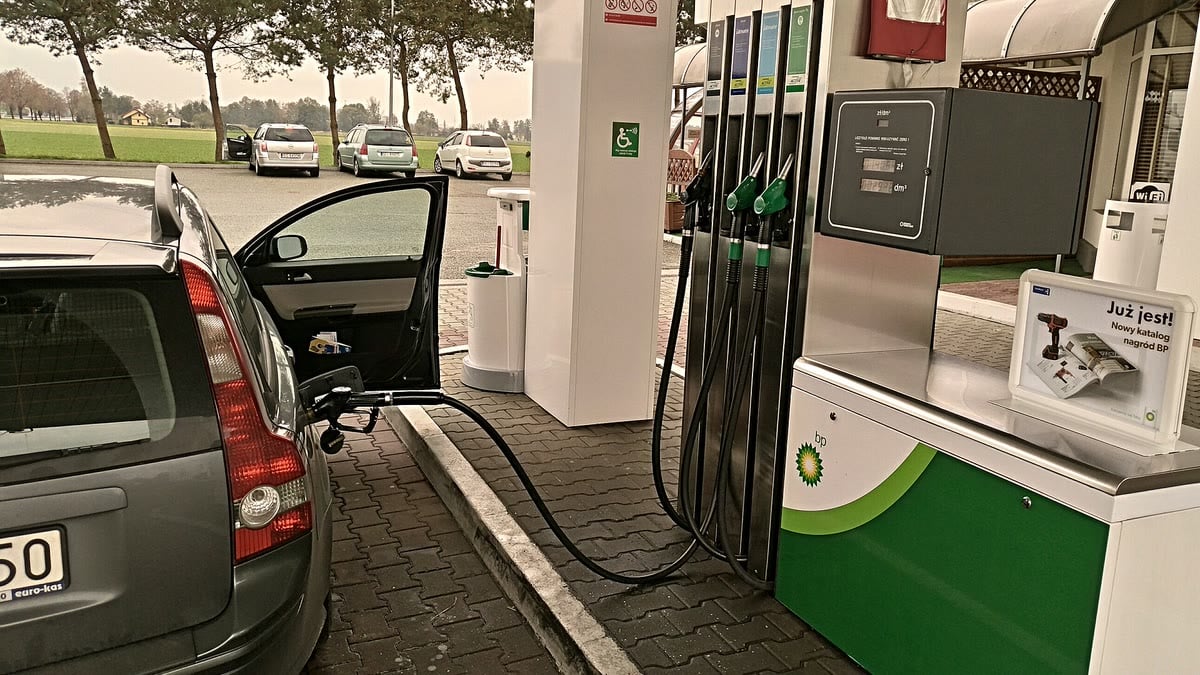
- Hero photograph — Filling station refueling a car, MichalPL, Wikimedia Commons, CC BY-SA 4.0 — 23 Oct 2017; cropped for this guide