Buying a used electric car is a battery-and-paperwork decision as much as a normal car inspection. This guide shows how to verify battery health, remaining warranty, charging access, ownership transfer and operating cost before paying; the key takeaway is that a low asking price only makes sense after the battery, warranty and daily charging plan are documented.
Key takeaways
- Ask for a dated battery diagnostic report from an authorised service centre; a dashboard range estimate alone is not a battery-health certificate.
- Warranty terms differ by model, registration type and owner. Confirm the VIN-specific coverage and the process for transferring it before you pay.
- Check that home or nearby public charging fits the car's connector, route and parking situation. Use the EV charging-station directory to map practical options.
- Complete the RC, insurance, PUC, loan-closure and ownership-transfer checks together; a signed sale receipt is not the same as a completed transfer.
- Compare total cost: purchase price, energy, charging losses, insurance, tyres, service, finance and the remaining battery-warranty runway.
Why this checklist matters now
Recent Vahan-based reports show India's electric-car market has crossed a new 2026 milestone and sustained strong monthly growth. That is a market signal, not proof that any particular used EV is a good buy, but it means buyers will increasingly encounter older EVs, ex-demonstrator cars and first-owner resale listings.
Unlike a used petrol car, an EV's battery warranty and charging access can change the economics, so those checks come first.
1. Start with the car's real use case
Before comparing listings, write down the trips the car must handle. A city commuter with secure overnight parking has a different requirement from a household that makes frequent highway trips or lives in a rented building without a dedicated socket.
- Daily distance: use your actual weekday and weekend pattern, not the seller's claimed maximum range.
- Charging location: confirm whether a safe home connection is possible. If not, identify public chargers near home, work and regular routes.
- Route needs: check how much of your driving is city, highway, hill or extreme-weather use. Claimed range and usable range are not identical.
For a longer trip, compare charging stops and route time in the road-trip planner instead of relying only on the car's range display.
2. Treat battery health as the first gate
Battery state of health, or SoH, is a measure of how the usable energy capacity of the pack compares with its original condition. It is useful, but the number only has meaning when you know the diagnostic method, date, vehicle identification number and warranty threshold that apply to that model.
What to request from the seller
- A printed or digitally verifiable battery diagnostic report from the manufacturer's authorised service network, showing the VIN and report date.
- The measured usable capacity or SoH, recorded fault codes and any battery, motor or thermal-management alerts.
- Service invoices and evidence of software updates, recall work, accident repairs and any battery-related complaint.
- The original charging cable, portable charger, adapter and any supplied repair kit. Missing equipment changes the real purchase cost.
- A written explanation for any warning light, sudden range change, water exposure or underbody impact.
During the inspection, compare the report with the car's registration date, odometer and displayed range. A full battery icon does not prove that the pack still holds its original usable energy. A test drive should look for sudden state-of-charge drops, unusual power limitation, warning messages, inconsistent regenerative braking and charging that stops unexpectedly. These checks do not replace an authorised diagnostic.
3. Read the battery warranty as a second owner
Warranty language is not uniform across Indian EVs. It may depend on the model, battery size, private or commercial registration, first-registration date, mileage, service history and whether the manufacturer has been notified about the ownership change. The terms below are published examples checked on 16 November 2026, not a substitute for the warranty document for the exact car.
| Published term | First registration | Second or later registration | What the buyer must verify |
|---|---|---|---|
| Selected Tata EV terms | Eligible models may have a lifetime or unlimited-kilometre HV-battery term for the first registration; the brand defines the scope by model and conditions. | Tata's current warranty page lists 8 years or 1,60,000 km from first registration for the relevant second-registration terms, whichever comes first. | Exact model and battery, first-registration date, VIN confirmation and the required ownership-transfer notice. |
| Mahindra BE 6 and XEV 9e terms | Lifetime HV-battery warranty for the first registered owner, subject to private-registration conditions. | 10 years or 2,00,000 km from the first delivery date after ownership change, whichever comes first. | Private-registration eligibility, first-delivery date, remaining term, service conditions and written confirmation from Mahindra. |
Autocar India has separately explained that Tata's lifetime wording for eligible models refers to 15 years from registration and that the longer benefit is for first owners. Tata's own warranty page and Mahindra's own terms should be treated as the controlling documents. If a seller says the warranty will transfer automatically, ask the manufacturer to confirm that statement against the VIN in writing.
4. Check charging access and calculate the running cost
Charging is part of the vehicle, not an afterthought. Ask whether the seller used home AC charging, workplace charging or public DC charging, and check whether the supplied cable and the car's connector match your intended setup. Public charging rates, parking charges and availability vary by provider, so a public-only plan needs more margin than a home-charging plan.
- Check whether your parking space has a safe, approved electrical connection and whether installation or society permissions are needed.
- Record energy from the meter or charger, not just the battery percentage. Charging losses make wall-to-battery calculations differ.
- Compare a used EV with a petrol car on cost per kilometre, insurance, tyres, service, financing and depreciation, not energy cost alone.
The fuel-cost calculator can provide the petrol or diesel baseline. For an EV, use the electricity drawn from the meter: electricity tariff multiplied by kWh drawn, divided by kilometres driven.
Worked illustration: monthly energy cost
Assume, for illustration only and not as a market quote, 1,000 km of driving in a month, petrol at ₹100 per litre and petrol efficiency of 15 km per litre. Petrol energy cost is 1,000 ÷ 15 × ₹100 = about ₹6,667. If the EV draws 0.18 kWh per kilometre from the meter and the applicable electricity rate is ₹8 per kWh, the EV energy cost is 1,000 × 0.18 × ₹8 = ₹1,440. The difference is about ₹5,227 for that month.
This is an illustrative calculation checked in November 2026, not a promise of savings. Replace every input with your city fuel price, electricity tariff, vehicle efficiency, charging loss, public-charger fee and actual monthly distance. Add insurance, tyres, service, finance, home-charger cost and depreciation before deciding whether the price gap is justified.
5. Verify RC, insurance and transfer paperwork
Parivahan's current ownership-transfer guidance says a buyer applying in the same state should submit the transfer application within 14 days of the transfer; for an interstate transfer, the stated period is 45 days. Confirm the applicable RTO process, fee and tax position for the vehicle's state instead of treating an online seller message as proof of transfer.
- Match the VIN and registration number on the car, RC, insurance and battery report.
- Collect the RC, valid insurance certificate, PUC certificate, Form 29 and Form 30, and the identity and address documents required by the registering authority.
- Check whether a lender's hypothecation is still shown. Obtain the lender's closure or NOC paperwork before treating the vehicle as unencumbered.
- Check pending challans, tax status, permit or commercial use, accident history and flood exposure.
- Record the odometer, agreed price, accessories, known defects, payment milestones and handover date in a signed sale receipt.
The road-trip document checklist covers the documents that should remain valid after the purchase. Insurance and PUC should be checked as vehicle records, not assumed to be current because the listing is recent.
6. What to check before paying
- Body and structure: look for uneven panel gaps, paint mismatch, repaired rails, underbody scrapes and water marks around the cabin and battery area.
- Tyres, brakes and suspension: check wear across all wheels, braking feel, steering pull, suspension noise and the age of the tyres.
- 12-volt battery and electronics: test the screens, cameras, lights, climate control, windows, key fobs, connected app and charging-port lock.
- Charging test: try the supplied AC equipment and, where practical, a compatible public charger. Record whether the session starts, maintains power and ends cleanly.
- Service history: verify invoices with the workshop, not only a seller-created spreadsheet. Look for missed services, repeated battery warnings or unresolved software faults.
- Usage history: ask whether the car was a taxi, rental, delivery vehicle, flood-recovery vehicle or accident-repaired vehicle. Commercial use can affect wear and warranty terms.
Walk away from a listing where the seller will not permit an independent inspection, VIN check, charging test or written warranty confirmation. The point is not to reject every older EV; it is to price the documented condition rather than an attractive odometer reading.
7. Compare total ownership cost before paying
Use a simple side-by-side sheet for the exact car and a petrol alternative. Include:
- Purchase price, transfer costs, financing interest and any outstanding loan closure.
- Energy cost based on your real route and charging mix.
- Insurance, tyres, routine service, consumables and likely repairs.
- Remaining battery and vehicle warranty, including conditions for the next owner.
- Home charging work, public charging fees and the time cost of charging on long trips.
- Expected resale value and the evidence you will have for the next buyer.
For a new-EV price, range and charging benchmark, compare this checklist with our guide to EVs under ₹10 lakh. A used EV can be the lower-cost option in one driving pattern and the wrong fit in another; the calculation has to use your distance, tariff, parking and ownership period.
FAQs
Is a used EV safe to buy if the battery warranty is still active?
Remaining warranty reduces one risk but does not prove the car's condition. Obtain VIN-specific coverage, a dated battery diagnostic and service history before comparing the price.
How do I check the battery health of a used electric car?
Request an authorised report identifying the car, date, usable capacity or SoH and fault codes. Combine it with a charging test and battery-tray inspection; dashboard range is only one operating signal.
Does an EV battery warranty automatically transfer to the next owner?
Not always. Terms differ: Tata requires the second or subsequent owner to notify the company for the relevant lifetime battery warranty, while Mahindra publishes a separate post-transfer term for eligible vehicles. Confirm the process with the manufacturer.
How quickly must a used EV ownership transfer be completed?
Parivahan states 14 days for an in-state application and 45 days for an interstate transfer. State procedures, taxes, fees and lender documents can affect the timeline, so keep the acknowledgement and check the RTO status.
Sources
- Autocar India — “October 2026 electric car sales: Over 30,000 units hit for fifth straight month” — 04 Nov, 2026.
- Maxabout — “India's electric car retail crosses 3 lakh in 2026” — 12 Nov, 2026.
- Tata.ev — “EV Lifetime Battery Warranty & Coverage Details” — accessed 16 Nov, 2026.
- Autocar India — “Tata Curvv EV, Nexon EV 45 now get 15-year battery warranty” — 10 Jul, 2025.
- Mahindra Electric SUV — “Terms & Conditions” — accessed 16 Nov, 2026.
- Parivahan Sewa — “Transfer of Ownership” — accessed 16 Nov, 2026.
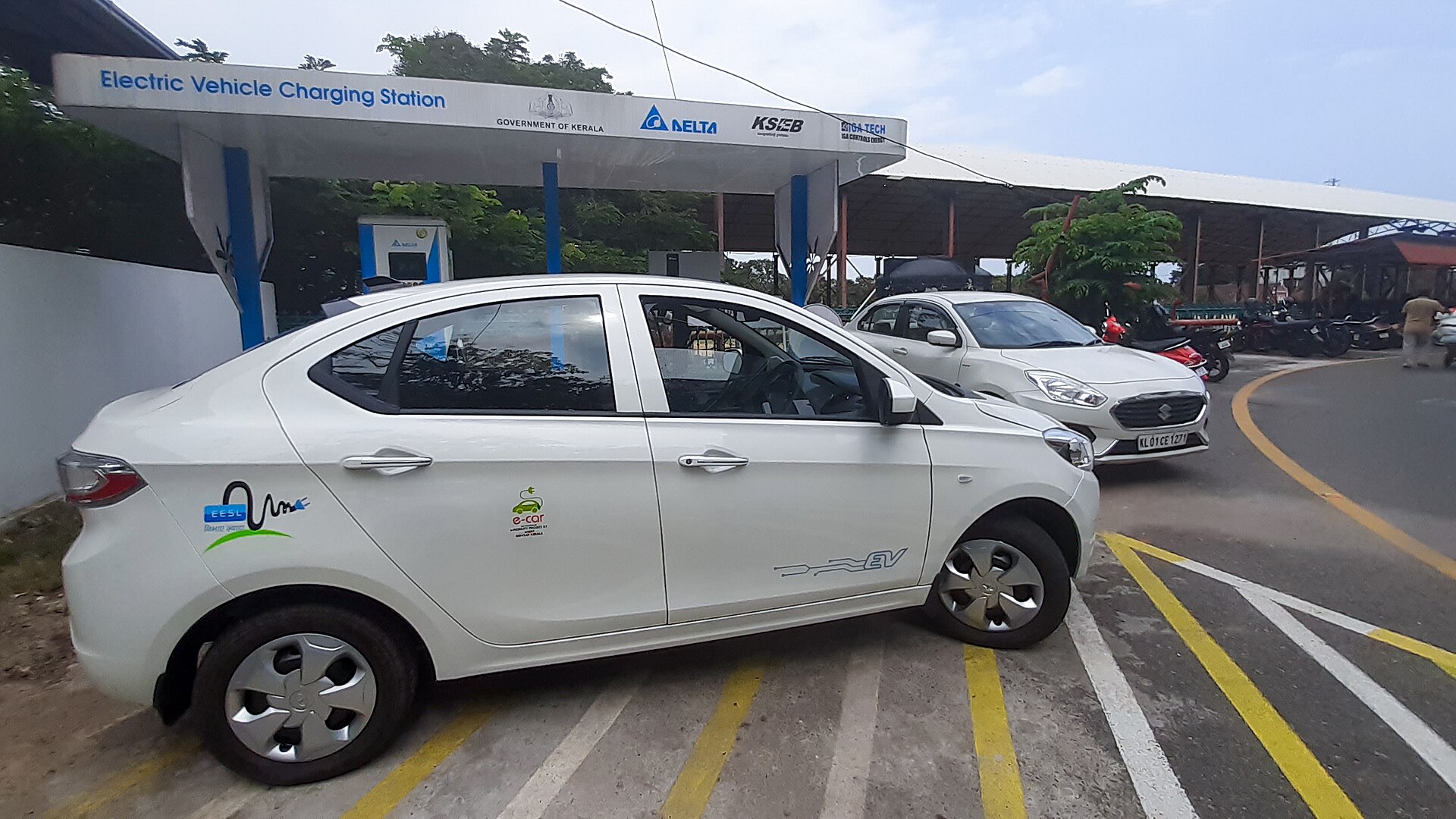
- Wikimedia Commons — Shagil Kannur, “Electric Car and Electric Vehicle Charging Station at Government Secretariat, Thiruvananthapuram” — 26 Aug, 2020; CC BY-SA 4.0. Hero photograph.
This article is for general information only and is not financial, insurance or legal advice.