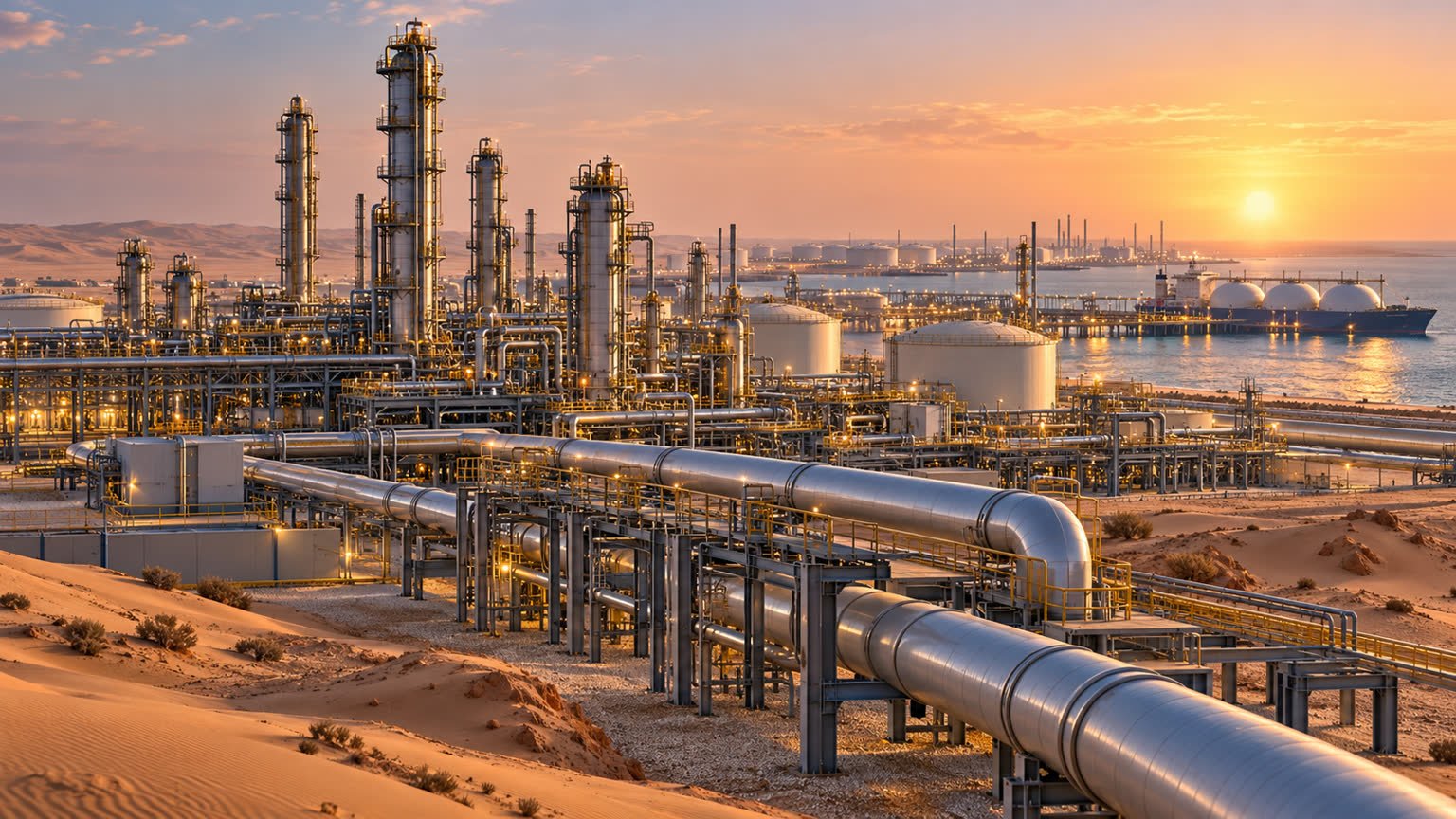
Abu Dhabi National Oil Company (ADNOC) has taken the final investment decision (FID) on the Ruwais Diyab unconventional-gas development in Abu Dhabi, with planned output of 345 million standard cubic feet per day (mmscfd) from 2029. The project matters beyond the UAE because it is intended to reinforce domestic gas supply and support the country’s future liquefied natural gas (LNG) export ambitions, but it is not an immediate change to petrol or diesel prices.
ADNOC announced the decision at ADIPEC on 2 Nov 2026, and Reuters separately reported the same production and timing details. For drivers and fleet operators, the practical takeaway is that this is a future energy-supply story: its market effect will depend on construction, drilling, gas-network integration and later LNG sales rather than on today’s pump board.
Key takeaways
- ADNOC confirmed an FID for the Ruwais Diyab unconventional-gas development on 2 Nov 2026.
- Planned initial output is 345 mmscfd of raw gas from 2029, over a 25-year period.
- ADNOC says future production could expand to as much as 1 billion standard cubic feet per day.
- The gas will be processed on site and connected to the UAE network through new pipeline infrastructure.
- The project supports UAE energy security and LNG ambitions, but does not guarantee lower global gas or fuel prices.
What ADNOC approved
An FID is the point at which a company formally commits to proceed with a project after technical, commercial and development work. In this case, ADNOC described Ruwais Diyab as its first large-scale unconventional-gas development. The project is in Abu Dhabi and is being advanced by ADNOC Onshore under a design-build-operate model.
The company said the development follows technical studies, field testing and subsurface analysis intended to reduce development risk. It also cited AI-enabled drilling and well-completion technologies as part of the delivery approach. Those details describe ADNOC’s planned development method; they do not mean the project is already producing at commercial scale.
The numbers and timing
ADNOC expects the full development to deliver 345 mmscfd of raw gas from 2029 and to continue for 25 years. The company also said output could eventually reach up to 1 billion standard cubic feet per day. That larger figure is a future potential, not the starting volume and not a guaranteed production level.
Gas will be processed at the site and connected to the UAE’s gas network by new pipelines. That design gives the project two possible roles: first, supply for domestic power and industry; and second, additional feedstock that can support ADNOC’s LNG export plans. Reuters’ account matched the company’s output, start-date and network-connection details.
Why this matters to global energy markets
The UAE is already a major energy producer, but the new project shows how Gulf producers are trying to add gas supply alongside their oil businesses. ADNOC said the UAE has 298 trillion standard cubic feet of conventional gas reserves and 160 trillion standard cubic feet of unconventional gas resources, figures attributed to the company’s 2 Nov 2026 announcement.
More domestic gas can reduce the pressure to divert existing supplies between electricity generation, industrial users and export projects. If the development reaches its planned schedule, it could also give the UAE more flexibility in how it feeds LNG facilities and serves customers in international markets. That is strategically relevant while buyers in Asia and elsewhere are looking for reliable long-term gas supply.
The effect should not be overstated. A project that starts in 2029 cannot resolve a short-term LNG shortage, and the announcement did not provide a project investment value or a confirmed new LNG sales contract. The eventual market impact will depend on actual production, pipeline completion, contract terms and the balance between UAE domestic demand and export volumes.
What it means for drivers, fleets and transport costs
Natural-gas developments affect mobility differently from a crude-oil price move. They do not automatically change gasoline or diesel at service stations. A motorist who wants to check current pump rates can use FuelPrice’s live fuel prices page, while a fleet operator can use the fuel-cost calculator to model a trip using the latest available input.
There can be indirect effects over time. Gas supply can influence electricity generation, industrial costs and the availability of LNG for heavy transport or shipping in markets where those fuels are used. More stable domestic gas supply may also help the UAE protect industrial operations during periods of international volatility. But those are potential system-level effects, not a promise of cheaper fuel for a particular driver.
What remains unconfirmed
The FID confirms the decision to proceed; it does not confirm that every future milestone will arrive on schedule. ADNOC has not yet announced a commercial production date more precise than 2029, a final investment figure, or the share of the gas that would be directed to LNG exports. The company’s “up to 1 billion standard cubic feet per day” statement is an expansion possibility and should be read as such.
Readers should also distinguish raw-gas output from saleable LNG. Raw gas needs processing, transmission and, for exports, liquefaction and shipping. Each step has its own construction, operating and contracting requirements. The project therefore adds to the UAE’s potential supply picture first; it becomes an international LNG-market factor only as those later steps are completed.
What to watch next
The next useful checkpoints are construction activity at Ruwais Diyab, drilling and completion progress, connection of the new pipelines to the UAE network, and any later announcement on LNG offtake or export volumes. Market watchers should also track whether the 2029 schedule is maintained and whether the possible expansion toward 1 billion standard cubic feet per day receives a separate development commitment.
For continuing context on global fuel, gas and mobility developments, readers can follow FuelPrice’s worldwide fuel and energy news. The reader takeaway is straightforward: ADNOC has committed to a significant future gas project with a clear UAE supply and LNG angle, but the project is expected supply, not an immediate price cut.
This article is for general information only and is not financial, insurance or legal advice.