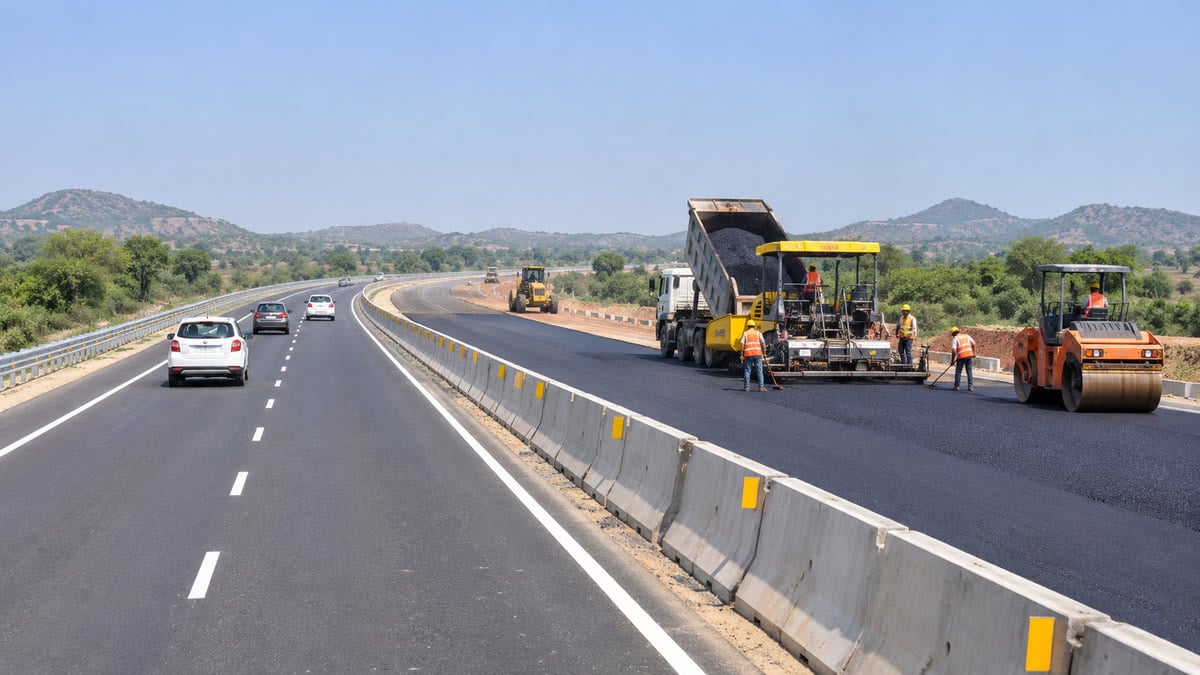
Ashoka Buildcon has received a Letter of Acceptance (LoA) from the National Highways Authority of India (NHAI) for balance construction work on the Karvad–Jujuwa section of the Vadodara–Mumbai Expressway in Gujarat, according to the company’s exchange filing dated 9 Nov 2026. The award is a project step, not a new toll notification or an immediate promise that the unfinished stretch is open to traffic.
For drivers, the useful takeaway is simple: the corridor has moved from bidding to a formally accepted EPC award, but route availability, toll collection and any opening date still depend on construction and separate official notices.
Key takeaways
- Ashoka Buildcon’s accepted EPC price is ₹865.90 crore, excluding GST, as disclosed on 9 Nov 2026.
- The scope covers balance work on an eight-lane access-controlled expressway from km 128.0 to km 154.6, a 26.6-km span in Gujarat.
- The company filing gives an 18-month execution period and a 10-year defect-liability period; the NHAI tender record lists the work period as 540 days.
- The disclosure does not announce a road-opening date, a revised toll fee or a change to the toll rules for motorists today.
What NHAI has awarded
The 9 Nov 2026 filing hosted in the NSE archives says Ashoka Buildcon has received the LoA for the project and identifies NHAI as the awarding entity. It describes the work as an engineering, procurement and construction, or EPC, contract. In practical terms, the contractor is being engaged to complete the specified highway work for the authority; the filing does not say that the contractor will operate the route or set user fees.
The accepted EPC price is ₹865.90 crore excluding GST. An independent EquityBulls report published on 9 Nov 2026 also reported the LoA, the same accepted price and the 18-month execution period. That confirmation matters because the company’s earlier 5 Nov disclosure had only placed the project at the lowest-bidder stage; the latest filing records the subsequent acceptance.
Which stretch is covered
The NHAI Government eProcurement record identifies Package IX as balance work for an eight-lane access-controlled expressway from km 128.0 to km 154.6 on the Vadodara–Mumbai Expressway, covering the Karvad-to-Jujuwa section in Gujarat. The difference between the listed chainages is 26.6 km. The company’s 9 Nov filing repeats the same corridor description.
The original procurement record, published on 28 May 2026, carried an estimated tender value of ₹873.62 crore and a stated period of work of 540 days. The later accepted EPC price of ₹865.90 crore is a contract figure excluding GST, so the two amounts should not be presented as a consumer saving or as a final tax-inclusive project cost. One is the tender estimate; the other is the accepted bid price disclosed by the contractor.
What it means for drivers and transporters
The award may eventually help complete a missing or unfinished part of a major road corridor, but the immediate effect for road users is limited. The public documents reviewed for this report do not give a mobilisation date, a calendar completion date, a traffic-opening schedule or a new fee-plaza notification. Drivers should therefore treat the section as a project under execution until NHAI publishes a separate operational update.
That distinction is important for commercial operators. A construction award can improve the prospect of a more continuous route in the future, but it does not yet change trip timing, route permissions or the toll payable on an existing journey. Until a new section is officially opened, fleet managers should continue planning around currently available roads and known restrictions. The road-trip planner can help compare available routes and travel times before dispatch.
Fuel budgeting should also be based on the route that is actually usable today. A shorter future alignment may eventually reduce distance or idling, but those benefits cannot be counted before the road is open. For a current trip estimate, use the fuel-cost calculator with the vehicle’s real mileage, fuel type and planned distance rather than assuming that the awarded stretch is already available.
What does not change yet
- No new toll rate: the LoA does not announce a per-trip fee, an annual pass change or a revised toll schedule.
- No immediate opening: the award confirms construction responsibility, not completion or public access.
- No fixed calendar deadline: the filing gives 18 months for execution but does not state when that period starts.
- No automatic route saving: fuel, time and toll benefits can be assessed only after the road’s operational status and fee structure are officially notified.
Motorists should also avoid treating the ₹865.90-crore figure as a toll-funded charge. It is the accepted EPC price for the construction package, and the filing does not say that this amount will be recovered directly from an individual trip or vehicle category.
Timeline and accountability
The company filing specifies an 18-month execution period and a 10-year defect-liability period. The NHAI tender record expresses the work period as 540 days. These descriptions point to the same broad construction window, but neither document gives a start date that would allow a reliable public completion date to be calculated.
The 10-year defect-liability term is a contract condition, not a guarantee that construction will finish on a particular day or that every future maintenance issue will be resolved without delay. The next useful updates will be the formal start or mobilisation information, physical progress, any revised completion schedule and the notification that defines when traffic can use the completed section.
What to watch next
For readers who use the Gujarat–Maharashtra corridor, the practical checklist is to watch NHAI or project-authority updates for traffic opening, diversions, fee-plaza operations and the applicable vehicle classes. Once a route is operational, the toll-charge calculator can be used to compare the notified toll with other available routes. Until then, the LoA should be read as a construction milestone rather than a change to today’s travel cost.
Bottom line
Ashoka Buildcon’s NHAI LoA is a verified move from bid selection to an accepted contract for balance work on the Karvad–Jujuwa section of the Vadodara–Mumbai Expressway. It is relevant to drivers and transporters because completing the section could improve future corridor continuity, but there is no confirmed toll, opening or trip-cost change for motorists as of 10 Nov 2026.
Sources
- Ashoka Buildcon exchange filing, “Receipt of LOA for National Highways Authority of India (NHAI) Project” — 9 Nov 2026
- Government eProcurement System, NHAI Package IX tender record — published 28 May 2026; accessed 10 Nov 2026
- EquityBulls, “Ashoka Buildcon Receives ₹865.90 Crore Letter of Acceptance for Vadodara-Mumbai Expressway Package IX” — 9 Nov 2026