Olectra Greentech reported consolidated profit of ₹52.12 crore for the quarter ended 30 Sep 2026, up 5.4% year on year, while revenue from operations rose 4.6% to ₹687.01 crore. The result matters to Indian electric-bus operators because it shows the scale of the company’s current pipeline, but it does not by itself set new passenger fares, delivery dates or charging access.
Key takeaways
- The company’s unaudited consolidated net profit was ₹52.12 crore for Q2 FY27, compared with ₹49.43 crore in the year-ago quarter.
- Revenue from operations rose to ₹687.01 crore from ₹656.62 crore in the quarter ended 30 Sep 2026.
- ET Auto and The Times of India reported an electric-bus order book above 8,000 and cumulative electric-vehicle deliveries above 4,750.
- Olectra said its next-generation electric buses are planned for Q4 FY27, but no model price, customer route or delivery schedule was announced.
- For operators, the next useful evidence is conversion of the order pipeline into buses, depots, charging plans and scheduled service.
What Olectra reported for Q2 FY27
Olectra’s board approved the unaudited standalone and consolidated financial results for the second quarter and half year ended 30 Sep 2026 on 9 Nov 2026, according to the company’s exchange filing record. The consolidated figures are the appropriate headline measure for the wider group, which includes its subsidiaries; they should not be read as a direct statement of the profitability of every individual bus contract.
On that consolidated basis, profit after tax increased 5.4% to ₹52.12 crore from ₹49.43 crore in Q2 FY26. Revenue from operations rose 4.6% to ₹687.01 crore from ₹656.62 crore. ET Auto also reported consolidated EBITDA of ₹109.88 crore, up 18% year on year, while profit before tax rose to ₹72.74 crore from ₹68.46 crore. These are company-result figures for the quarter ended 30 Sep 2026, not a forecast for the full financial year.
The result therefore shows moderate year-on-year growth in the quarter, with stronger movement in operating profit than in revenue. That is useful context for fleet buyers and public-transport agencies: a growing EV-bus business still has to execute procurement, manufacturing, commissioning and after-sales work before an order becomes a reliable passenger service.
Why the order book matters more than the headline profit
ET Auto reported that Olectra delivered 401 electric vehicles during Q2 FY27, taking first-half deliveries to 759, and that cumulative deliveries had crossed 4,750. The Times of India separately reported cumulative deliveries above 4,750 and an order book of more than 8,000 electric buses. The figures point to a sizeable operating pipeline, but an order book is not the same as buses already delivered or running on a named route.
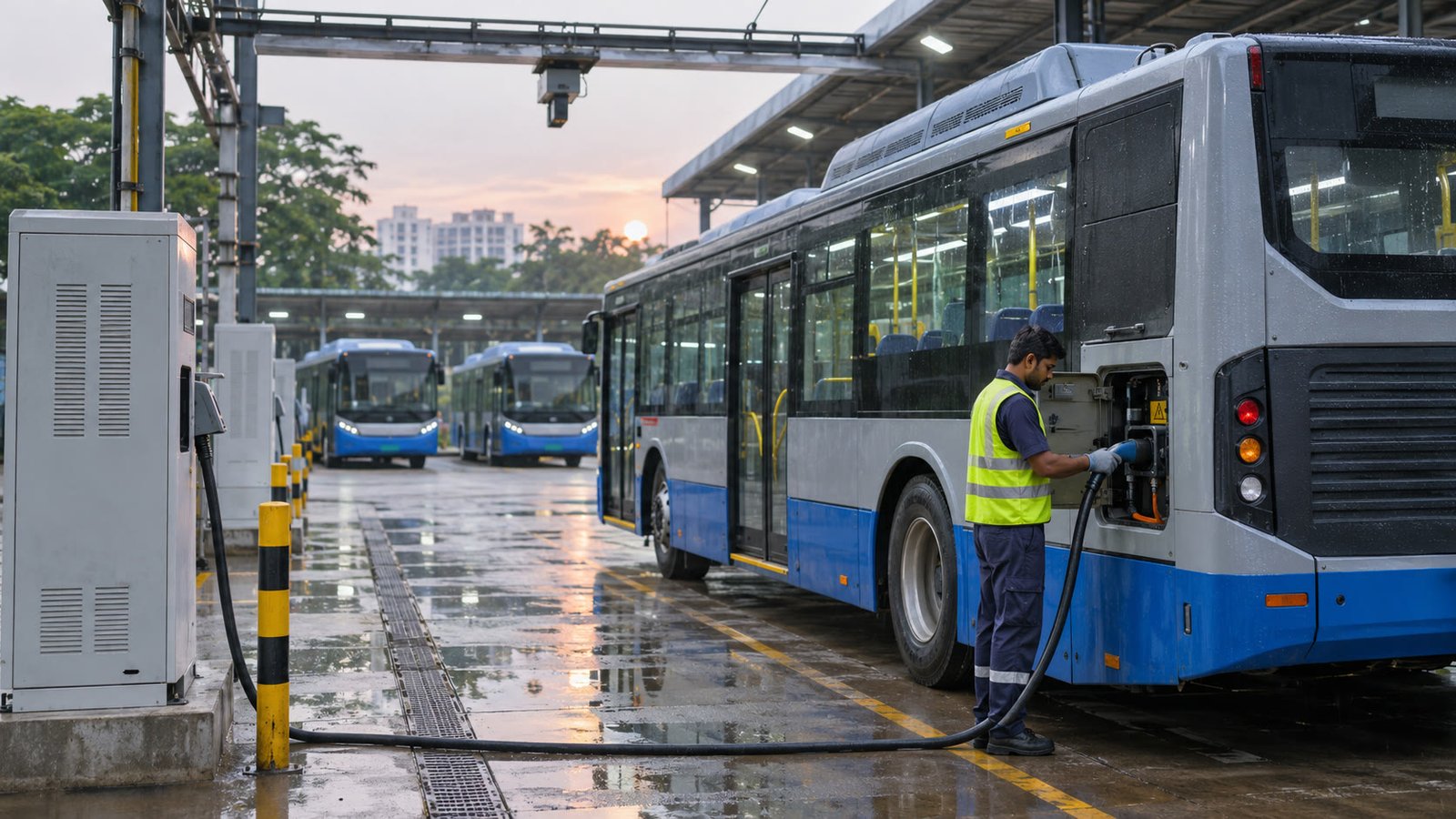
For a state transport corporation, city operator or contracted fleet, the practical question is whether vehicles can be deployed at the required duty cycle. That means matching bus range and passenger load with route distance, charging time, depot power, maintenance cover and reserve vehicles. A large order can improve future supply visibility, but it does not remove those operating constraints.
The same reporting places Olectra’s electric-bus operations across 55 Indian cities. That geographic spread may help the company build service and maintenance experience, yet it does not tell a passenger which city will receive the next bus or when a particular route will change. Those details still require an operator, transport authority or company announcement.
What changes for Indian EV and public-transport users
There is no immediate retail-price or private-car update in this result. The direct reader impact is on the supply side of electric public transport: if Olectra converts more of its order book into deliveries, transport agencies may have another source of electric buses for urban and intercity services. The effect on fares, frequency and travel time will depend on the contracts and routes that are eventually published.
Operators assessing a route should separate vehicle economics from network readiness. FuelPrice’s state-wise EV charging directory can help with a broad charging-network check, but it does not confirm a specific Olectra depot, charger or contracted route. The relevant operational data will come from the fleet tender, depot plan and service-level agreement.
For a comparable diesel baseline, operators can use the fuel-cost calculator with a clearly stated distance, mileage and fuel price. That tool is not an electric-bus tariff calculator: electricity demand charges, depot tariffs, charger utilisation, battery warranty and maintenance terms need separate inputs before a route-level comparison is meaningful.
What is still unconfirmed
The planned Q4 FY27 introduction of next-generation electric buses is an expected company milestone, not a confirmed public launch date. The result coverage does not specify the bus models, battery capacity, certified range, charging time, customer allocation, purchase price or route-wise delivery schedule. It also does not say how much of the reported order book is scheduled for delivery in the next quarter or how much remains subject to contract and production timing.
That distinction matters because commercial EV announcements often contain several different stages: an expression of interest, a signed order, a vehicle delivered to a depot, a vehicle commissioned and a bus carrying passengers. The Q2 numbers confirm reported company performance and a reported pipeline; they do not mean that more than 8,000 buses are already in service.
What to watch next
The next useful updates should include the number of buses delivered against the order book, the names of commissioning cities, the charging arrangements at each depot and the operating data from loaded routes. For buyers and operators, the meaningful specification is not only a claimed range. Availability, maintenance response, charger turnaround and the vehicle’s performance on its actual duty cycle will determine whether an electric bus can replace a diesel service without reducing reliability.
The reader takeaway is straightforward: Olectra’s Q2 FY27 result and reported 8,000-plus electric-bus order book show a growing commercial-EV pipeline, while the 4,750-plus cumulative deliveries indicate that vehicles are already being deployed. The next step is implementation. Until route, model, delivery and charging details are published, the result is a signal about fleet capacity—not a promise of a particular new bus service or a guaranteed operating saving.
Sources
- National Stock Exchange of India — Olectra Greentech corporate filings and Q2 FY27 financial-results record — 9 Nov 2026
- ET Auto — Olectra Greentech Q2 net profit rises 5% to ₹52 crore, revenue grows 5% — 9 Nov 2026
- The Times of India — Olectra Greentech net profit rises 5% in Q2 FY27 on EV growth — 9 Nov 2026