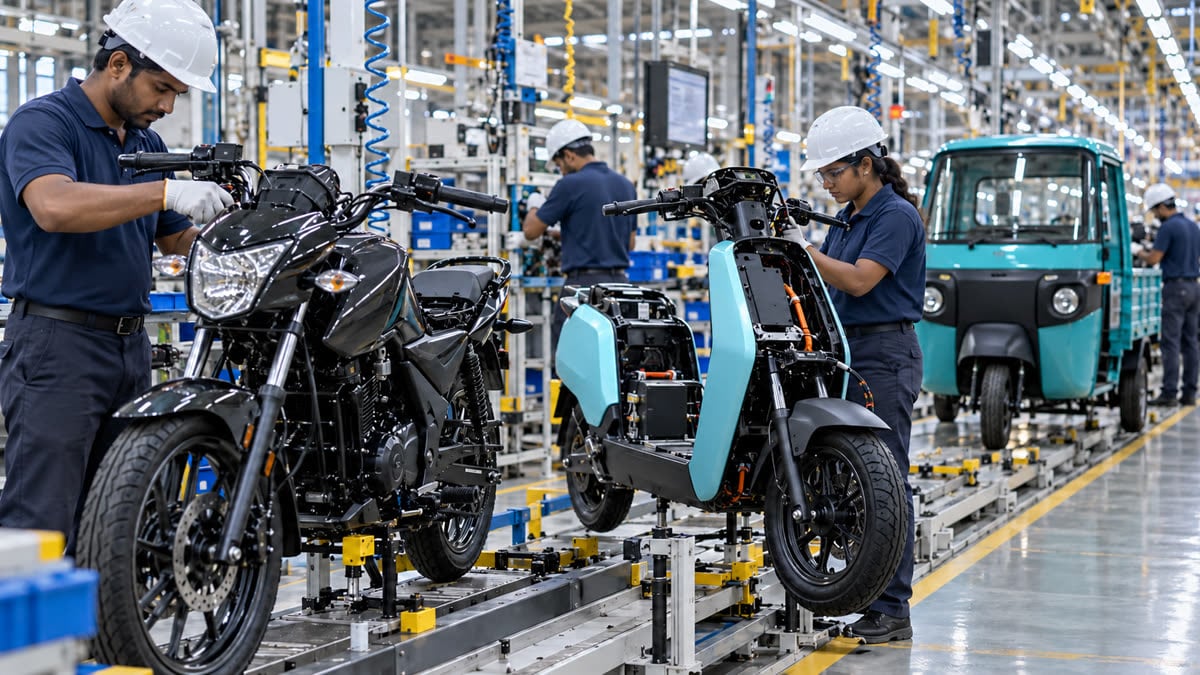
Bajaj Auto on 27 October 2026 reported consolidated net profit attributable to owners of ₹3,436.10 crore for the second quarter of FY27, up 61.9% from ₹2,122.03 crore in the year-earlier quarter. Consolidated revenue from operations reached ₹25,125.56 crore, up 59.7% year on year. For Indian two-wheeler buyers and fleet operators, the result shows how exports and the electric portfolio are supporting the company’s growth, but it does not announce a change to showroom prices.
The results cover July–September 2026 and were approved by the board on 27 October 2026. The figures below are reported on the basis stated by Bajaj Auto and independently covered by Business Standard, ETAuto and Autocar Professional on the same date.
Key takeaways
- Consolidated Q2 FY27 net profit rose 61.9% year on year to ₹3,436.10 crore, while consolidated revenue increased 59.7% to ₹25,125.56 crore.
- Standalone profit rose 35.2% to ₹3,353.76 crore and standalone revenue crossed ₹20,000 crore for the first time at ₹20,003.43 crore.
- Total vehicle sales increased 19% to 15,48,884 units; export billings rose 40% to 7,78,528 units, according to the company’s Q2 coverage.
- The electric portfolio, led by Chetak and electric three-wheelers, closed in on 2,00,000 units and contributed about one-third of domestic revenue.
- The buyer takeaway is not an automatic price cut: vehicle prices, finance, insurance, fuel or charging costs and dealer charges still need to be checked separately.
Read the result correctly: consolidated versus standalone
Bajaj Auto’s result has two commonly quoted profit numbers because the company reports both standalone and consolidated accounts. Standalone figures describe Bajaj Auto Limited itself. Consolidated figures include its financing arm and European mobility investments, so the two bases should not be compared as if they were competing estimates.
| Reporting basis | Q2 FY27 profit | Year-on-year change | Q2 FY27 revenue | Year-on-year change |
|---|---|---|---|---|
| Consolidated | ₹3,436.10 crore | 61.9% higher | ₹25,125.56 crore | 59.7% higher |
| Standalone | ₹3,353.76 crore | 35.2% higher | ₹20,003.43 crore | 34.1% higher |
Business Standard and ETAuto reported the consolidated numbers from the 27 October 2026 filing, while Business Standard and Autocar Professional reported the standalone figures. Keeping the bases separate is important for readers who see a 62% headline in one report and a 35% headline in another.
Exports and EVs were central to the quarter
The operating picture was broad, but export demand was especially important. Total vehicle sales rose to 15,48,884 units in Q2 FY27, with two-wheeler sales at 12,83,961 units and commercial-vehicle volumes at 2,64,923 units. Autocar Professional reported that export billings across two-wheelers and commercial vehicles reached 7,78,528 units, up 40% year on year, while Business Standard described exports as the main volume driver in the quarter.
The domestic-versus-export split also adds context. Business Standard reported domestic sales growth of about 4% compared with 41% growth in exports. That does not mean domestic demand disappeared; it means the quarter’s headline growth was helped more by overseas recovery, product mix and currency realisations than by a broad domestic volume surge. Bajaj Auto said Africa and Latin America reached strong or record levels during the quarter, although the company also faced intermittent logistics disruption.
Electric mobility was the other important signal. The company’s electric portfolio, which includes Chetak electric scooters and electric three-wheelers, closed in on 2,00,000 units during the quarter, according to Business Standard and Autocar Professional. The outlets reported that EVs contributed roughly one-third of domestic revenue, while Chetak’s quarterly volumes more than doubled year on year despite supply constraints. These figures show a larger role for electric products in the business mix; they do not establish the running cost or resale value of any individual scooter.
What the result means for buyers and operators
A strong quarterly result is not the same as a price announcement. Bajaj Auto’s reported performance reflects volumes, exports, product mix, pricing and costs across several markets. A buyer’s on-road price still depends on the selected variant, local taxes, registration, insurance, financing terms, dealer charges and any dated offer.
For a petrol motorcycle or three-wheeler, the useful comparison is the cost of the actual route rather than the company’s profit percentage. Monthly distance, observed mileage, fuel price and service intervals can change the ownership picture. The fuel cost calculator can help turn those inputs into a trip or monthly estimate, while the live fuel-price tracker provides a dated rate to use in that calculation.
For an electric scooter or electric three-wheeler, the corresponding checks are charging access, energy tariff, battery warranty, service support, payload and daily utilisation. Buyers can use the EV charging directory to check the availability question separately from the vehicle’s headline range. That is particularly relevant for operators whose savings depend on keeping a vehicle moving rather than parked while waiting for a charge.
What to watch next
The next useful signals will be whether export momentum holds, whether domestic registrations improve after the festive period and whether the electric portfolio can grow without the supply constraints mentioned in the Q2 coverage. The mix between two-wheelers, commercial vehicles and electric products will matter more to operating performance than any single headline profit number.
For vehicle buyers, the practical test is whether a specific model fits the daily route and budget. Compare the dated on-road quote with the expected fuel or charging bill, insurance, maintenance and financing cost. A company’s strong quarter may indicate product and market momentum, but it does not remove those ownership variables.
Reader takeaway
Bajaj Auto’s Q2 FY27 results show a business growing through exports, higher volumes and a larger electric contribution. The cleanest way to use the news is to treat it as market context: check the exact vehicle price and availability, then calculate the running cost for the route and usage pattern that matter to you.
Sources
- Bajaj Auto, “Disclosures: stock-exchange filings and Q2 FY27 results”, 27 Oct 2026
- Business Standard, “Bajaj Auto Q2 net profit rises 62% to ₹3,436 cr on exports, EV sales”, 27 Oct 2026
- ETAuto, “Bajaj Auto Q2 FY27 net profit rises 62% to ₹3,436 crore”, 27 Oct 2026
- Autocar Professional, “Bajaj Auto Q2 Net Profit Rises 35% to Rs 3,354 Crore as Revenue Crosses Rs 20,000 Crore”, 27 Oct 2026