Delhi’s push to put public EV chargers at dealerships has hit an implementation warning: Federation of Automobile Dealers Associations (FADA) President Sai Giridhar said on 27 Oct 2026 that securing additional electricity load can sometimes cost more than the charger itself. This matters because Delhi’s Electric Vehicles Policy, 2026, effective from 1 Jul 2026, requires original equipment manufacturers (OEMs) operating in the capital to deploy at least one public charging station at each dealership.
Key takeaways
- FADA says the cost of getting extra electricity load from a state utility or distribution company can be a bigger hurdle than buying the charger hardware.
- Delhi’s policy requires at least one public charging station per dealer, with three charging points for two- and three-wheelers and two for four-wheelers.
- The policy also provides for a single-window process and expedited EV connections, while Delhi’s operational guidelines set a six-month installation window.
- This is an implementation warning, not a new national charging rule, consumer fee or announced change in EV prices.
What FADA flagged at the EV conclave
Giridhar raised the issue at the Autocar Professional EV Conclave in Delhi on 27 Oct 2026. According to Autocar Professional, dealerships can offer convenient locations for public charging, but connecting them to the required electricity load remains a hurdle.
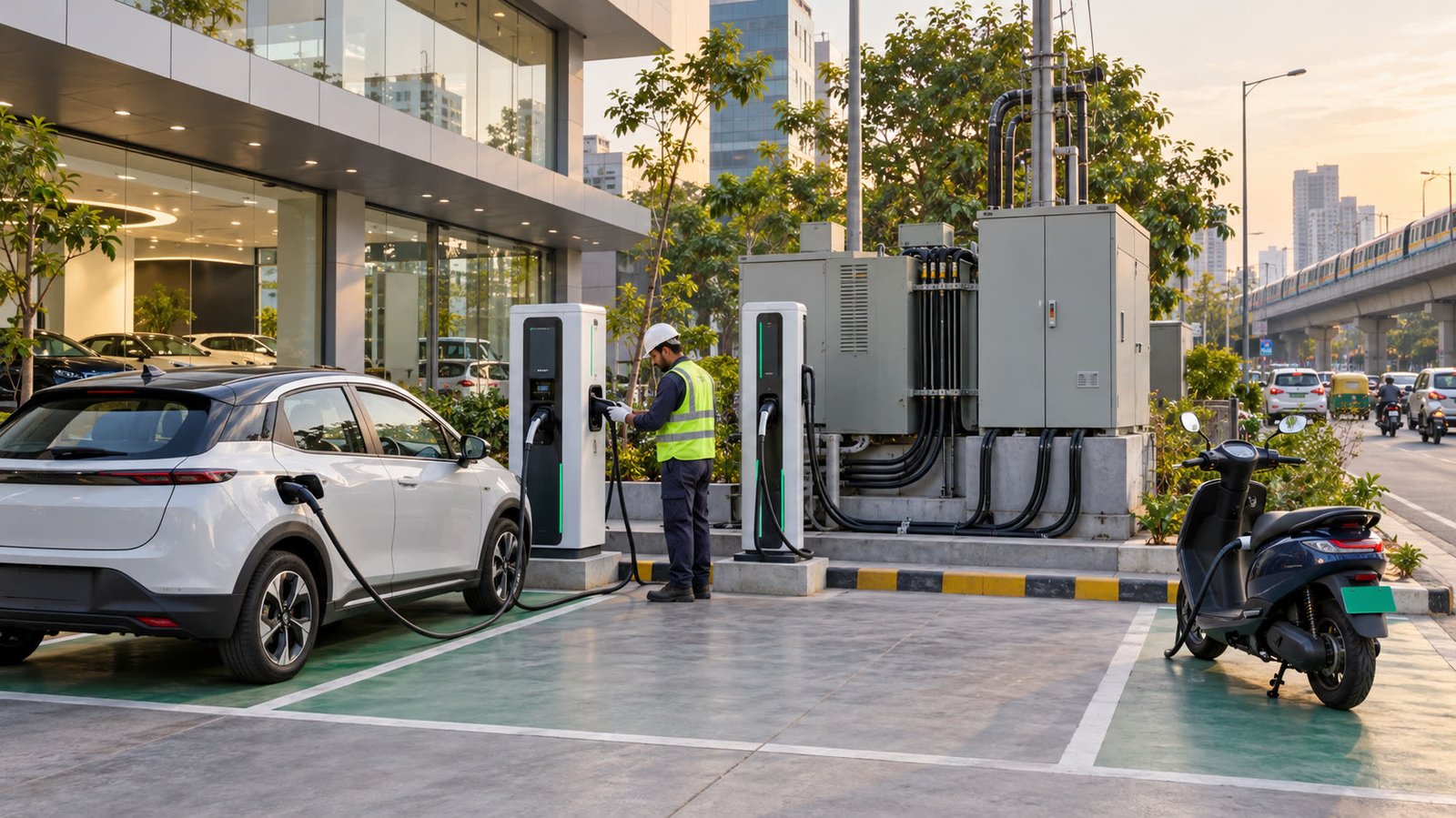
FADA’s warning is about the connection and capacity needed to energise a charger, not just the price of the charging unit. Giridhar said the additional-load connection cost is sometimes, or often, higher than the charger itself. The report does not give a rupee figure, and it does not say that every dealership will face the same cost. The practical point is that a charger can be installed on a site but still require utility approvals, electrical work and adequate sanctioned capacity before drivers can use it reliably.
FADA also said that moving EV adoption beyond large cities will need investment in dealer service infrastructure. That includes trained technicians and specialised equipment for battery repair. For buyers, the charging point and the workshop that supports the vehicle are therefore related parts of the ownership network.
What Delhi’s EV policy requires
The confirmed requirement comes from the Delhi government’s Delhi Electric Vehicles Policy, 2026, notified on 30 Jun 2026 and effective from 1 Jul 2026. Its OEM obligations say each dealer must have at least one public EV charging station. The station must include a minimum of three charging points for two- and three-wheelers and two charging points for four-wheelers.
The policy also assigns Delhi Transco Limited a role in aggregating demand and load requirements. It calls for a single-window facility to help charging and battery-swapping operators obtain approvals and expedited EV connections. Those provisions recognise that charging infrastructure needs coordination with the power system, not only space and hardware.
Delhi’s operational guidelines add an execution timeline. Hindustan Times reported on 3 Jul 2026 that the dealership charging infrastructure is to be deployed within six months of notification. The guidelines also say a dealership could be deactivated from the incentive-processing portal until it complies. That makes the electricity connection a practical part of meeting the policy, rather than a later optional upgrade.
Why the power connection matters to drivers
For an EV user, the useful question is not simply whether a dealership has a charger in its parking area. The charger must be energised, accessible, compatible with the vehicle and available when the vehicle needs it. If a dealer is waiting for additional load or electrical work, the point may not yet provide a dependable public charging option.
That distinction matters for Delhi residents who are planning regular urban travel, as well as fleet operators that need predictable charging locations. A dealer-based network can place chargers near service centres and vehicle sales outlets, but its value will depend on uptime, operating hours, queue management and the ability to support different vehicle categories. FADA’s separate concern about technician training also matters to owners who expect an authorised workshop to handle high-voltage systems and battery-related faults.
Drivers can check nearby public infrastructure in FuelPrice’s state-wise EV charging directory before treating a dealership charger as part of a route. For an inter-city trip, the road-trip planner can help organise stops and driving time; the live list should still be checked because a charger’s presence does not guarantee real-time availability.
What EV buyers and fleet operators should check
The latest warning does not change the Delhi policy or introduce a new payment obligation for vehicle owners. It does, however, give buyers and operators a practical checklist:
- Ask whether the dealership charger is already energised and open for public use, rather than only installed.
- Check the connector type, charging speed, operating hours and any access or parking conditions.
- Confirm whether the dealer has trained EV technicians and battery-diagnostic capability for the vehicle category being considered.
- For regular routes, identify a second charging option instead of relying on a single dealer location.
- Compare the running-cost assumptions for the route with current petrol and diesel rates using the live fuel-price pages, while treating charging tariffs and actual energy use as location-specific.
What to watch next
The next stage is execution. The useful signals will be whether Delhi’s single-window connection process reduces approval time, whether OEMs publish operational dealer-charger coverage, and whether the six-month requirement is met in practice. FADA’s comments may also renew the discussion about who bears connection upgrades and how charging investments can remain commercially viable outside the largest urban markets.
For now, the confirmed change is the Delhi dealer-charging obligation. The power-load concern is a reported industry warning about how quickly that obligation can become usable infrastructure. It should not be read as a nationwide mandate or as evidence that a particular EV purchase will cost more.
FAQs
Does the dealer-charging requirement apply across India?
No. The requirement described here is part of Delhi’s Electric Vehicles Policy, 2026, and applies to OEMs operating in the National Capital Territory. Other states may set separate charging or EV-policy requirements.
How many charging points must a Delhi dealer provide?
The policy specifies at least three charging points for two- and three-wheelers and two charging points for four-wheelers at the public station required per dealer.
Has Delhi announced a new charger fee for buyers?
No new buyer fee or EV price change is stated in the reported FADA warning. The actual use of a charger, including any tariff or access condition, may vary by operator and location.
Sources
- Autocar Professional — Electricity Connection Costs Could Slow Dealership Charging Rollout: FADA — 27 Oct 2026
- Government of NCT of Delhi — Delhi Electric Vehicles Policy, 2026 — 30 Jun 2026
- Hindustan Times — Delhi govt finalises new EV policy rules for incentives, grievances, manufacturing — 3 Jul 2026