Bajaj Auto has launched its new WEGO portfolio of electric three-wheelers, positioning it as the company’s widest integrated EV line-up in the segment. The official launch announcement dated 14 April, 2026 says the range starts at Rs 3,11,908 (ex-showroom Delhi) and includes both passenger and cargo formats, with certified range claims stretching up to 296 km on the top passenger variant.
For FuelPrice readers, this is more than a product launch update. It is a meaningful mobility and operating-cost story: three-wheelers are a core part of India’s urban and semi-urban transport economy, and any large EV portfolio expansion in this category directly affects fuel demand at the street level, last-mile logistics economics, and daily earnings models for operators.
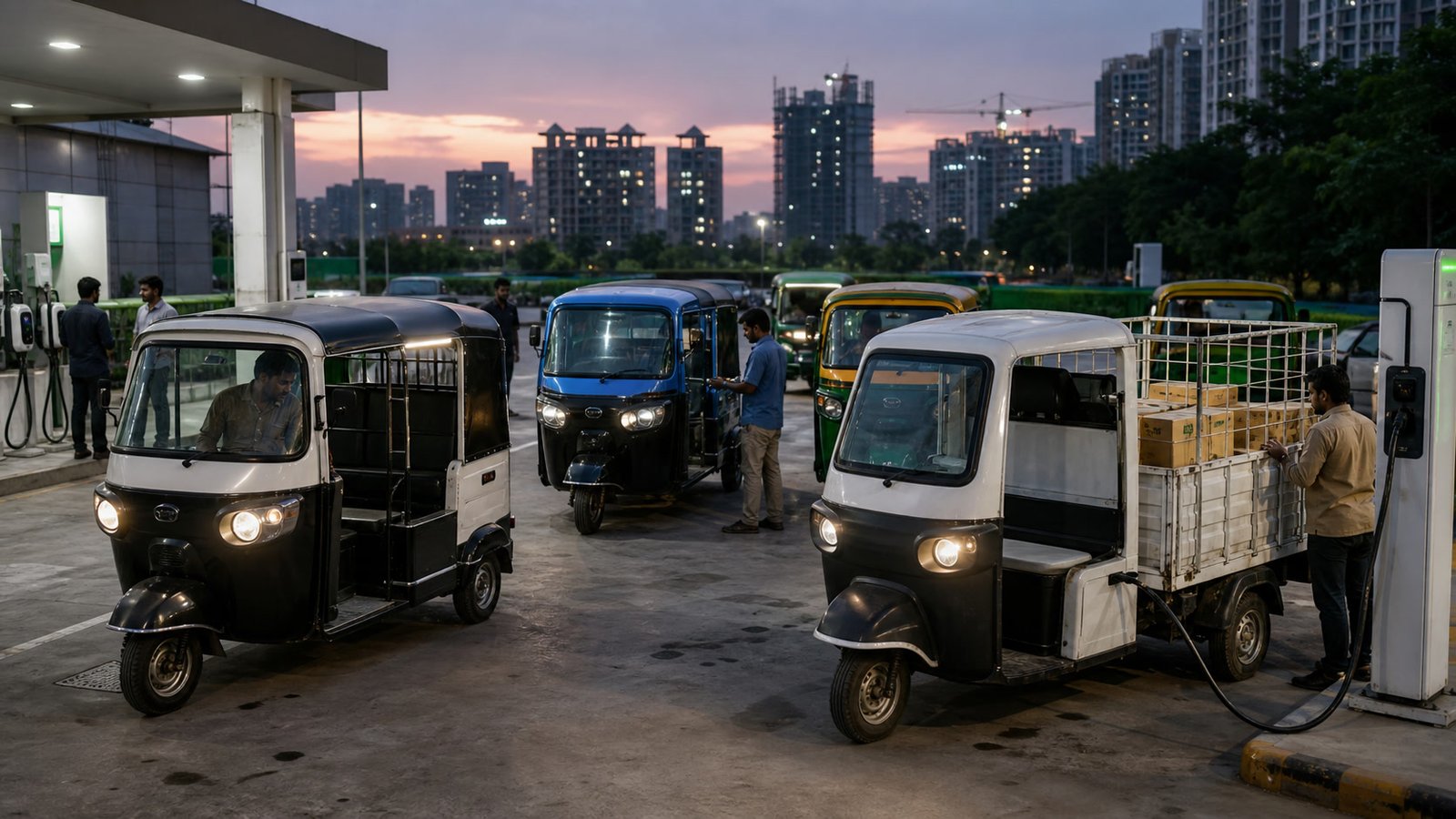
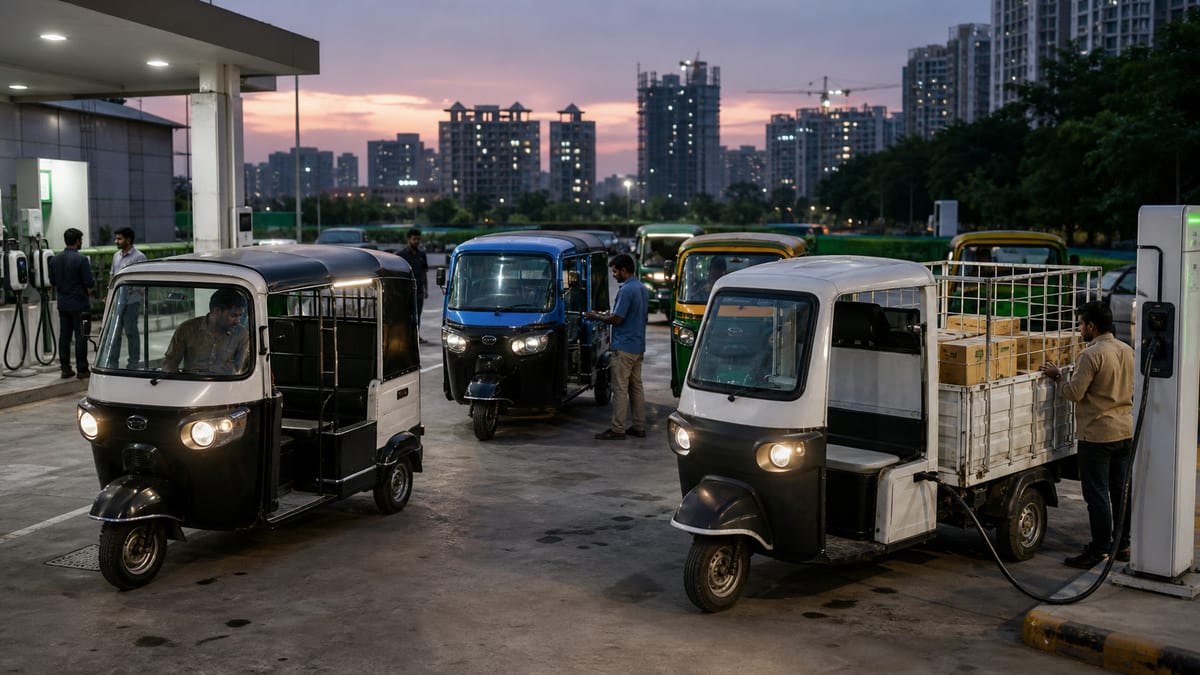 Representative EV three-wheeler charging and loading scene matching the WEGO launch theme of passenger-plus-cargo last-mile operations.
What Bajaj Announced
According to Bajaj Auto’s press release, WEGO now spans the P50, P70, P90 passenger families and the C90 cargo family. The company says the platform is built around a two-speed automatic electric drivetrain, regenerative braking, and a battery management system, while offering operator-focused features such as Bluetooth connectivity, digital LCD cluster, hill hold, climb mode, and improved ergonomics for driver entry and exit.
The launch note also emphasizes service readiness: a 5-year warranty, roadside assistance, and access to more than 1,500 sales and service touchpoints. In a segment where uptime directly drives daily cash flow, after-sales depth is as important as upfront price.
Variant and Price Structure
| Series / Variant | Use case | Certified range | Ex-showroom Delhi |
|---|---|---|---|
| P5009 | Intra-city passenger | 213 km | Rs 3,11,908 |
| P5012 | Contract carriage / urban | 272 km | Rs 3,69,301 |
| P7009 | Shared commuting | 182 km | Rs 3,23,001 |
| P7012 | Shared commuting (higher range) | 259 km | Rs 3,63,062 |
| P9018 | Extra-large people carrier | 296 km | Rs 4,48,303 |
| C9009 | Last-mile cargo | 149 km | Rs 3,87,371 |
| C9012 | Higher-load cargo | 207 km | Rs 4,34,128 |
Why This Launch Matters for Fuel and Logistics
The three-wheeler segment is where EV transition can produce measurable operating-cost effects early. Daily route intensity is high, fixed-route behavior is common, and diesel/CNG substitution logic is straightforward for fleet owners and individual drivers. When a mainstream OEM expands EV choices across passenger and cargo, the decision set improves: operators can align battery-range-cost combinations with actual trip economics instead of forcing a one-size-fits-all product.
That is the central strategic value of the WEGO move. Bajaj is not offering one halo variant; it is creating a portfolio architecture that maps to multiple earning patterns: short urban loops, inter-neighborhood shared routes, semi-urban longer runs, and intra-city goods drops. This is exactly where fuel-to-electric migration accelerates when product fit improves.
Who Is Affected
- Passenger operators: More range-price options can reduce idle time and improve per-day trip confidence.
- Cargo operators and small merchants: Dedicated cargo EV options strengthen unit economics for local delivery chains.
- Fleet aggregators: Portfolio depth allows route-specific vehicle allocation and better utilization planning.
- Fuel retailers in dense city corridors: Gradual long-term demand rebalancing is likely as three-wheeler electrification scales.
- Competing OEMs: Pressure rises on both product breadth and ownership-support packages.
What Changes Now
Post-launch, the near-term market test is not only booking count; it is deployment quality. Three variables will decide practical adoption speed: financing accessibility, charging uptime in high-density corridors, and service turnaround in commercial usage conditions. Bajaj’s 1,500-plus touchpoint claim addresses one adoption barrier, but monthly field performance will determine real conversion rates.
For policy and mobility observers, launches like this also intersect with broader city transport planning. As e-3W penetration rises, municipal focus shifts from “pilot EVs” to “operational EV infrastructure”: feeder charging, parking discipline, and route-level demand clustering.
What to Watch Next
- State-wise rollout pace across top e-3W markets
- Real-world range outcomes versus certified figures under payload and weather stress
- Financing penetration for first-time EV commercial buyers
- Service response times and parts availability in high-usage fleets
- Any competitive price response from established e-3W rivals
Final Takeaway
Bajaj WEGO is a high-signal launch for India’s last-mile mobility transition: broad variant spread, strong claimed range at multiple price points, and a clear passenger-plus-cargo strategy. For operators, the story is about daily earnings stability and route-fit flexibility. For the fuel ecosystem, it is another indicator that commercial urban mobility electrification is shifting from selective adoption to structured scale.