India is targeting a nationwide shift to barrier-free Multi-Lane Free Flow (MLFF) tolling by March 2027, using Automatic Number Plate Recognition (ANPR) cameras and FASTag to charge vehicles while they keep moving. For drivers, this is a change in how a toll crossing is detected and recovered—not a toll waiver: the tag must remain active, the balance must be sufficient and any e-notice must be handled on time.
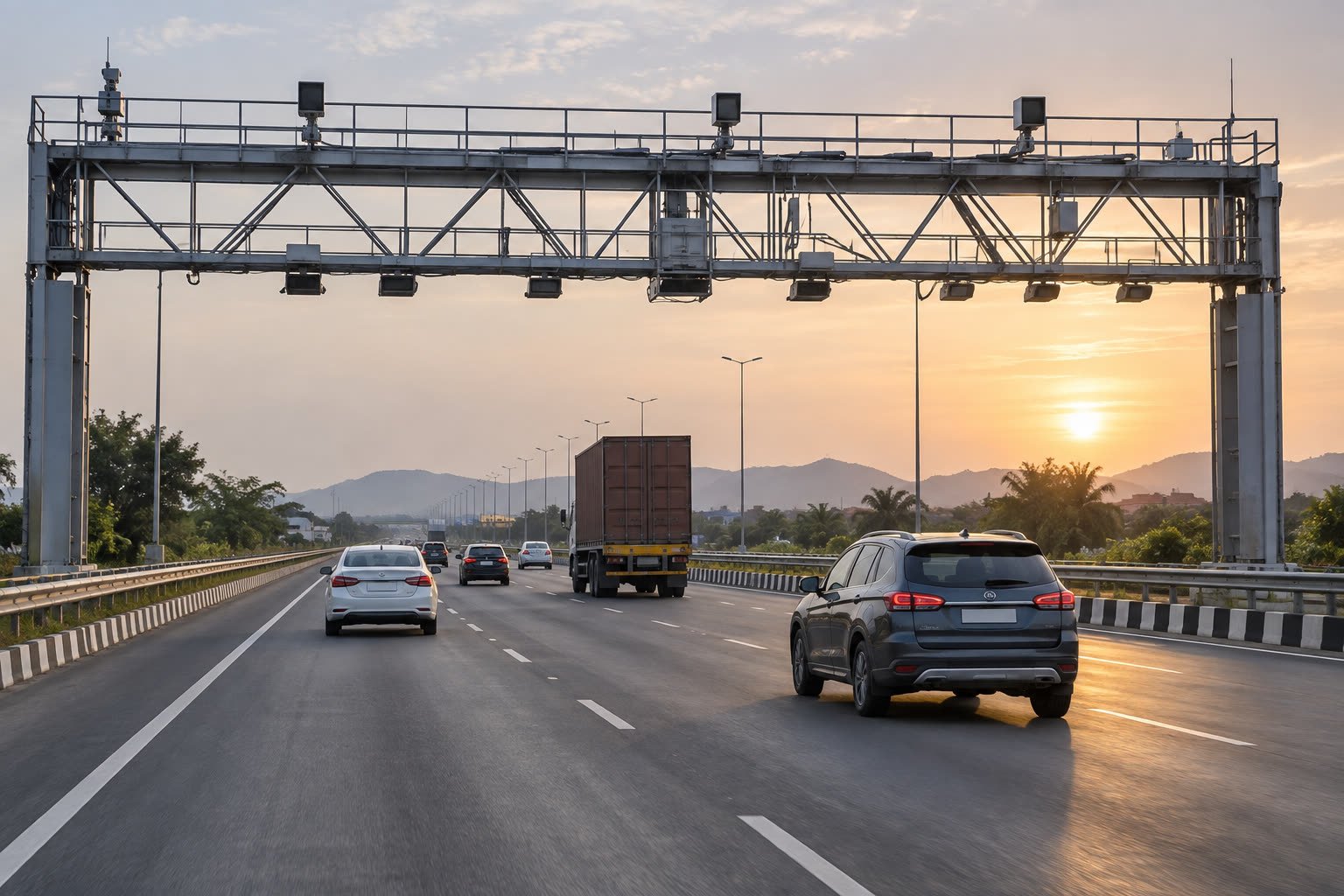
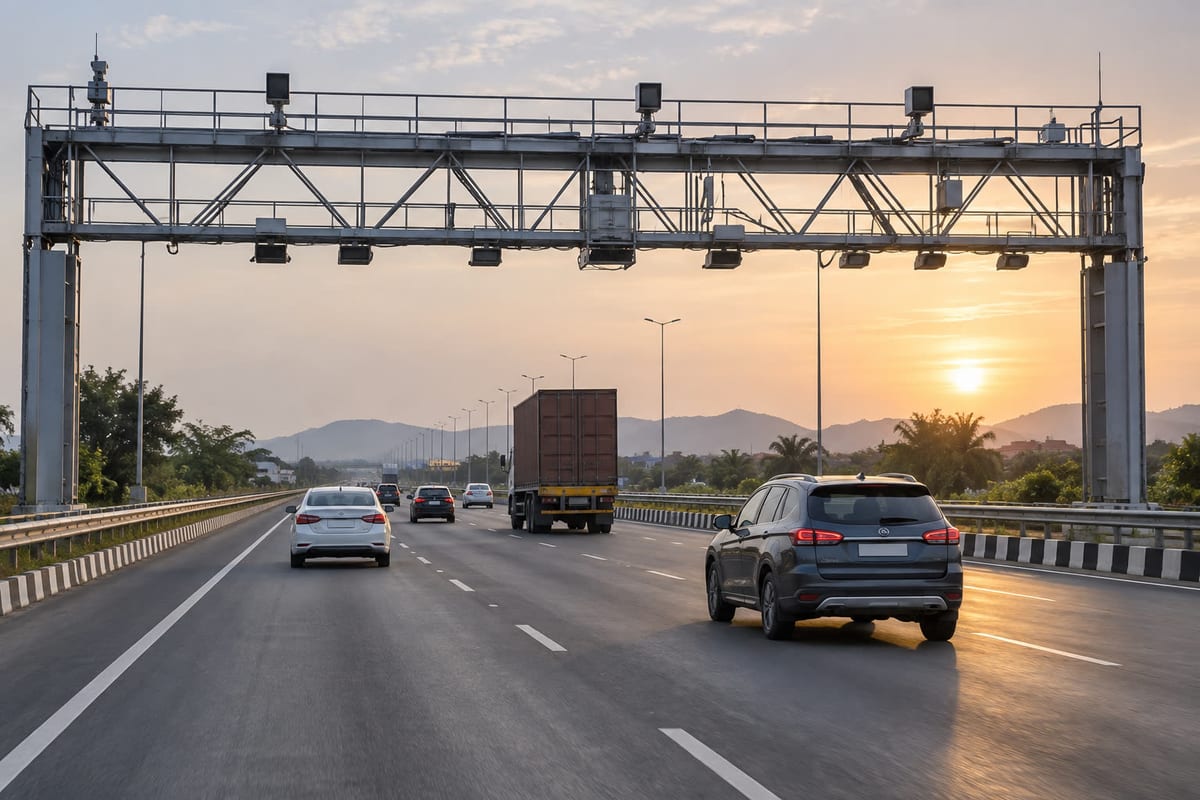 Barrier-free tolling uses overhead cameras and FASTag readers to identify moving vehicles. Credit: FuelPrice editorial illustration, AI-generated and representational.
Key takeaways
- The March 2027 nationwide deadline is a government target reported from Union minister Nitin Gadkari, not an already completed rollout.
- A 22 Jul 2026 government update said MLFF had been awarded at 17 fee plazas, with five live and bids invited for 104 more.
- The system combines ANPR, AI analytics and RFID-based FASTag collection so vehicles can pass without stopping at a conventional barrier.
- Under the National Highways Fee Rules, an unpaid toll can be settled at the original amount within 72 hours of an e-notice; after that, the payable amount is twice the applicable fee.
What the government has confirmed
The Ministry of Road Transport and Highways said in a Press Information Bureau update dated 22 Jul 2026 that the government is implementing MLFF through ANPR with AI analytics and RFID-based electronic toll collection. The stated objective is to charge the user fee without requiring a vehicle to stop, slow down or remain in a designated lane.
That same official update listed 17 fee plazas where the implementation contract had been awarded. Five were described as live: Choryasi in Gujarat, Mundka in Delhi, Gharaunda in Haryana, and Manoharpura and Daulatpura in Rajasthan. It also said bids had been invited for 104 additional fee plazas. This is the clearest published deployment snapshot; it should not be read as confirmation that every listed location is already operating without barriers.
Separately, reports by The Times of India, Hindustan Times and The New Indian Express said Gadkari was targeting a nationwide barrier-free system by February–March 2027, with more than 70% of toll booths targeted for MLFF by the end of December 2026. Those dates are targets and expectations, not a notification changing every toll plaza overnight. FuelPrice had earlier explained the highway authority’s MLFF and related design direction in its earlier coverage of NHAI’s high-speed highway guidelines.
How a barrier-free toll crossing works
At a conventional toll plaza, a vehicle slows down, a FASTag reader authorises the payment and a boom barrier opens. In an MLFF section, overhead equipment reads the vehicle’s registration plate and the RFID tag, while the toll system classifies the passage and sends the deduction through the FASTag ecosystem. The driver does not need to choose a cash lane or stop at a booth.
The change is therefore about collection and traffic flow, not about making the toll amount discretionary. The applicable fee still depends on the notified plaza, vehicle category and route. Drivers planning a highway journey can use FuelPrice’s toll-charge calculator to check the route cost before leaving.
What drivers should check now
Keep the payment chain working
Barrier-free tolling removes the physical checkpoint, but it does not remove the payment obligation. The latest government information says more than 98% of National Highway user-fee collection already happens through FASTag. A non-functional tag, an insufficient balance or a failed transaction can therefore create a post-passage recovery issue rather than a visible stop at the plaza.
Check that the FASTag is active, keep enough balance for the planned route and watch the alerts from the issuer bank. For non-commercial cars, jeeps and vans, the FASTag Annual Pass for 2026–27 costs ₹3,075 and covers one year or 200 fee-plaza crossings, whichever comes first, according to the government’s July update. That pass is a separate payment product; it does not mean every vehicle or every road is free of charges.
Understand the e-notice window
The National Highways Fee (Determination of Rates and Collection) (Second Amendment) Rules, 2026 came into effect on 17 Mar 2026. They define an unpaid user fee as a toll recorded by electronic collection equipment but not received. The recovery process uses an electronic notice linked to the registered vehicle and the VAHAN system.
If an e-notice is issued, the original user fee can be paid within 72 hours without the additional charge. If it remains unpaid after that window, the amount becomes twice the applicable toll. The rules also allow a vehicle owner or driver to submit a representation through the designated portal within 72 hours. The government says the representation should be examined within five days; if it is not disposed of in that period, the unpaid-fee claim lapses. Unpaid dues can later be recorded in VAHAN and may affect vehicle-related services.
These safeguards matter more as MLFF expands because a driver may not see a barrier or a booth attendant at the moment a payment fails. Keep the vehicle registration details, FASTag account and contact number up to date so an alert can be acted on promptly.
What it could change for trip costs
The practical benefit is less stopping and less stop-and-go driving around toll points. That can make a long trip more predictable and may reduce idling fuel use, especially on busy corridors. It does not, by itself, guarantee a lower notified toll or a cheaper journey. The money impact will depend on the toll schedule, the route, vehicle efficiency and whether a payment failure creates a higher recovery amount.
For a more complete estimate, compare the toll total with fuel and distance in the fuel-cost calculator, then use the road-trip planner to organise stops and route timing. This is particularly useful for fleet operators, who need to distinguish a shorter queue from a lower invoice.
What to watch next
The next meaningful test is whether the tendered plazas move from contract award to reliable live operation and whether the government’s December and March targets are met. Drivers should also watch the list of locations, the reliability of ANPR and FASTag matching, and the way grievances are handled when a plate is misread or a deduction is disputed.
The government has separately said that GPS-based barrier-free tolling needs further deliberation on security, privacy and operational control. For now, the confirmed system is the ANPR-plus-FASTag model at selected plazas. The sensible preparation for drivers is simple: keep FASTag active, maintain balance, read e-notices and check the route’s notified toll before starting the trip.
Sources
- India’s barrier-free tolling explained: No more stopping as FASTag & number plate recognition will help collect toll automatically — The Times of India, 27 Sep 2026.
- FASTag Based Toll Collection and Digital Tolling System — Press Information Bureau, 22 Jul 2026.
- Barrier-free tolling across India by March 2027, says Nitin Gadkari — The New Indian Express, 11 Sep 2026.
- Barrier-free toll plaza system expected to be operational by March 2027: Nitin Gadkari — Hindustan Times, 12 Sep 2026.
- National Highways Fee Rules, 2026 Amended to Strengthen Toll Compliance and Digital Enforcement — Press Information Bureau, 18 Mar 2026.