Service centres in Bengaluru are reporting more cases of engine stalling, starting trouble and lower fuel efficiency amid Karnataka’s dispute over ethanol levels in petrol. The reports matter because a vehicle symptom can raise fuel and repair costs, but they do not yet prove that E20 or above-spec fuel caused any particular failure: the Centre and oil marketing companies say their prescribed tests found compliant fuel.
For drivers, the immediate takeaway is to check the vehicle’s permitted ethanol blend and keep dated fuel and service records while the competing test claims are examined.
Key takeaways
- New local reports: Deccan Herald reported on 10 Nov 2026 that service managers and mechanics in Bengaluru had seen more complaints involving starting trouble, stalling and reduced fuel efficiency, particularly among older vehicles.
- The complaint is reported, not proven: India Today reported on 8 Nov 2026 that Karnataka’s chief minister said the state had received motorists’ complaints and was investigating possible excess ethanol blending.
- Official tests differ: A 7 Nov 2026 Press Information Bureau release said an OMC and Centre for High Technology exercise tested 893 E20 samples from 27 states and Union territories, including 56 samples from Karnataka, and found them within the prescribed range.
- There is no settled nationwide finding: Karnataka’s claims and the oil companies’ rebuttal use different testing accounts. The next useful evidence is a transparent, jointly verifiable retest.
What Bengaluru workshops are reporting
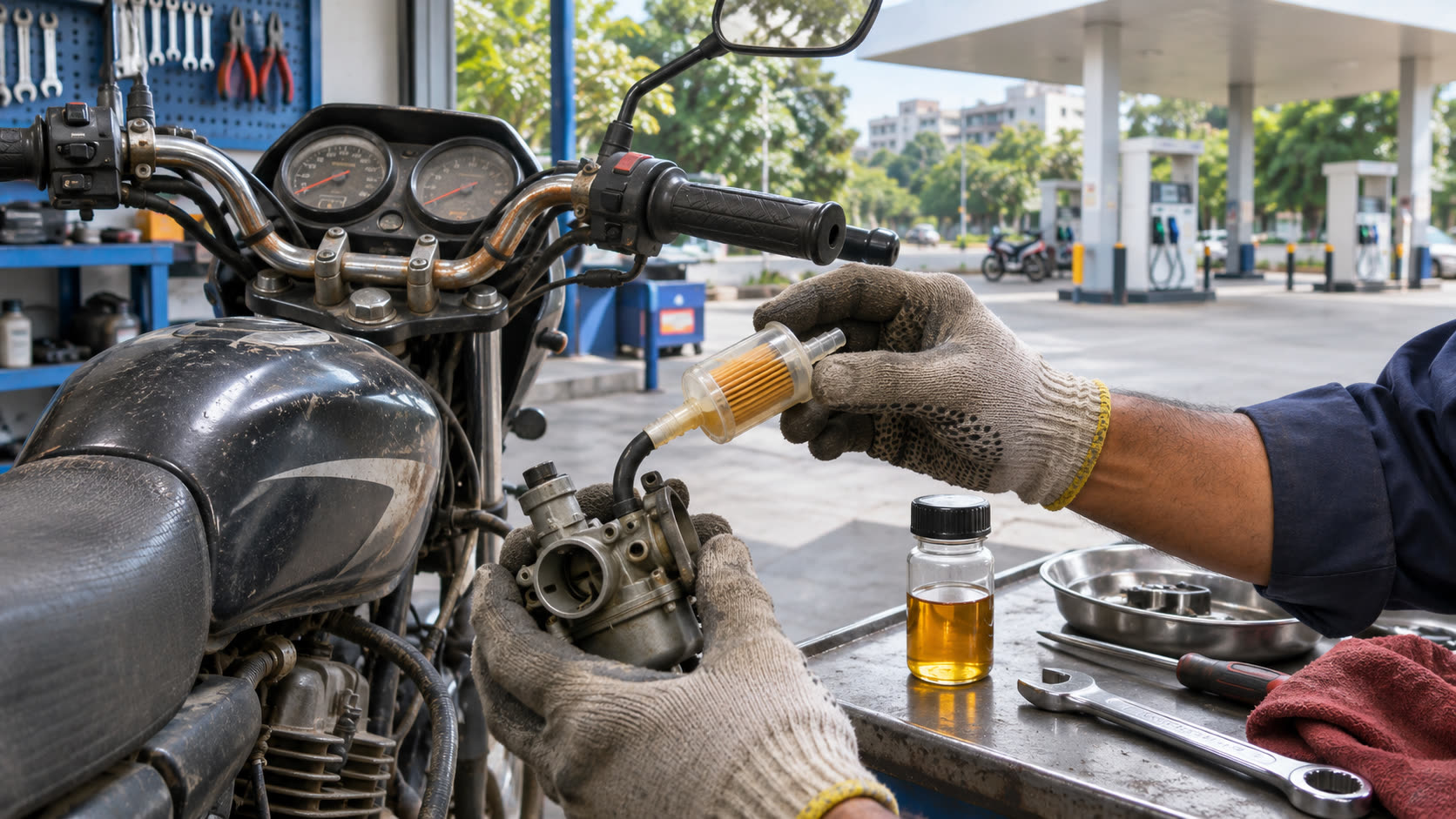
In its 10 Nov report, Deccan Herald said service managers at major two-wheeler and car centres had noticed a rise in complaints from motorists. The accounts included motorcycles that stalled or became difficult to start, sticky deposits noticed during servicing, and reports of lower mileage. The report said older vehicles were a particular concern for the mechanics it spoke to.
Those are accounts from workshops and motorists, not a citywide failure count or a laboratory conclusion. A Bangalore University chemistry professor quoted in the report said engine design, fuel quality and octane rating also affect how a vehicle responds. That caution is important: a complaint after refuelling can be genuine without proving which part of the fuel supply chain, vehicle condition or maintenance history caused it.
Some service providers have reportedly suggested anti-corrosion products or additives to customers. That is not an official remedy, a regulator finding or proof that an additive will solve a fuel-system problem. Owners should not treat a workshop suggestion as confirmation that the petrol was above the E20 specification.
What is confirmed, and what is disputed
E20 petrol means petrol blended with 20% ethanol by volume. The immediate dispute is not about whether India has an E20 programme; it is about whether particular samples collected in Karnataka contained more ethanol than the prescribed limit and whether the competing tests followed the required method and sample-handling process.
On 7 Nov 2026, the Ministry of Petroleum and Natural Gas said in a PIB release that 893 samples tested across 27 states and Union territories were within the 19% to 21% range. It said all 56 Karnataka samples in that exercise were between 19% and 20%, with an average of 19.30%. The Indian Express separately reported the same OMC statement and its call for the state to share complete sampling records, laboratory reports and retained samples for independent verification.
Karnataka’s position is different. The Indian Express reported that the state said its separate testing found some samples above the prescribed 20% level and sought action and consumer protection. The oil marketing companies rejected that account, questioned the sampling and testing methodology, and asked for a joint exercise using the prescribed procedure. Until the methods and samples are independently checked, the confirmed story is that the claims conflict, not that all petrol in Karnataka is over-blended.
What the dispute means for drivers
First, check the fuel-compatibility information for the specific vehicle in its label, owner’s manual and service documentation. Do not assume that a vehicle designed for E20 can use a higher blend, or that a reported fault automatically proves a fuel-quality violation.
Second, measure a change rather than relying on a single impression. Note the date, pump, litres purchased, odometer reading, route conditions and any warning light or starting problem. If a workshop finds a fault, ask for the diagnosis and parts replaced in writing. These records can help separate a repeatable fuel-economy change from traffic, tyre, servicing or mechanical factors.
For a dated running-cost comparison, use the fuel cost calculator after recording actual litres and distance. Check the rate used for the calculation against the live fuel prices page for the relevant date and location.
This is a follow-up to FuelPrice’s earlier report on the Karnataka E20 petrol row. The new element is the Bengaluru workshop reporting; the underlying fuel-quality claims remain contested.
What to watch next
- Whether Karnataka and the OMCs conduct a jointly witnessed retest using retained samples and the statutory method.
- Whether the state publishes outlet-wise reports and the complete laboratory method, rather than only headline ethanol readings.
- Whether the Centre, regulators or vehicle manufacturers issue a specific response for owners who can document a repeatable fuel or component problem.
- Whether any consumer compensation proposal moves beyond a demand and receives a formal design or approval.
Reader questions
Does this prove that all E20 petrol is over-blended?
No. Karnataka has reported one set of findings, while the Centre and OMCs have reported compliant results from their own quality exercise. The two accounts must be reconciled through transparent testing.
Does a mileage drop prove that ethanol caused it?
No. Mileage depends on vehicle calibration, traffic, driving pattern, tyre pressure, maintenance and fuel quality. A repeatable change is worth documenting, but it is not by itself a laboratory finding.
What should a driver keep while the dispute is examined?
Keep the vehicle’s blend-compatibility information, dated fuel receipts or digital payment records, odometer readings and written service diagnoses. Avoid presenting an unverified cause as confirmed until the fuel and vehicle evidence is checked.
Sources
- Deccan Herald — “Bengaluru: Vehicle complaints rise amid concerns over ethanol-blended petrol” — 10 Nov 2026
- Press Information Bureau, Ministry of Petroleum and Natural Gas — “E20 Petrol Supplied by PSU Oil Marketing Companies Meets Prescribed Quality Standards” — 7 Nov 2026
- The Indian Express — “30% ethanol blend in petrol? Karnataka accuses Central OMCs of exceeding limit” — 7 Nov 2026
- India Today — “Excess ethanol mix national concern: DK Shivakumar says got thousands of complaints” — 8 Nov 2026