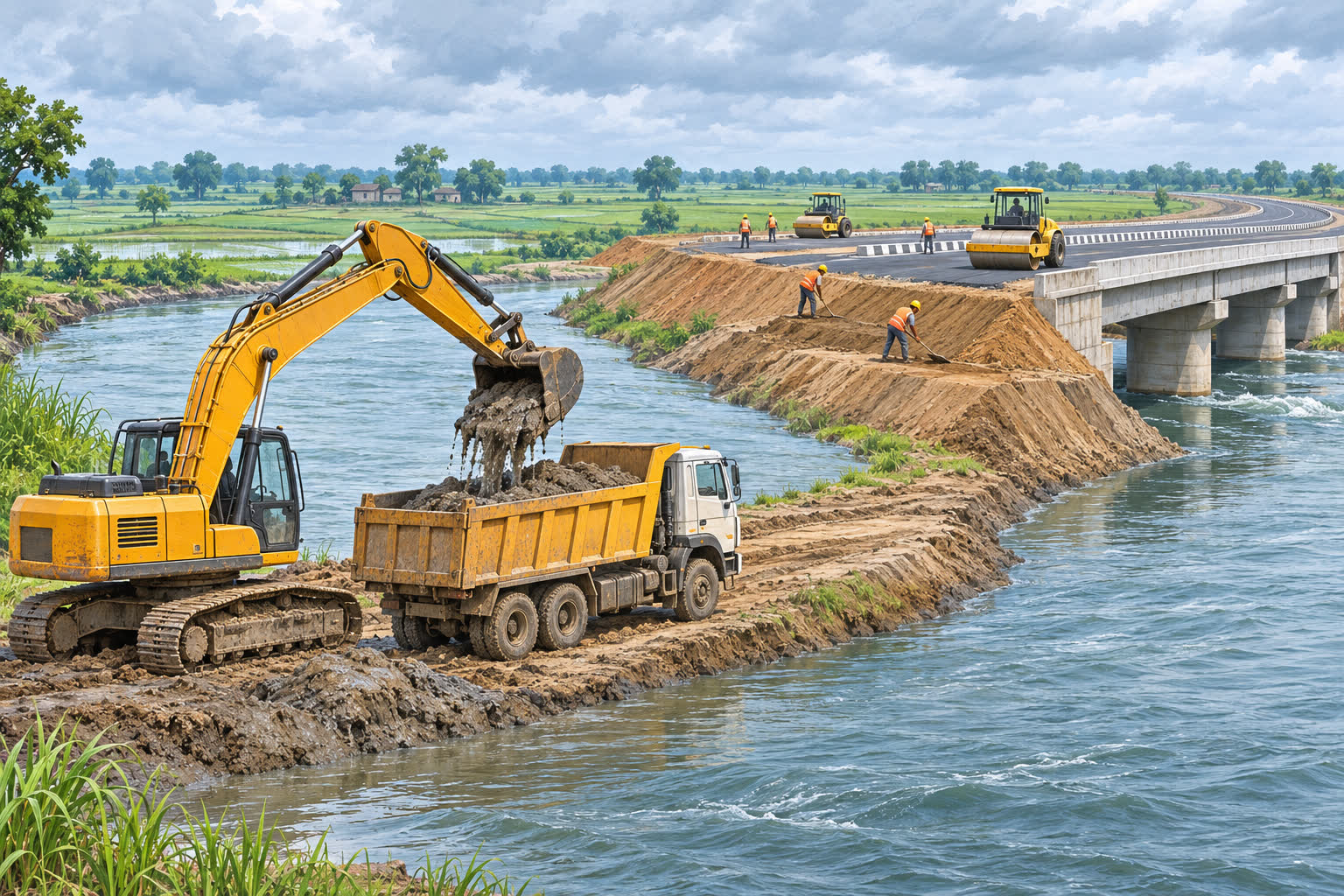
MoRTH and the Bihar government signed a Memorandum of Understanding (MoU) on 3 Nov 2026 to scientifically desilt rivers and other water bodies and use suitable excavated silt in National Highway projects. For drivers and freight operators, the announcement points to a possible long-term improvement in flood resilience and road construction speed; it does not announce an immediate toll change, route opening or new travel rule.
Key takeaways
- The ‘Nadi Sanjivani’ framework connects river restoration and flood management with highway construction in Bihar.
- The official release lists 39 NHAI projects covering about 1,561 km and an estimated ₹58,340 crore under construction in the state.
- Another 11 proposed projects cover about 1,982 km and involve an estimated ₹1,85,200 crore, according to the same release.
- The reported silt volumes differ: the PIB release gives one set of figures, while The Indian Express gives a higher estimate. Both say use will depend on technical suitability and approvals.
- There is no toll revision or project-specific travel timetable in the MoU announcement.
What the Bihar–MoRTH MoU does
The agreement brings two infrastructure problems under one operating framework. Bihar’s rivers and water bodies accumulate sediment, which can reduce water-carrying capacity and worsen drainage during heavy rainfall. At the same time, highway projects need earthwork and embankment material. The stated plan is to remove silt only from approved locations through scientific methods, test whether it meets applicable construction specifications, and then transport usable material to National Highway works.
The Ministry of Road Transport and Highways (MoRTH) describes the initiative as ‘Nadi Sanjivani’. Its official release on the MoU says the framework is intended to improve drainage and water flow, conserve agricultural soil and provide an alternative source of construction material. The Bihar government’s Road Construction Department is to act as the nodal department, supported by a state-level committee for approvals, monitoring and operational issues.
How large is the road-building context?
The official release says 39 NHAI projects, spanning approximately 1,561 km and carrying an estimated investment of ₹58,340 crore, are under construction in Bihar. It also lists 11 proposed projects covering around 1,982 km with an estimated investment of ₹1,85,200 crore. The Indian Express reported the same project lengths and investment figures on 3 Nov 2026, providing an independent check on the scale of the programme.
These figures describe the wider project pipeline, not a guaranteed benefit from the new MoU. Individual sections will still need land, design, environmental and construction approvals. The agreement can make material sourcing more efficient only where the excavated silt passes testing and can be moved to a project at a practical cost.
The silt numbers need careful reading
The government’s 3 Nov release says 243 lakh cubic metres of suitable silt will be used in 16 ongoing National Highway projects, with a further 835 lakh cubic metres proposed for 27 future projects. The Indian Express reported a different estimate of 393 lakh cubic metres for ongoing projects and about 1,050 lakh cubic metres for future projects.
That is a material difference, so it should not be presented as one settled number. The common point is that the volumes are estimates tied to technical suitability and approvals; neither the MoU nor the reporting supports treating all identified silt as immediately available construction material. The project-level figures should be checked against subsequent NHAI and Bihar government approvals.
What it could mean for people using Bihar roads
No immediate toll or route change
The announcement is a construction and water-management framework. It does not set a new toll fee, introduce a FASTag rule, open a named highway section or announce a closure. Travellers should therefore continue to check the live route and toll information relevant to their journey. The toll-charge calculator can help estimate the toll part of a trip, while the road-trip planner can be used to compare route options.
Possible benefits will arrive through project execution
If desilting is carried out at approved locations and usable material is available near a project, contractors may need to haul less fresh earth from distant sources. The Indian Express reported that long-distance movement of construction material adds time and fuel use to highway work. In that case, better local sourcing could support construction schedules and reduce pressure on agricultural soil. Those are expected project effects, not a promise of lower tolls or cheaper consumer travel.
For drivers, the more direct potential benefit is reduced disruption if restored water-carrying capacity helps lower flood-related road closures in vulnerable corridors. That outcome depends on the quality, location and maintenance of the desilting work. A highway embankment built with suitable tested material also needs normal drainage, safety and maintenance measures; the MoU does not remove those requirements.
What happens next
The official framework calls for detailed technical assessments of identified water bodies. Extraction is to remain within prescribed limits so that river ecosystems, banks, embankments, bridges and other structures are not adversely affected. Silt is to be tested against MoRTH specifications and relevant Indian Roads Congress codes. Joint measurement, digital records and reconciliation of extracted, transported and used quantities are intended to provide an audit trail.
For readers, the practical watchpoints are the list of approved water bodies, the National Highway packages that receive material, test results, work schedules and any traffic advisories. Until those details are released, the announcement should be understood as a policy and implementation framework rather than a promise that a particular Bihar route will open sooner.
Reader takeaway
Bihar’s MoU is relevant to road users because flood management and highway construction are being planned together. It may improve resilience and project logistics over time, but it does not change today’s toll bill. Before a Bihar road trip, check the current route, tolls and fuel assumptions separately; the fuel cost calculator can help estimate the fuel portion of the journey.
Sources
- Ministry of Road Transport & Highways and Government of Bihar Sign MoU for Scientific Desilting of Water Bodies and Utilisation of Silt in National Highway Projects — Press Information Bureau, 3 Nov 2026.
- How NHAI plans to use Bihar’s river silt to construct highways, reduce floods in the state — The Indian Express, 3 Nov 2026.
- Nadi Sanjivani MoU for river silt management and National Highway construction — Chief Minister’s Office, Bihar, 3 Nov 2026.