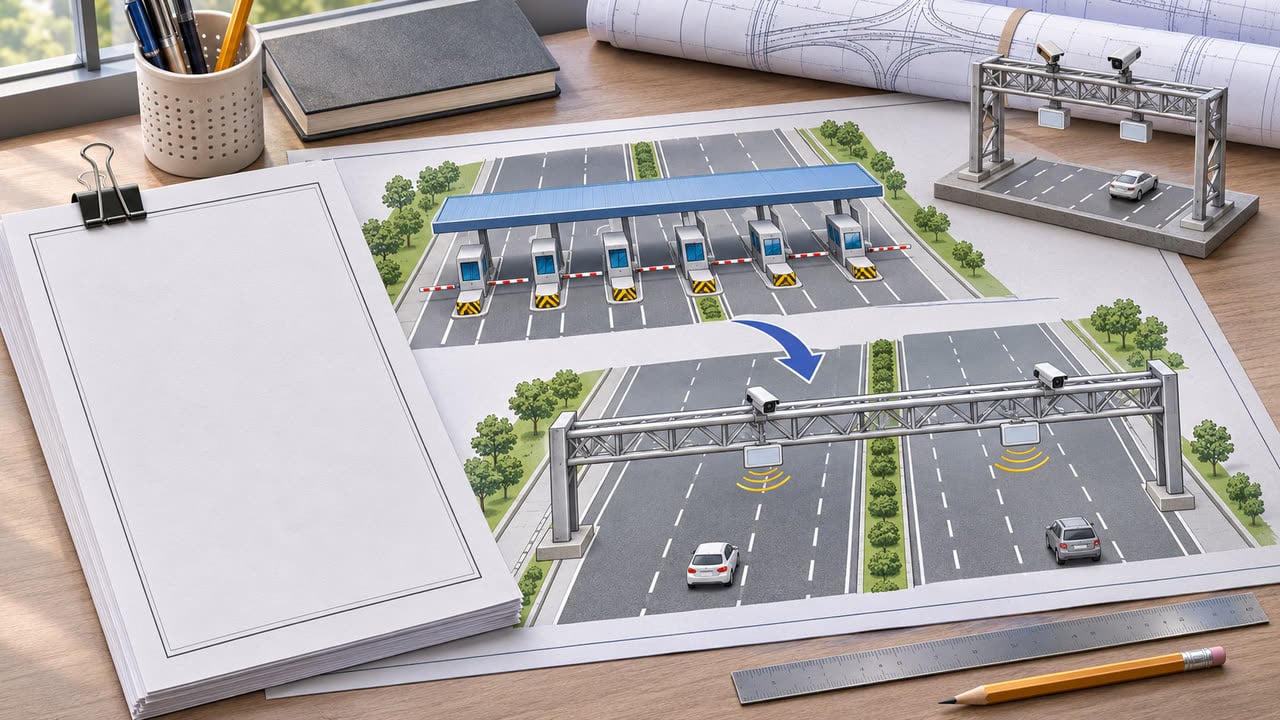
MoRTH has agreed in principle to make barrier-less Multi-Lane Free Flow (MLFF) tolling mandatory for new BOT, TOT and InVIT National Highway fee-plaza proposals. Under the Ministry of Road Transport and Highways’ 13 October 2026 road-map letter to NHAI, new plazas on the relevant stretches are to become MLFF within one year of the appointed date, using FASTag readers and vehicle databases for automated e-notices. For drivers, this is a future tolling-infrastructure change, not an immediate change to the toll rate at every operating plaza.
Key takeaways
- The primary MoRTH direction covers new BOT/TOT/InVIT proposals before bidding, with MLFF made mandatory in principle.
- New plazas on a project stretch are targeted for MLFF within one year of the appointed date.
- Overhead RFID readers and automatic number-plate recognition (ANPR) cameras are intended to identify moving vehicles and deduct tolls through FASTag.
- Projects already awarded or under construction may be covered where plaza construction has not started; existing operational plazas are not automatically converted.
- Recent reports differ on the exact lane-count cap, so the common policy change is more reliable than any single universal lane number.
What the MoRTH road map says
The official letter is addressed to the NHAI chairman and records that the competent authority in the ministry has agreed in principle to the proposed implementation of barrier-less tolling at BOT, TOT and InVIT fee plazas. It asks NHAI to take the necessary action and submit a detailed proposal for consideration and approval. That wording matters: the letter sets a clear implementation direction, but it is not a notification changing the user fee on an existing road overnight.
For new proposals that have not been awarded, the letter says MLFF-based tolling will be mandatory before the bidding process. It also says all new plazas on the stretch should be MLFF within one year of the appointed date, with integration to NPCI and VAHAN databases for automated e-notice generation and enforcement. The system is expected to maintain minimum operational accuracy of 99% for vehicle identification and transaction processing, subject to validation through monitoring and audit equipment.
The same road map also recognises that some existing BOT/TOT/InVIT plazas may later adopt MLFF. That is a separate implementation path. The document does not direct every operational fee plaza to remove its booths immediately, which is why motorists should wait for a project-specific notice before assuming that a familiar toll point has changed.
How barrier-less tolling is designed to work
MLFF replaces the stop-and-pay arrangement with equipment mounted above the carriageway. High-performance RFID readers are intended to read a valid FASTag while a vehicle is moving, while ANPR cameras provide a vehicle-registration check. The applicable user fee can then be deducted without a conventional toll booth or a queue at a payment window.
The Indian Express reported on 30 October 2026 that NHAI’s guidelines also provide for an e-Notice under Rule 14 of the National Highways Fee (Determination of Rates and Collection) Rules, 2008 when a vehicle does not have a valid and functional FASTag. The Economic Times reported on 2 November 2026 that the revised design is meant for future National Highway projects and eligible ongoing projects where construction of the toll plaza has not started. For projects still at the detailed project report stage, the layout can be built into bidding documents; for some awarded projects, it may be adopted through a change in scope.
That means the operational experience will depend on more than the gantry itself. Tag-reading reliability, accurate vehicle records, number-plate visibility, clear advance signs and a workable process for e-notice disputes will determine whether the promised reduction in stopping and congestion is felt by everyday users.
Why the reported lane counts need careful reading
Recent coverage is not identical on the number of lanes in the new layouts. The Indian Express said a four-lane highway would have eight fee-plaza lanes, a six-lane highway 10 lanes and an eight-lane highway 12 lanes, including spare capacity for emergencies. The Economic Times described the revised policy as limiting a toll plaza to a maximum of eight tolling lanes, with an additional over-dimension or spare lane.
The primary 13 October road-map letter is the source for the mandatory-MLFF direction and the one-year implementation target; it does not publish a universal lane table in that letter. The difference in reporting may reflect different definitions of tolling lanes, spare lanes or the particular project guideline being described. Readers should therefore treat the exact lane layout as a project-design detail and not as a blanket announcement that every highway will have the same number of lanes.
What the change means for drivers and fleet operators
First, there is no announced across-the-board toll-price revision in this policy direction. It changes how future fee collection is designed. The relevant toll amount will still come from the user-fee notification for the highway section, while the MLFF equipment changes how that amount is collected.
Second, a working FASTag becomes even more important on corridors that adopt the system. Before a long trip, motorists can check their expected toll charges and route cost and keep the tag ready for the journey. A vehicle that is identified by ANPR but has no valid, functional tag may be routed into an e-notice process rather than being stopped at a booth.
For a private driver, the practical benefit should be less stop-start delay at a converted plaza, but no specific time saving is guaranteed until the equipment is installed and operating reliably. For a bus, truck or delivery fleet, smoother toll passage could reduce repeated idling on busy corridors, but operators will still need a process for checking transactions and resolving notices. Combining the toll estimate with a fuel cost calculation for the full trip gives a more realistic view of the journey cost than looking at the toll alone.
Route choice will also matter during the transition. A project may have one MLFF plaza and another conventional plaza, or a new layout may apply only after a project milestone. The FuelPrice road-trip planner can help compare route distance and trip costs while the system is rolled out.
What to watch next
The next meaningful milestones are NHAI’s detailed proposal and approval, project tender documents that incorporate the MLFF requirement, and project-specific notices about the start of barrier-less collection. The Economic Times report also makes clear that the policy is not an automatic conversion order for every existing operational plaza.
For background on how gantry-based tolling, e-notices and FASTag checks fit together, see the barrier-less FASTag tolling guide. Until a specific plaza is formally brought under the new system, drivers should follow the payment method and toll notification already displayed for that section.
Sources
- Ministry of Road Transport and Highways, “Road Map for implementation of Barrier-less Tolling at BOT/TOT/InVIT fee Plazas”, 13 Oct 2026 (primary letter copy hosted by Highway Operators Association of India).
- The Indian Express, “Barrier-less system to reduce toll lanes in new highways”, 30 Oct 2026.
- The Economic Times, “No more land acquisition for toll plazas: Future highway tolls to collect tolls from moving vehicles through overhead cameras”, 2 Nov 2026.