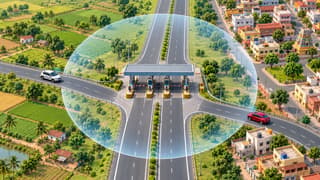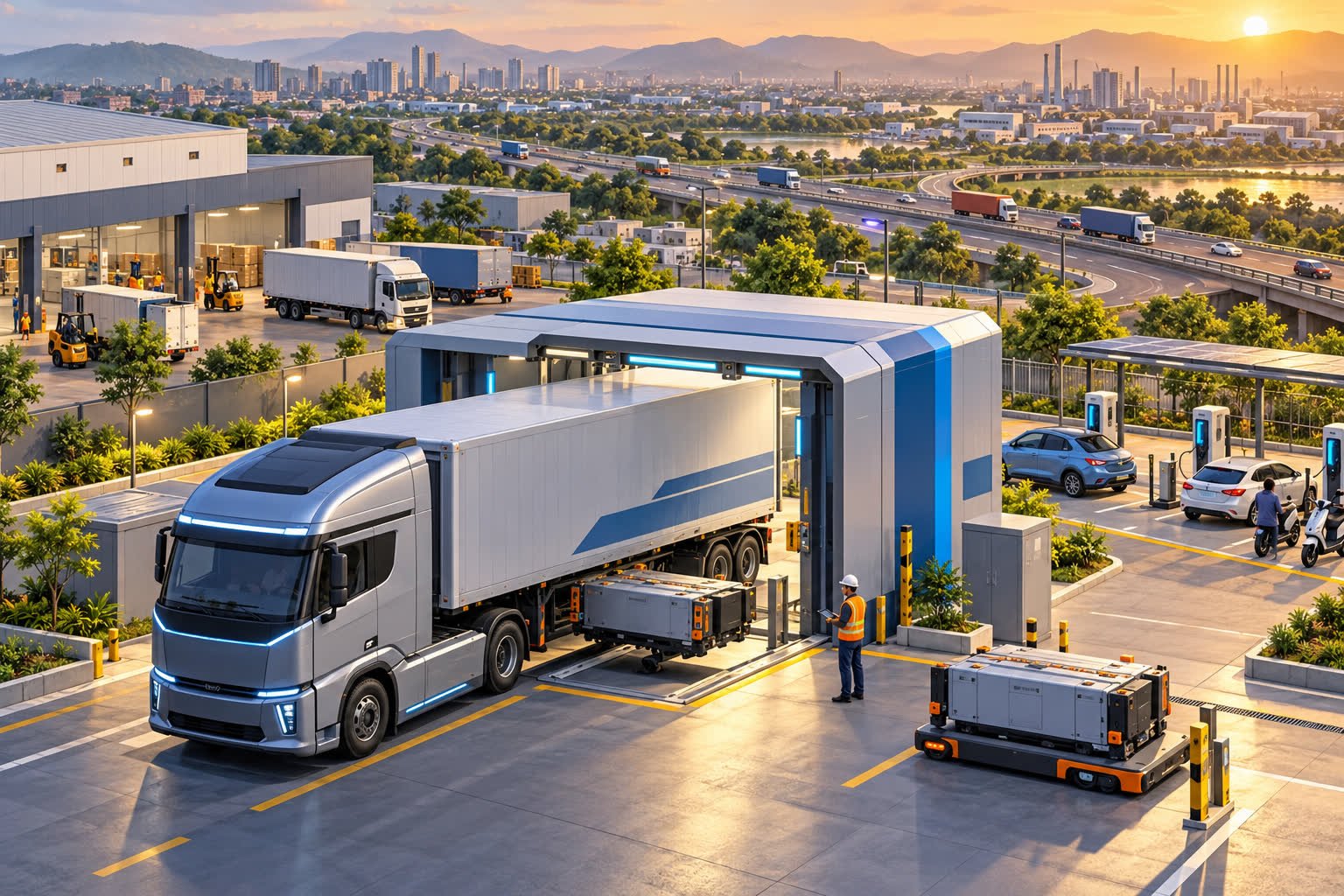
Blue Energy Motors and Hindustan Petroleum Corporation (HPCL) operationalised Bhiwandi’s first battery-swapping station for electric heavy-duty trucks on 26 Oct 2026, according to company information reported by Autocar Professional and PTI/NDTV Profit. The site pairs truck battery swapping with public EV charging, bringing a faster energy option to a major Mumbai–Pune freight hub.
The announcement matters mainly to fleet operators, not because it changes how every EV can recharge today, but because it tests whether battery swapping can reduce the time that electric freight vehicles spend off the road. The reports reviewed do not give a tariff, truck-eligibility list or a wider station rollout schedule for this facility.
Key takeaways
- The station is in Vadape, Bhiwandi, Maharashtra, and supports Blue Energy Motors’ electric heavy-duty trucks.
- Battery replacement is stated to take less than five minutes, compared with the longer dwell time associated with plug-in charging.
- The same site includes public EV charging for electric two-wheelers, four-wheelers and commercial vehicles.
- The facility extends the Mumbai–Pune Electric Freight Corridor, but it is not evidence that a continuous battery-swap network is already available across the route.
What has opened at Bhiwandi
The facility has been set up by Blue Energy Motors in partnership with HPCL at Vadape in Bhiwandi taluka. Autocar Professional reported on 26 Oct that the automated station can swap batteries for the company’s heavy-duty electric trucks in under five minutes. PTI, carried by NDTV Profit later the same day, also described the station as Bhiwandi’s first battery-swap facility for electric heavy trucks.
Battery swapping changes the vehicle’s energy stop from a wait for the installed battery to recharge into a replacement operation. That can be useful for trucks working to fixed delivery windows, although the benefit depends on compatible battery packs, charged inventory, safe handling and a process that works consistently at operating scale.
The Bhiwandi facility also includes charging equipment for electric two-wheelers, cars and commercial vehicles. That makes the site broader than a truck-only depot, but public charging and truck battery swapping are different services. An electric car driver cannot assume that the truck-swap equipment is compatible with a passenger vehicle.
Why Bhiwandi and the Mumbai–Pune corridor matter
Bhiwandi is a major warehousing and distribution centre in the Mumbai Metropolitan Region. Trucks moving goods through the area often operate on schedules where a long energy stop can affect vehicle utilisation, loading plans and the next delivery window. A sub-five-minute swap, if available to an eligible fleet at the required time, could reduce that particular operational constraint.
The station extends the Mumbai–Pune Electric Freight Corridor that Blue Energy Motors launched in October 2025. The company and HPCL had announced their strategic partnership in January 2026; this facility is the first reported operational step from that tie-up. The corridor angle is important because electric freight depends on predictable energy access at the places where trucks actually load, unload and turn around, not only on vehicle range.
For operators comparing diesel and electric trucks, the relevant calculation is therefore wider than the energy price. It includes the purchase or lease structure, battery ownership or replacement terms, payload, route length, charging or swapping access, driver time, maintenance and the cost of a missed delivery slot. A new station improves the infrastructure side of that comparison, but it does not by itself prove that an electric truck is cheaper for every route.
What fleet operators need to confirm
The reports on the launch do not state the station’s public operating hours, swap price, queue process, battery inventory, payment method or the exact truck models supported. Those details matter before a fleet can build the facility into a dispatch plan. Operators evaluating a route can verify those conditions with the station operator and compare them with the truck’s own charging and warranty requirements.
- Whether the truck’s battery format is supported and whether swaps are limited to Blue Energy Motors vehicles.
- Whether the station is open to all eligible fleets or operates through a contracted fleet programme.
- How the swap charge is calculated and whether battery rental, energy and service fees are separate.
- Whether a backup plug-in charger is available if charged batteries are temporarily unavailable.
- How far the next compatible energy point is on the Mumbai–Pune movement plan.
Private EV owners using the public side of the facility can use the state-wise EV charging station directory to compare available charging points, but the directory should not be treated as confirmation that this particular truck-swap bay accepts passenger vehicles. Charging access, connector type and live availability remain separate checks.
What this means for EV adoption
The launch shows how an existing fuel-retail network can become a multi-energy site. HPCL supplies the established roadside location and operating footprint, while Blue Energy Motors brings the vehicle-specific battery-swap requirement. That combination could be useful for commercial EVs, where downtime has a direct effect on utilisation, but its success will depend on repeatable service and enough compatible trucks to keep the infrastructure used.
It also gives other logistics corridors a model to watch: a dedicated truck-energy service alongside public charging, instead of treating every EV as if it needs the same hardware. The next meaningful signals will be additional operational locations, published access and pricing information, and evidence of how many fleets use the station in routine freight service.
Reader takeaway
For an electric-truck operator, the Bhiwandi launch is a useful infrastructure development, not a blanket range or cost guarantee. For other EV users, the public charging component may be relevant, but compatibility and live availability must be confirmed before a trip. A route plan can be built with the road-trip planner, while a diesel vehicle’s baseline running expense can be estimated with the fuel-cost calculator before comparing the full operating picture.
Sources
- Autocar Professional — Blue Energy Motors and HPCL Open Heavy-Duty Truck Battery Swapping Station in Bhiwandi — 26 Oct 2026
- NDTV Profit/PTI — Blue Energy Motors Opens Battery-Swap Station For EV Heavy Trucks Near Mumbai — 26 Oct 2026
- Free Press Journal — Bhiwandi Gets First Heavy Electric Truck Battery-Swapping Station, Boosts Mumbai–Pune Green Freight Corridor — 27 Oct 2026
- Blue Energy Motors — Press & Media company page — accessed 27 Oct 2026