The Delhi High Court has dismissed ICICI Lombard General Insurance Company Ltd’s appeal against a motor-accident compensation award of ₹1,70,86,530 plus 12% interest. The court held that a driver cannot automatically avoid a finding of negligence by saying he swerved to save a stray dog; the decision matters for how accident evidence and comprehensive/package cover are assessed, but it does not rewrite every motor policy.
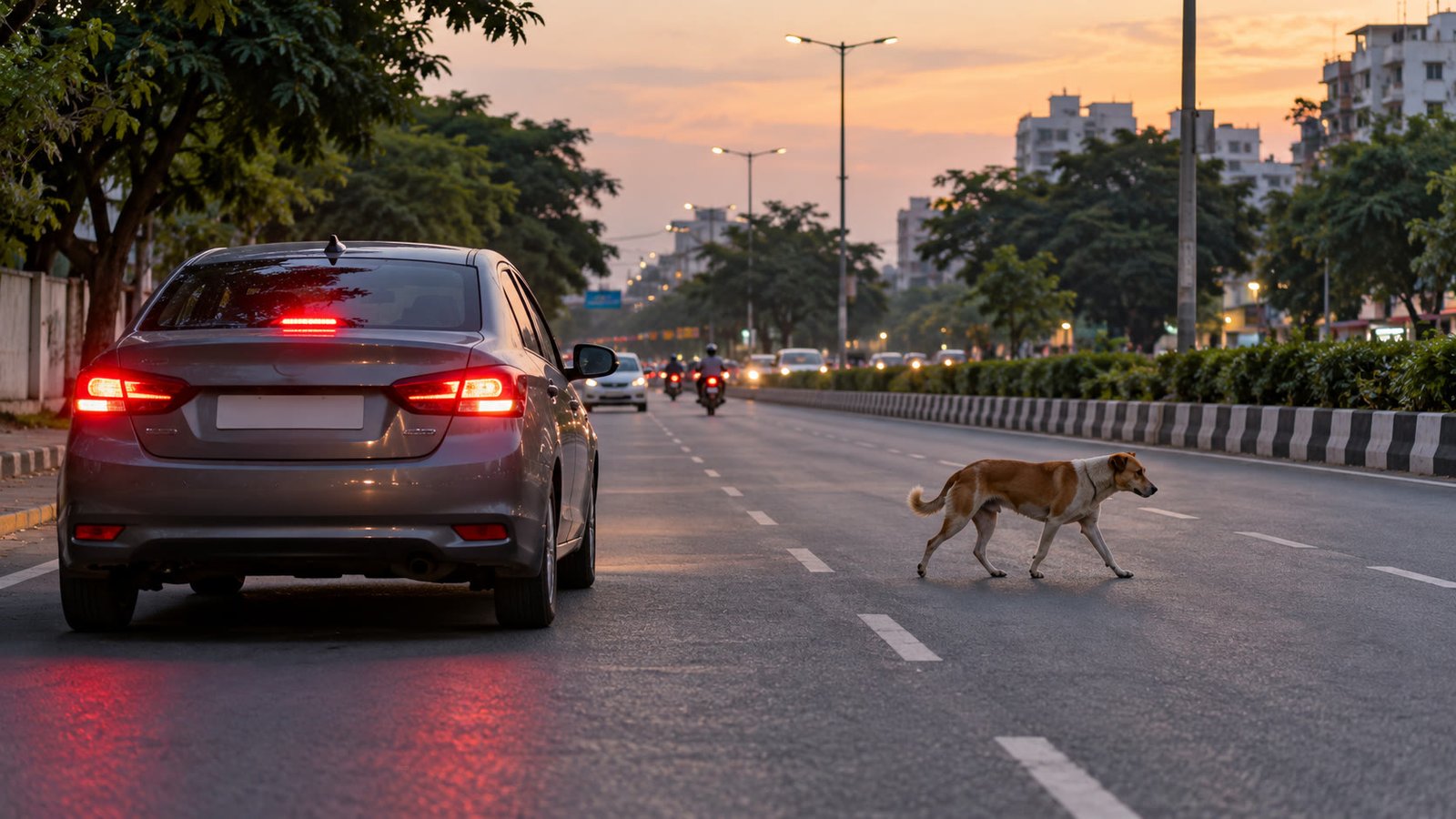
Illustrative visual: a representative road-safety scene, not a photograph from the case.
Key takeaways
- The judgment was pronounced on 5 October 2026 in an appeal arising from a 28 May 2014 crash near Chhattarpur Metro station in Delhi.
- The court rejected the insurer’s “agony of the moment” argument on the facts before it, saying drivers must retain reasonable control and vigilance even when an animal enters the road.
- It treated the injured rear-seat occupant as covered under the vehicle’s comprehensive/package policy in this case.
- The ruling is case-specific: it does not guarantee every accident claim, change premiums or make every animal-related collision legally identical.
What the Delhi High Court decided
The case concerned Satish Chandra Gupta, who was travelling in the rear seat of a company-owned Mercedes when the vehicle lost control and struck a divider near Vasant Kunj. The court record says Gupta suffered grievous injuries and remained in a coma until his death on 22 August 2020. The Motor Accidents Claims Tribunal had awarded ₹1,70,86,530 with 12% interest, and the insurer challenged both the finding of negligence and the amount.
One dispute was whether Gupta had been driving or was a passenger. The High Court relied on the accident record, police evidence and the statement of an ambulance driver who found Gupta unconscious in the rear seat. It concluded that he was an occupant and that the insurer had not displaced that evidence with the hospital note on which it relied.
Why the “agony of the moment” defence failed
The driver’s account was that a dog suddenly crossed the road and the car swerved while trying to avoid it. The insurer argued that this was a sudden danger that should remove the finding of negligence. The court did not accept that submission, distinguishing cases where a person’s conduct creates an emergency from situations involving an animal or another natural or intervening cause.
The judgment says a driver must account for road conditions, keep visual focus, maintain control of the vehicle and exercise the degree of care that the circumstances demand. It does not say a driver is negligent every time a vehicle swerves for an animal. Instead, the court assessed whether the evidence supported reasonable care in this particular accident and declined to treat the animal as an automatic explanation for the loss of control.
That distinction is important for drivers and claimants. A compensation tribunal or court still has to examine the evidence: the road scene, speed and control, witness accounts, medical and police records, and the wording of the policy. The judgment is a reminder that a sudden hazard may explain a manoeuvre, but it does not by itself settle the negligence question.
What the ruling means for motor insurance
The High Court also considered whether a rear-seat occupant in a company-owned car was covered. It held that the policy in dispute was a comprehensive/package policy rather than an Act Only policy and that Gupta was covered as an occupant on the evidence in this case. The court also found that the insurer had not proved that he was an employee whose status would exclude the claim on the argument advanced.
This should not be read as a new universal claims rule. A package policy, an Act Only policy, endorsements, exclusions, the identity of the occupant and the evidence about the accident can all affect the outcome. The difference between policy categories is explained in this third-party versus comprehensive car insurance guide.
The ruling also does not announce a new premium, renewal or add-on requirement. It applies the policy and accident evidence before the court. For anyone reviewing cover, the useful document is the policy schedule and wording, including who is covered as an occupant and what exclusions apply; the policy-document reading checklist explains those fields in plain language.
What vehicle owners can document after a crash
The practical lesson is record quality. A vehicle owner or passenger involved in a crash can keep the policy schedule, driver and vehicle details, photographs of the road and damage, medical records, police documents, witness contacts and insurer correspondence together. Those records do not decide liability on their own, but they help establish what happened and which policy terms were in force.
- Record the location, road layout, lighting, traffic and any visible obstruction without altering the scene.
- Keep the original medical, police and vehicle-inspection documents, along with dated photographs.
- Check that the claim description, driver details and passenger details are consistent across the documents.
- Read the policy wording before assuming that a comprehensive label answers every coverage question.
A separate car-insurance claim process guide covers the usual documents and the difference between reporting a claim and establishing the final liability. Actual claims remain dependent on the facts, the policy and the forum deciding the dispute.
What this judgment does not change
It does not create a fixed compensation benchmark of ₹1,70,86,530 for future stray-animal accidents. That amount belongs to this claimant’s case and includes the assessment made for his injuries and long-term care. It also does not mean that insurers must accept every claim where a driver says an animal appeared suddenly, or that a driver can never rely on a genuine mechanical failure or another proved cause.
The narrower takeaway is more useful: a sudden hazard is judged alongside the driver’s control, attention and reasonable response, while insurance coverage turns on the policy and the evidence. For road users, that means the presence of an animal is part of the factual story, not a substitute for proving how the accident occurred.
Questions readers may have
Did the Delhi High Court create a new motor-insurance rule?
No. It decided an appeal on the evidence and policy before it. The judgment reinforces a fact-based approach to negligence and occupant cover; it does not amend the Motor Vehicles Act or set a new premium rule.
Does a comprehensive policy always pay for an injured occupant?
Not automatically. The court’s finding concerned the package policy and facts in this dispute. Policy wording, exclusions, endorsements, the person’s status and the accident evidence still matter.
Can a driver never swerve for an animal?
The judgment does not say that. It says that swerving to avoid an animal does not, by itself, remove the need to examine speed, control, attention and reasonable care in the circumstances.
Sources
- Delhi High Court — ICICI Lombard General Insurance Co Ltd v. Satish Chandra Gupta & Ors., judgment dated 5 October 2026.
- Hindustan Times/PTI — Road users in India have a propensity not to adhere to traffic regulations: Delhi HC, 26 October 2026.
- Verdictum — “Agony Of The Moment” Not A Defence For Negligent Driving: Delhi High Court On Accident Caused While Avoiding Stray Dog, 7 October 2026.
This article is for general information only and is not financial, insurance or legal advice.